
In This Article
Somewhere between “too hard” and “sinking into a marshmallow” sits the mattress most sleep experts actually recommend, and yet almost nobody explains it properly before you’ve already spent £600. A memory foam pocket spring mattress is exactly what it sounds like: individually wrapped coils doing the heavy lifting underneath, topped with a contouring layer of memory foam that moulds itself around your shoulders, hips and lower back. It’s the compromise mattress. The “I can’t decide” mattress. And for a huge number of UK sleepers, it’s the right one.
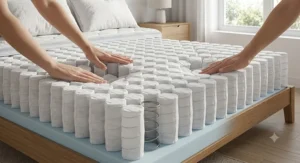
Here’s the 40-second version, because you shouldn’t have to scroll for a definition: a memory foam pocket spring mattress (often just called a hybrid) combines a core of hundreds or thousands of independently moving coils with one or more layers of viscoelastic memory foam on top, giving you spring-like bounce and airflow underneath with foam-like pressure relief where your body actually touches the surface.
That combination didn’t happen by accident. Which?’s own hybrid mattress testing confirms hybrids are built from foam layers wrapped around a pocket-sprung core, and explains why this format has grown so popular with UK shoppers caught between two once-rival technologies. This guide walks through seven real UK-available mattresses, from a genuinely affordable option through to full-blown luxury builds, with honest analysis of who each one actually suits — not just a list of what’s inside the box.
Anatomy of a Hybrid: How Memory Foam and Pocket Springs Work Together
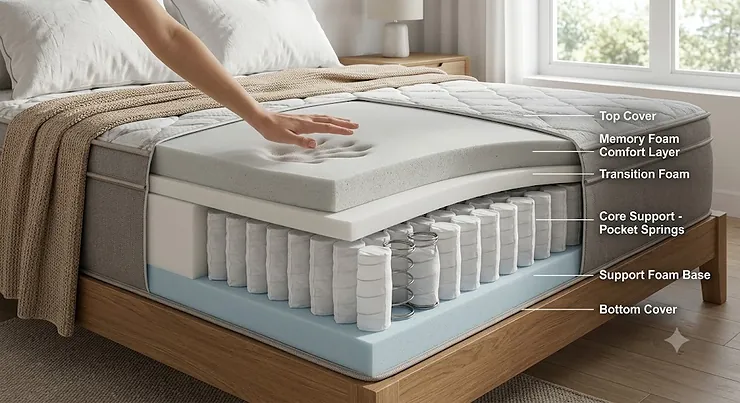
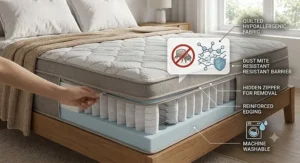
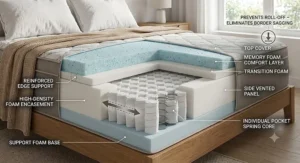
Before comparing products, it’s worth understanding what you’re actually buying, because “hybrid” gets used loosely by marketing teams. A proper memory foam topper spring base construction has three functional zones. At the bottom sits the support core — hundreds to several thousand fabric-wrapped coils, each one able to compress independently of its neighbours. That’s the bit doing the structural work: holding your weight, keeping your spine roughly level, and stopping one side of the bed from dipping when your partner rolls over.
Pocket springs themselves aren’t a new invention — the technology traces back over a century to early individually wrapped coil designs, refined considerably since into the precisely tuned, size-varied units used in modern hybrids. Above that sits the transition layer — often a firmer polyfoam that stops you feeling every individual spring and smooths the handover between bounce and contour. And on top, the comfort layer: memory foam, sometimes blended with gel, graphite or open-cell structures designed to stop it trapping heat. This is where the actual “hug” comes from. Layered mattress support like this matters because each layer is solving a different problem — springs solve sag and airflow, foam solves pressure points, and the transition layer stops the two fighting each other. A mattress with one thin foam sheet glued over a basic coil unit isn’t really a hybrid in the meaningful sense, even if the box says so. Spring count and foam density both matter more than either spec alone.
Quick Comparison Table
| Mattress | Springs | Firmness | Best For | Price Range |
|---|---|---|---|---|
| REM-Fit Pocket 1000 Hybrid | 1,000 pocket springs | Medium (6-6.5/10) | Budget buyers, guest rooms | Under £350 |
| Emma Original Hybrid | 3-zone pocket springs | Medium (6.5/10) | Hot sleepers, couples | £300-£450 range |
| Nectar Premier Hybrid | Dual spring system | Medium-firm (6-6.5/10) | Back and side sleepers | £400-£650 range |
| REM-Fit 4000 Ortho Elite | 4,000 dual-layer springs | Medium (9/10 support) | Back/joint pain sufferers | £450-£700 range |
| Simba Hybrid Pro | 4,800 springs | Medium-firm (8/10) | Side sleepers, couples | £700-£1,300 range |
| Panda Hybrid Bamboo | Zoned springs | Medium-firm (6.5-7/10) | Hot sleepers, allergy sufferers | £600-£950 range |
| DreamCloud Luxury Hybrid | Full-size 15cm springs | Medium-firm | Combination sleepers, couples | £700-£1,100 range |
Looking across the table, there’s a clear pattern: spring count and layer complexity climb steadily with price, but that doesn’t mean the priciest option automatically wins. The REM-Fit Pocket 1000 Hybrid and Emma Original Hybrid both deliver genuine hybrid construction well under £450, which is exactly the price bracket where a lot of “hybrid” mattresses quietly cut corners on spring quality. Meanwhile, the jump from Simba Hybrid Pro to DreamCloud Luxury Hybrid is less about outright support and more about surface finish — wool, quilting, and edge reinforcement rather than raw spring count.
💬 Already got a favourite? Scroll down to see the full breakdown — or keep comparing below.
Top 7 Memory Foam Pocket Spring Mattresses: Expert Analysis
1. REM-Fit Pocket 1000 Hybrid Mattress — best budget entry point
The clue is in the name: 1,000 full-height pocket springs running the entire depth of the mattress, which is unusual at this price point where many rivals use a shallow micro-spring layer instead. That matters because full-height springs give more genuine independent movement than the flatter, shorter coils some budget brands rely on.
The spring layer is topped with a deep comfort foam layer rated medium-firm, and REM-Fit’s open-cell foam structure is designed to circulate air rather than trap it against your skin. On paper this means you get a properly bouncy, breathable base without the classic “sleeping in a warm bath” complaint levelled at cheaper all-foam beds. Reviewers testing it consistently note it feels closer to a 6-6.5 out of 10 in practice than the 7/10 the brand advertises, which for most back, side and stomach sleepers lands in a comfortable, unremarkable middle ground — exactly what you want from a mattress you don’t want to think about.
Based on the spec comparison with pricier hybrids, what you’re sacrificing here is zoning sophistication — there’s no multi-zone support tailoring firmness to hips versus shoulders — and edge support that won’t match a premium build. For a spare room, a growing teenager, or a first hybrid purchase where you’re not certain the format suits you, that trade-off is entirely sensible.
Pros:
- ✅ Full-height springs run the entire mattress depth
- ✅ Genuinely breathable open-cell foam construction
- ✅ Strong partner motion isolation for the price
Cons:
- ❌ Limited zoning compared with higher-spec hybrids
- ❌ Edge support softer than premium alternatives
Prices for the REM-Fit Pocket 1000 Hybrid typically sit under £350 for a double at standard pricing, though the brand runs frequent promotional discounts — check current price before buying. Given the full-height spring construction, this is arguably the strongest value pick in this whole round-up.
2. Emma Original Hybrid Mattress — best all-rounder for hot sleepers
Formerly branded the Hybrid Premium, this is Emma’s best-selling mattress for good reason: it pairs memory foam with a 3-body-zone pocket spring layer, engineered to soften under shoulders and firm up under hips and lower back rather than treating your whole body as one uniform slab.
The standout spec is Airgocell foam, an open-cell structure built to promote airflow through the comfort layer. In practice this means the classic memory-foam complaint — waking up overheated — is far less pronounced here than on all-foam beds using older-generation viscoelastic material. Argos’s product listing for this line confirms the pocket-sprung-with-memory-foam-top construction runs to around 430 springs in some size variants, giving a reasonable balance between contour and support. Independent testers have noted the mattress can feel slightly softer than expected in the first few weeks before the foam fully settles, which is worth factoring into any early impressions.
What most buyers overlook about the Emma Original Hybrid is how well it performs on motion isolation for couples, given its mid-market price. Reviewers consistently report barely noticing a partner shifting position during the night, which is a genuinely useful differentiator if you’re a light sleeper sharing a bed.
Pros:
- ✅ Airgocell foam actively fights heat build-up
- ✅ 3-zone springs adapt support across the body
- ✅ Excellent motion isolation for couples
Cons:
- ❌ Noticeable break-in period before foam settles
- ❌ Softer surface feel may not suit firm-mattress fans
Expect a double in the £300-£450 range at standard pricing, with the brand’s frequent sales events regularly bringing that down closer to the lower end — always check current price rather than relying on the RRP.
3. Nectar Premier Hybrid Mattress — best for back and side sleepers
Nectar’s flagship hybrid uses an eight-layer construction combining full-size pocket springs, a secondary layer of micro springs, and memory foam — a dual-spring approach that’s more sophisticated than most mattresses in its price bracket attempt.
The brand rates firmness at 6-6.5 out of 10, and independent testing broadly agrees, describing a medium-firm feel with a distinct “hug” from the memory foam layer despite the springs adding noticeably more resistance than an all-foam Nectar model. What that spec sheet won’t tell you, but reviewers note, is that the mattress excels specifically for back and side sleepers while proving too soft for committed stomach sleepers, who need firmer hip support to keep their spine from sagging.
The dual-spring system deserves particular commentary: having both full-size and micro springs working together gives more nuanced pressure response than a single spring layer can manage, translating to genuinely strong pressure relief at the hips and shoulders. Aggregated reviewer sentiment flags weaker edge support as the main drawback — useful to know if you tend to sit on the mattress edge to get dressed, or share a smaller bed frame with a partner.
Pros:
- ✅ Dual spring layers deliver nuanced pressure response
- ✅ Strong temperature regulation for a foam-heavy hybrid
- ✅ Long sleep trial and extended guarantee as standard
Cons:
- ❌ Weaker edge support when sitting on the perimeter
- ❌ Too soft for committed stomach sleepers
Typical double pricing sits in the £400-£650 range depending on ongoing promotions, which Nectar runs almost continuously — it’s worth checking current price before assuming the RRP applies.
4. REM-Fit 4000 Ortho Elite Hybrid Mattress — best for back and joint pain
Where the Pocket 1000 keeps things simple, the 4000 Ortho Elite goes the other direction entirely: a dual-layer spring system that effectively doubles the coil count of a standard single-layer hybrid, paired with zoned open-cell memory foam varying in density across the mattress surface.
Most hybrid mattresses rely on one spring layer doing everything. Here, having two stacked layers of springs significantly increases stability and, over time, longevity — a genuinely meaningful engineering upgrade rather than a marketing flourish. The brand rates it Medium Support at 9 out of 10, and this model carries Good Housekeeping’s 2026 approval mark, a reasonably rigorous third-party endorsement in a category prone to self-awarded badges. Based on the spec comparison with entry-level hybrids, the zoned foam density is the real differentiator: varying firmness beneath the shoulders versus the lumbar region gives targeted pressure relief specifically aimed at reducing the aches that prompt people to search for an orthopaedic mattress in the first place.
Edge-to-edge stability and motion isolation both benefit from the dual-spring approach, and the mattress carries a mattress recycling option at end of life — a small but genuinely useful sustainability detail given how few beds are recycled responsibly in the UK.
Pros:
- ✅ Dual-layer 4,000-spring system boosts stability
- ✅ Zoned foam density targets lumbar and shoulder support
- ✅ Good Housekeeping 2026 approved
Cons:
- ❌ Firmer feel may not suit lightweight side sleepers
- ❌ Premium construction pushes it above true budget pricing
A double typically falls in the £450-£700 range, with REM-Fit’s regular sales events (the brand runs cooling and seasonal promotions frequently) often bringing genuine savings — always confirm current price at checkout.
5. Simba Hybrid Pro Mattress — best premium build quality
Simba’s mid-to-premium hybrid steps up from its entry-level sibling with roughly 4,800 titanium-based pocket springs across an eight-layer, 28cm-deep construction, plus a UK-sourced wool layer sitting just beneath the cover for softness and natural temperature regulation.
Independent testers awarded it a strong overall score, describing a responsive, bouncy medium-firm feel rated around 8 out of 10 for firmness, with light cushioning but no swallowing sink-in sensation. What most buyers overlook about the Simba Hybrid Pro is how much of its comfort comes from the wool layer specifically — testers note it’s thinner than marketing imagery suggests at roughly 2cm, yet still makes a surprisingly large difference to surface feel compared with the standard Simba Hybrid beneath it.
Reviewers consistently praise edge support and motion isolation, both genuinely useful for couples, while flagging the mattress’s weight (it’s heavy to lift and rotate) and premium price as the two realistic drawbacks. On paper, the near-double spring count compared with entry-level hybrids justifies a meaningfully firmer, more supportive feel — this isn’t a mattress that will bottom out under a heavier sleeper the way a budget hybrid might over time.
Pros:
- ✅ Nearly 4,800 springs across an eight-layer build
- ✅ UK-sourced wool layer adds natural temperature control
- ✅ Strong edge support and couple-friendly motion isolation
Cons:
- ❌ Heavy and awkward to lift or rotate
- ❌ Firmly premium pricing even during sales
Expect to pay in the region of £700-£1,300 for a double depending on size and ongoing offers — Simba runs regular seasonal discounts, so checking current price before purchase is genuinely worthwhile here.
6. Panda Hybrid Bamboo Mattress — best for hot and allergy-prone sleepers
Panda built its reputation on bamboo bedding accessories before entering the mattress market, and that heritage shows: this hybrid layers a bamboo-infused cover over BioCell foam, proprietary OrthoAlign orthopaedic-grade foam, and a seven-zone spring layer.
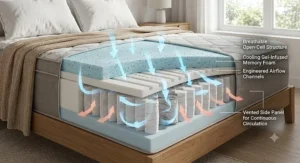
The brand rates firmness at 6.5-7 out of 10, though independent testers have described it as feeling closer to 7.5 in practice — worth noting if you’re expecting a plush surface. Reviewers consistently highlight the mattress’s cooling performance as a genuine standout, crediting the combination of bamboo’s natural breathability with open-cell foam and coil airflow for keeping the surface noticeably cooler than typical memory-foam-heavy competitors. Bamboo is also naturally hypoallergenic and antibacterial, which the spec sheet won’t dwell on but matters considerably if you’re prone to dust mite allergies or night sweats.
Based on the spec comparison with the Emma and Nectar hybrids above, the Panda’s seven-zone spring layer is more granular than most mid-market rivals’ three-zone systems, translating to more precisely targeted support beneath the hips and shoulders specifically. The trade-off is a firmer overall feel that lighter side sleepers may find less forgiving at pressure points, and reviewers have flagged noticeable off-gassing odour lingering for the first several days after unboxing.
Pros:
- ✅ Seven-zone spring layer gives granular support
- ✅ Genuinely strong cooling from bamboo and open-cell foam
- ✅ Naturally hypoallergenic, good for allergy sufferers
Cons:
- ❌ Firmer feel may not suit lighter side sleepers
- ❌ Noticeable off-gassing smell for the first week
A double typically runs in the £600-£950 range, with Panda’s discounts being less frequent than rival brands but still appearing around major sales events — check current price rather than assuming a constant markdown will apply.
7. DreamCloud Luxury Hybrid Mattress — best for combination sleepers and couples
DreamCloud’s flagship pairs high-quality memory foam with full-size pocket springs measuring roughly 15cm, an orthopaedically designed medium-firm build aimed squarely at reducing back, neck and shoulder discomfort across multiple sleeping positions.
What stands out on the spec sheet is genuine breadth of suitability: independent reviewers describe it working well for back and stomach sleepers primarily, while still performing adequately for side and combination sleepers — a harder balance to strike than brands typically admit. The combination of low motion transfer and strong edge support makes it a particularly sensible pick for couples with different sleep positions or body weights, since neither partner should feel the other rolling over or dipping the mattress edge.
Reviewers consistently note enhanced breathability contributing to a cooler night’s sleep than older-generation all-foam mattresses, though this is a genuinely deep, tall mattress that some buyers find takes noticeably longer to fully expand and off-gas after unboxing compared with slimmer competitors. Here’s what to weigh: DreamCloud backs the mattress with an unusually long trial period and lifetime guarantee by UK market standards, which meaningfully de-risks a purchase at this price point if you’re on the fence about firmness.
Pros:
- ✅ Full-size 15cm springs suit multiple sleep positions
- ✅ Strong edge support and low motion transfer
- ✅ Unusually long trial period and guarantee
Cons:
- ❌ Slower to fully expand than slimmer hybrids
- ❌ Tall profile may not suit low bed frames
Typical double pricing falls in the £700-£1,100 range, with the brand’s frequent promotional events often bringing meaningful reductions — always verify current price before checkout.
Practical Usage Guide: Setup, Break-In and Maintenance
Getting a boxed hybrid mattress right in the first month matters more than most retailers admit. Unbox it in the room it’ll actually live in — these mattresses are heavy and awkward once expanded, and dragging a fully inflated hybrid up a staircase is a genuinely bad afternoon. Cut the packaging carefully away from the mattress fabric itself, then leave it uncovered in a well-ventilated room for several hours before making the bed, allowing any initial off-gassing smell to dissipate.
Expect full expansion to take 24-72 hours depending on foam thickness, though it’ll be sleepable within a few hours. Genuine full loft, where the springs and foam settle into their intended feel, can take a full two to four weeks — this is the break-in period reviewers refer to when a mattress feels softer or firmer in week one than it does by week four. Don’t judge firmness definitively until you’ve slept on it for at least ten nights.
For ongoing maintenance, rotate the mattress head-to-foot every three months for the first year to encourage even wear across the foam layers, then every six months after that. Most hybrids don’t need flipping (check your specific model, as a small number are double-sided), but rotation alone meaningfully extends foam lifespan. Use a breathable, washable protector from day one — it’s far easier to wash a £30 protector than deal with a stained mattress outside a warranty claim. Common first-30-days mistakes include judging the mattress too early, sleeping on it without a protector, and failing to check the base or slats are compatible, since a hybrid’s weight and flex profile can behave differently on a slatted base versus a solid platform.
Real-World Scenarios: Who Actually Needs Which Mattress
The renter on a budget, moving in eighteen months. If you’re furnishing a first flat or know you’ll be moving again soon, the REM-Fit Pocket 1000 Hybrid makes sense: genuine pocket-spring construction without a premium price tag, and light enough that a single-handed house move doesn’t turn into a two-person ordeal.
The couple with different sleeping temperatures. One of you runs hot, one runs cold, and you’ve argued about the duvet tog rating more than once. The Emma Original Hybrid or Panda Hybrid Bamboo both prioritise airflow and cooling technology specifically, addressing the most common source of hybrid-mattress friction between partners.
The forty-something with a stiff lower back most mornings. If you’re waking up reaching for the ibuprofen before you’ve even had coffee, the zoned, orthopaedically-focused support of the REM-Fit 4000 Ortho Elite or Nectar Premier Hybrid targets exactly this complaint, with denser support specifically positioned beneath the lumbar region.
The household treating this as a decade-long investment. If budget genuinely isn’t the constraint and you want the mattress equivalent of buying quality tools once, the Simba Hybrid Pro or DreamCloud Luxury Hybrid deliver noticeably more sophisticated construction, longer trials, and stronger edge support that holds up over years rather than months.
Problem → Solution: Fixing Common Hybrid Mattress Complaints
Problem: waking up too hot. Memory foam has a well-documented tendency to trap body heat, since dense viscoelastic foam simply doesn’t breathe like open coil space does. Solution: prioritise models with open-cell or gel-infused foam, like the Emma Original Hybrid‘s Airgocell layer or the Panda Hybrid Bamboo‘s naturally breathable cover, and pair with a moisture-wicking mattress protector rather than a plastic-backed one.
Problem: partner disturbance during the night. Traditional open-coil mattresses transfer motion across the entire spring unit, so every toss and turn ripples across to your side. Solution: look specifically for individually wrapped pocket springs — every mattress in this guide qualifies — since independent coil movement is the core mechanism that isolates motion between sleepers.
Problem: sagging or a persistent dip after a few years. This is usually a sign of an under-specified spring count or foam that’s compressed beyond its designed lifespan, typically after seven to ten years of use. Solution: rotate regularly from day one (see the usage guide above), and if you’re replacing an existing mattress specifically because of sagging, prioritise a model with a higher spring count, such as the REM-Fit 4000 Ortho Elite or Simba Hybrid Pro.
Problem: too firm at the shoulders, too soft at the hips (or vice versa). A single, uniform spring layer treats every part of your body identically, which rarely suits anyone perfectly. Solution: choose a genuinely zoned model — the Panda Hybrid Bamboo‘s seven-zone layer or Nectar Premier Hybrid‘s dual-spring system both address this directly, varying firmness across distinct body regions rather than applying one blanket tension throughout.
Problem: uncertainty about firmness before committing to buy online. Nobody wants to gamble several hundred pounds on a feel they’ve never tested. Solution: every mattress featured here comes with a substantial home trial period (typically 100-365 nights), specifically so genuine at-home testing replaces guesswork.
How to Choose a Memory Foam Pocket Spring Mattress
Choosing the right hybrid comes down to working through a handful of criteria in the right order, rather than fixating on spring count alone.
- Identify your dominant sleep position first. Side sleepers generally need more give at the shoulders and hips; back and stomach sleepers usually benefit from firmer, more uniform support to prevent the pelvis sinking too deeply.
- Set a genuine budget range, not a single number. Prices fluctuate with sales events, so working within a range (say, £400-£600) rather than a fixed figure keeps you flexible when a discount appears on a slightly pricier model.
- Check the spring count relative to size and price, not in isolation. A 1,000-spring single mattress and a 1,000-spring king cover very different areas, so springs-per-square-metre matters more than a headline number.
- Prioritise open-cell or gel-infused foam if you sleep hot. This single spec change addresses the most common hybrid-mattress complaint more effectively than almost any other factor.
- Match firmness to body weight as well as position. Heavier sleepers generally need firmer support to avoid excess sinkage, regardless of preferred sleeping position.
- Check the trial period and returns process before buying, not after. A mattress that feels fine in a shop for ten minutes can feel entirely different after two weeks of actual use.
- Confirm delivery includes old mattress removal if you need it. Hybrid mattresses are heavy, and this small logistical detail is easy to overlook until moving day.
NHS sleep posture guidance reinforces several of these points directly, recommending you check whether a mattress is both comfortable and genuinely supportive, and suggesting you trial a prospective new mattress by lying on it for at least twenty minutes before buying — advice that applies just as well to interpreting a home trial period as it does an in-store test.
Common Mistakes When Buying a Pocket Spring with Memory Foam Top Mattress
The single most common mistake is judging firmness from a five-minute lie-down in a showroom, or worse, from product photography. A mattress with a pocket spring with memory foam top construction needs proper weight-bearing time to reveal how it actually behaves, since foam response and spring compression both change with sustained pressure over minutes, not seconds.
The second frequent error is buying based on spring count alone, ignoring foam quality entirely. A mattress boasting 5,000 springs paired with a thin, low-density foam topper can feel worse in practice than a well-engineered 1,500-spring hybrid with properly zoned, higher-density foam — the numbers only tell part of the story.
Third: skipping the base compatibility check. Not every hybrid performs identically on a slatted frame versus a solid platform base, and using an unsuitable base can void your warranty entirely in some cases. Fourth, buyers frequently underestimate delivery logistics — these are heavy, bulky items, and narrow staircases or tight doorways can turn straightforward delivery into a genuine problem, particularly with taller luxury models like the DreamCloud Luxury Hybrid. Finally, many shoppers ignore the returns and collection process until they need it, only to discover restocking fees or complicated collection logistics buried in the small print — always read this before, not after, purchase.
Memory Foam Pocket Spring vs All-Foam: Is a Combined Spring Foam Mattress Worth It?
The core trade-off between a combined spring foam mattress and an all-foam alternative comes down to airflow, bounce, and edge support versus pure, uninterrupted contouring.
All-foam mattresses, built entirely from layered memory foam and polyfoam without any coil core, generally offer deeper, more consistent body-hugging contour since there’s no spring resistance interrupting the sink. That makes them a strong choice for people who specifically want that enveloped feeling, or who need maximum motion isolation with zero bounce (useful in shared beds with very different body weights). The trade-off is heat retention — dense foam without an airflow layer beneath it traps warmth more readily — and a lack of edge support, since foam alone tends to compress more noticeably near the perimeter without a supportive coil structure reinforcing it.
Hybrids solve both of those specific weaknesses by design. The spring layer creates airflow channels through the mattress structure that pure foam simply can’t replicate, while also providing firmer, more consistent edge support since coils compress less dramatically than foam alone. The trade-off runs the other way: hybrids generally cost more to manufacture than equivalent all-foam mattresses, given the added engineering complexity of the coil layer, and they weigh considerably more — a genuine consideration if you move frequently or need to manoeuvre a mattress up a tight staircase alone. For most UK sleepers without a strong existing preference either way, the hybrid format’s balance of cooling, support and edge stability makes it the more broadly forgiving choice, which is reflected in just how much of the current UK mattress market has shifted toward hybrid construction in recent years.
What to Expect: Real-World Performance and Foam Spring Mattress Reviews
Specs on a box rarely translate directly to lived experience, so it’s worth setting expectations properly. Aggregated foam spring mattress reviews across the models in this guide converge on a few consistent themes: initial firmness typically softens slightly over the first two to four weeks as foam layers fully expand and settle, motion isolation is consistently rated as a genuine strength of pocket-sprung hybrids compared with older open-coil designs, and edge support varies more between models than almost any other spec — cheaper hybrids reliably underperform here regardless of how strong their central support feels.
Temperature performance is the most frequently discussed real-world factor, and reviewer sentiment consistently favours models with explicit cooling engineering (open-cell foam, gel infusion, bamboo covers) over those relying on spring airflow alone to offset a dense foam layer above it. Reviewers testing across brands also flag a genuine “settling in” period as near-universal — don’t be alarmed if a mattress feels notably different in week one versus week three, since this is standard behaviour for genuine memory foam rather than a fault.
Where real-world performance most reliably diverges from the spec sheet is around firmness ratings themselves: brand-stated firmness numbers (typically on a 1-10 scale) are frequently self-assessed and inconsistently applied across the industry, so independent tester consensus — where a brand’s “7/10” is repeatedly experienced as closer to 6 or 6.5 in practice — is generally more reliable than the number printed on a mattress label.
Memory Foam Pocket Spring Mattresses for Different Sleepers and Hybrid Comfort Zones
Not every sleeper needs the same hybrid comfort zone configuration, and this is where zoning genuinely earns its marketing budget rather than just filling out a spec sheet. A three-zone hybrid comfort zone layout, as found in the Emma Original Hybrid, typically softens beneath the shoulders while firming beneath the lumbar region — a reasonable general-purpose setup for most sleep positions.
Side sleepers specifically benefit from more pronounced shoulder and hip give, since these are the two heaviest pressure points in that position; models with denser zoning, like the Panda Hybrid Bamboo‘s seven-zone layer, generally perform better here than simpler three-zone builds. Back sleepers need more uniform, moderate firmness across the whole surface to keep the spine level, which makes less aggressively zoned hybrids like the Nectar Premier Hybrid or DreamCloud Luxury Hybrid a sensible fit. Stomach sleepers, who are a genuine minority but not a negligible one, need firmer support overall to stop the hips sinking below shoulder level — the Simba Hybrid Pro and REM-Fit 4000 Ortho Elite‘s firmer builds suit this group better than the softer end of this line-up.
Combination sleepers, who shift position multiple times a night, are arguably the hardest group to serve, since they need a mattress that performs reasonably well across all three positions rather than excelling narrowly at one. This is precisely where a genuinely well-engineered hybrid comfort zone system earns its higher price tag over a simpler single-zone alternative.
Long-Term Cost & Maintenance
Sticker price is only part of the real cost equation. A quality pocket-sprung hybrid typically lasts seven to ten years with reasonable care, occasionally longer for higher-spring-count models with denser foam, which means the real comparison is cost-per-year rather than upfront outlay alone.
Run the maths on two realistic examples: the REM-Fit Pocket 1000 Hybrid, at roughly £300 for a double with an expected seven-year lifespan, works out to around £43 per year. The Simba Hybrid Pro, at roughly £900 for a double with a realistic nine-to-ten-year lifespan given its more robust spring and foam engineering, works out to somewhere between £90-£100 per year. The premium option costs more per year in this example, not less — but that calculation shifts considerably if the cheaper mattress needs replacing after five years due to sagging, while the premium option comfortably reaches ten.
Ongoing costs are modest but worth budgeting for: a decent mattress protector (£20-£40, replaced every two to three years), and potentially a topper further down the line if firmness preferences shift with age or health changes. Warranty terms also affect real-world value meaningfully — several models in this guide carry ten-year guarantees as standard, which meaningfully reduces the financial risk of a mattress underperforming its expected lifespan, provided you register the guarantee and retain proof of purchase.
Features That Actually Matter (And Those That Don’t)
Cutting through marketing language: spring count matters, but only relative to mattress size and in combination with foam quality — a headline number alone tells you very little. Zoned support genuinely matters, particularly for side sleepers and combination sleepers who need differentiated pressure relief across the body. Open-cell or gel-infused foam genuinely matters if you sleep hot, addressing the single most common hybrid mattress complaint directly.
What matters considerably less than marketing suggests: exact thread counts on the cover fabric, which have negligible impact on how the mattress actually feels or performs once a protector and fitted sheet are on top. “Orthopaedic” as an unregulated marketing term also deserves scepticism — there’s no legal standard defining what makes a mattress orthopaedic in the UK, so the label alone guarantees nothing about actual construction quality or medical benefit. Similarly, an impressively high layer count can be more marketing theatre than substance if several of those “layers” are thin fabric or padding sheets rather than functionally distinct foam or spring components. Genuinely useful features worth prioritising instead: a proper trial period of at least 60-100 nights, a clear warranty term, transparent spring count and foam density figures, and independently verified reviewer testing rather than only relying on a brand’s own marketing claims.
Safety, Regulations & Fire Compliance Guide
Every mattress legally sold in the UK, regardless of construction type, must comply with fire safety regulation, and this is worth understanding as a buyer rather than assuming it’s invisible small print. The Furniture and Furnishings (Fire) (Safety) Regulations 1988, most recently amended in 2025, set the fire safety standards new mattresses sold in the UK must meet, covering both filling materials and overall ignition resistance. Reputable UK retailers and the brands featured in this guide comply as standard, but it’s genuinely worth checking for the compliance label when buying from less established or overseas sellers, particularly through third-party marketplaces.
Beyond fire safety, general mattress hygiene and health guidance is worth factoring in too. If back pain is a specific driver behind your purchase, it’s worth reading beyond marketing copy — NHS-affiliated guidance on sleep posture specifically recommends checking that a mattress supports the natural curve of your spine without gapping or excessive sinkage, rather than assuming firmness alone solves the problem. For households with allergy concerns, hypoallergenic or naturally antibacterial materials (like the bamboo used in the Panda Hybrid Bamboo) can meaningfully reduce dust mite exposure, though a washable, allergen-barrier protector remains the single most effective additional safeguard regardless of which mattress you choose.
✨ Ready to Sleep Better Tonight?
🔍 Take your search for the right memory foam pocket spring mattress further — compare current prices and availability on the models above before they change. A properly zoned hybrid could be the difference between waking up stiff and waking up genuinely rested.
FAQ
❓ Is a memory foam pocket spring mattress good for back pain?
❓ How long does a pocket spring memory foam mattress last?
❓ What firmness should I choose for a hybrid mattress?
❓ Do memory foam pocket spring mattresses sleep hot?
❓ What's the difference between pocket springs and open coil springs?
Conclusion
There’s no single best memory foam pocket spring mattress, only the best one for how you actually sleep, what your budget genuinely allows, and how long you want it to last before this whole decision comes round again. If you’re testing the format for the first time or furnishing on a tight budget, the REM-Fit Pocket 1000 Hybrid delivers real hybrid construction without real hybrid pricing. If joint pain or back discomfort is driving the search, the zoned, orthopaedically-focused builds of the REM-Fit 4000 Ortho Elite or Nectar Premier Hybrid deserve serious consideration. And if this is a long-term investment where cost-per-year matters more than the number on the price tag, the Simba Hybrid Pro and DreamCloud Luxury Hybrid both justify their premium positioning with genuinely more sophisticated engineering.
Whichever you land on, the fundamentals covered here — spring count relative to size, foam quality over layer-count theatre, firmness matched honestly to your sleep position, and a trial period long enough to actually judge it — will serve you far better than choosing on price or packaging alone. Sleep on a decision this size for at least a couple of weeks before you fully commit to it, quite literally.
✨ Don’t Miss These Exclusive Deals!
🔍 Take your sleep quality to the next level with these carefully researched picks. Click through to check current pricing and availability. The right hybrid mattress could genuinely transform how rested you feel every single morning!
Recommended for You
- Foam and Spring Hybrid Mattress: 7 Best UK Picks for 2026
- Hybrid Mattress Under £500: 7 Genuinely Comfy Picks (2026)
- 7 Best Hybrid Mattress for Heavy People Picks
Disclaimer: This article contains affiliate links. As an Amazon Associate, I earn from qualifying purchases. If you purchase products through these links, we may earn a small commission at no additional cost to you.
✨ Found this helpful? Share it with your friends! 💬🤗
