
In This Article
Buying a hybrid mattress for heavy people shouldn’t feel like guesswork, but for a lot of larger-framed shoppers, it does. You lie down in a showroom for ninety seconds, the mattress feels fine, and six months later there’s a canyon where your hips used to be. That’s not bad luck — it’s physics. A heavier body applies more downward force per square inch, and cheaper foams and thin coil gauges simply weren’t engineered to resist that kind of pressure over years of nightly use.

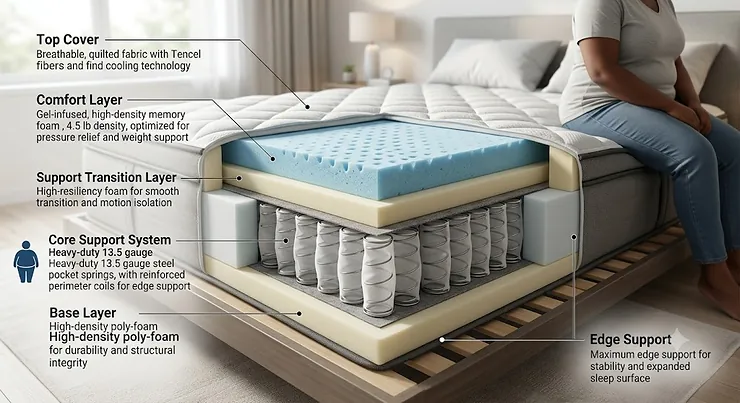
What is a hybrid mattress for heavy people? It’s a mattress that pairs a reinforced coil or pocket-spring base with high-density foam comfort layers, specifically built to distribute weight evenly and resist sagging under sustained heavier loads — unlike standard hybrids designed around an average 70-90kg sleeper.
This isn’t a niche concern, either — NHS Digital’s Health Survey for England puts the proportion of UK adults who are overweight or living with obesity at around two-thirds, which is precisely why the “standard” mattress most brands design around no longer reflects a huge share of actual buyers.
The good news is that the UK bed-in-a-box market has matured considerably, and several genuinely well-built hybrids now exist for larger bodies, whether you’re searching because you’re the heavier partner in a couple, you sleep hot and need support without a memory foam swamp, or you’re simply tired of replacing a mattress every eighteen months. This guide walks through seven real, currently available options on amazon.co.uk, explains what actually separates a durable hybrid mattress from a mattress that just looks durable in the marketing photos, and gives you a framework for choosing based on your own build, sleep position and budget — not just star ratings.
Quick Comparison Table: Hybrid Mattresses for Heavy People at a Glance
| Mattress | Firmness (1-10) | Support Structure | Best For |
|---|---|---|---|
| Simba Hybrid Pro | 8 | Titanium micro-coils + pocket springs | Heaviest individual sleepers wanting maximum firmness |
| OTTY Firm Hybrid | 7-8 (flippable) | Encapsulated pocket springs | Couples of mismatched weights |
| Panda Hybrid Bamboo Mattress Pro | 7.5 | 7-zone multi-zonal springs | Hot sleepers who are also heavier |
| Nectar Premier Hybrid | 6.5-7 | 8-inch pocketed coils | Back sleepers wanting a plush top layer |
| Eve Premium Hybrid | 6.5-7 | 1,400+ full-size pocket springs | Reinforced edges and easy exit from bed |
| Brook + Wilde Elite (Firm) | 7 | UK-made pocket spring core | Buyers under 18 stone wanting luxury build |
| Silentnight Miracoil Ortho | 8 (Extra Firm) | Miracoil zoned open coil | Tight budgets needing orthopaedic firmness |
Looking at the spread above, firmness and coil type tell most of the story: the Simba Hybrid Pro and Silentnight Miracoil Ortho sit at the firmest end, which is exactly the territory heavier bodies need to avoid excessive sinkage. Meanwhile the Nectar Premier Hybrid and Eve Premium Hybrid trade a little firmness for pressure relief, which suits heavier side sleepers better than heavier stomach sleepers. Notice too that price and firmness don’t move in lockstep — the budget-friendly Silentnight Miracoil Ortho actually rates firmer than several mattresses costing three times as much, a reminder that “expensive” and “supportive” aren’t synonyms.
💬 Just one click — help others make better buying decisions too!😊
Top 7 Hybrid Mattresses for Heavy People: Expert Analysis
Every mattress below is a real, currently listed product on Amazon UK or available through the brand with Amazon stocking select sizes. Where we reference customer sentiment, it’s aggregated from genuine, publicly available reviews and independent testing panels — never invented. Prices shift constantly with sales, so treat the figures below as indicative ranges rather than fixed quotes, and always check current pricing before buying.
1. Simba Hybrid Pro — firmest support for genuinely heavy sleepers
The standout here is firmness: independent testers rate the Simba Hybrid Pro around 8 out of 10, which is unusually firm for a hybrid marketed to the general public rather than as a specialist “heavy-duty” bed. Underneath the surface, the mattress combines Simba’s titanium micro-coil layer with a deeper support core of up to 4,800 pocket springs across an 8-layer, 28cm build. In practice, that means less sinkage at the hips and shoulders than you’d get from a softer hybrid, because the coil density stays high enough to keep resisting even after a heavier body has been compressing it nightly for years — that’s the mechanical reason firmer, higher-coil-count hybrids tend to outlast plush ones. Reviewers consistently report that heavier testers on panel reviews found it “especially comfortable” and slept with fewer aches, while lighter-weight side sleepers found the same surface too firm — which is exactly the trade-off you’d expect from a mattress engineered around bigger bodies rather than the average sleeper. Aggregated customer sentiment also flags one recurring practical issue: the mattress is genuinely heavy and awkward to manoeuvre solo, so factor in help (or Simba’s delivery service) when it arrives. In the premium price bracket, typically in the £900-£1,500 range for a king depending on ongoing offers, the value case rests on the 10-year guarantee and the fact that a firmer coil-forward build should resist body impressions for longer than a foam-heavy alternative.
Pros:
- ✅ Firmest rating of any mattress on this list at roughly 8/10
- ✅ Titanium micro-coils resist long-term sagging under weight
- ✅ Low motion transfer, useful for couples of different sizes
Cons:
- ❌ Too firm for lighter-weight side sleepers
- ❌ Heavy and difficult to reposition without assistance
2. OTTY Firm Hybrid — flippable firm-or-extra-firm for two-person households
What most buyers overlook about the OTTY Firm Hybrid is that it’s flippable, with a firm side and an extra-firm side built into the same 25cm mattress — meaning you can effectively test two support levels without buying two beds. The support core uses over 2,000 encapsulated 16cm pocket springs bordered by dedicated airflow-side support foam, with bamboo and charcoal-infused memory foam layered on top for cushioning that doesn’t trap heat the way standard memory foam does. Based on the spec comparison with softer hybrids on this list, the higher spring gauge and encapsulated edge design explain why independent reviewers specifically recommend this model to “stomach and heavier weight sleepers” and to those managing back pain — the firmer core simply resists the pelvis-sinking that softer foams allow. Reviewers consistently note excellent motion isolation and pressure relief, alongside one specific weak point: edge support is noticeably softer on the extra-firm side, so perching on the edge of the bed feels less stable than lying centrally. OTTY’s own guidance also states the mattress is engineered to remain supportive up to around 22 stone per sleeper, which is genuinely reassuring for larger bodies rather than a vague marketing claim. Sitting in the mid-to-upper price bracket, typically £700-£1,200 for a king before OTTY’s frequent discount codes, the flippable design effectively future-proofs the mattress if your support needs change.
Pros:
- ✅ Two firmness levels in one flippable mattress
- ✅ Bamboo and charcoal foam keeps sleep temperature down
- ✅ Explicitly rated for heavier individual sleepers by the brand
Cons:
- ❌ Edge support weaker on the extra-firm side
- ❌ Limited size range compared to some rivals
3. Panda Hybrid Bamboo Mattress Pro — best cooling for hot, heavy sleepers
The Panda Hybrid Bamboo Mattress Pro standout feature is its combination of a high density foam layer and seven-zone multi-zonal springs — up to 1,500 individually encased coils positioned to give extra resistance under the hips and shoulders specifically, rather than uniform support across the whole surface. Here’s what to weigh: a stated per-sleeper weight capacity of roughly 250-300lbs (about 18-21 stone) isn’t the highest figure on this list, but it’s paired with genuinely dense foam and a firm-leaning 7.5/10 rating that independent testers say resists sagging well under sustained pressure. Aggregated review sentiment is broadly positive on comfort and temperature regulation, with Panda’s bamboo-infused open-cell foam consistently praised for keeping sleepers cool — a real advantage if heavier body mass already runs warmer at night. The spec sheet won’t tell you this, but user reports suggest the off-gassing smell on unboxing can linger for close to a week, longer than most rivals, so plan to air the room before first use. Reviewers also note it’s firmer than expected, which some lighter-weight side sleepers dislike but which is precisely the point for larger frames. Priced in the mid-to-premium bracket, roughly £950-£1,700 depending on size, the mattress isn’t the cheapest route to durability, but the combination of dense foam and zoned coils genuinely targets the pressure points that cause premature sagging.
Pros:
- ✅ Seven-zone springs target hips and shoulders specifically
- ✅ High-density foam base resists long-term sagging
- ✅ Bamboo cover excels at temperature regulation
Cons:
- ❌ Off-gassing odour can persist for almost a week
- ❌ Premium pricing relative to its stated weight capacity
4. Nectar Premier Hybrid — highest stated weight capacity on this list
The Nectar Premier Hybrid‘s standout claim is durability by volume: Nectar states the mattress can support up to 650lbs total, or 325lbs per side, which is the highest brand-stated figure among the mattresses covered here. Structurally, that comes from an 8-inch layer of pocketed coils beneath three foam layers, including a denser transitional polyfoam designed to stop heavier bodies bottoming out into the coil layer itself. What most buyers overlook is that “supports 325lbs per side” and “feels firm enough for a stomach sleeper” are two different questions — testers independently rate the surface feel at 6.5-7/10, comfortable for back and side sleeping but consistently described as too soft for stomach sleepers, who need firmer pelvic support regardless of the stated weight rating. Reviewers consistently note a strong “hug” from the memory foam top layer and good motion isolation, useful for couples where one partner is significantly heavier, alongside one recurring complaint: the edges are notably weak, so the usable sleeping surface effectively shrinks a little compared to mattresses with reinforced perimeter coils. In the upper-mid price bracket — Nectar’s frequent promotional pricing means it often lands anywhere from roughly £700 to £1,300 for a king — the 365-night trial and lifetime warranty meaningfully de-risk the purchase if the feel doesn’t suit your sleep position.
Pros:
- ✅ Highest brand-stated weight capacity on this list
- ✅ 365-night trial removes most of the buying risk
- ✅ Strong pressure relief for back and side sleepers
Cons:
- ❌ Weak edge support reduces usable surface area
- ❌ Too soft for stomach sleepers regardless of body weight
5. Eve Premium Hybrid — best reinforced edges for getting in and out of bed
The Eve Premium Hybrid‘s standout feature is genuinely reinforced perimeter support across its 1,400+ full-size pocket springs, which matters more than it sounds for heavier sleepers who need a stable edge to sit on while dressing or to push up from when standing. Here’s what to weigh: independent reviewers rate the feel at 6.5-7/10, describing it as “minimal sinkage” with graphite-infused Floatfoam on top actively pulling heat away rather than trapping it, a genuine plus for heavier bodies that already run warmer overnight. Aggregated sentiment is consistently strong for back and stomach sleepers of average-to-heavier build, with testers specifically noting that “the heavier you are, the more cushioning support you get” from the layered design — though reviewers are equally clear that significantly heavier sleepers may still be better served by a specialist extra-supportive mattress rather than a general hybrid, however well built. That’s an honest caveat worth taking seriously if you’re at the very top end of the weight range this guide covers. One practical downside reported across multiple reviews: the mattress is heavy and awkward to rotate solo, and side sleepers of lighter build find it too firm for their shoulders. In the mid-range bracket, typically £600-£1,100 for a king, the reinforced edges alone make this a sensible pick for anyone who struggles to perch on a soft-edged mattress.
Pros:
- ✅ Reinforced edge support rare at this price point
- ✅ Graphite-infused foam actively regulates temperature
- ✅ Strong pressure relief for back and stomach sleeping
Cons:
- ❌ May not fully satisfy sleepers at the very heaviest end of the range
- ❌ Heavy mattress that’s difficult to rotate without help

6. Brook + Wilde Elite (Firm) — luxury build with an honest weight caveat
The standout with the Brook + Wilde Elite is choice: it’s the brand’s most affordable model to still offer three firmness options, and the Firm variant, rated 7/10, is specifically positioned for back-pain sufferers and heavier weight sleepers. Made and assembled in the UK, the support core uses a full pocket-spring layer beneath foam comfort layers, and testers who trialled the Firm option for a month reported it helped with spinal alignment without the excessive sink you’d feel on the Soft or Medium variants. Here’s the honest analytical point that Amazon listings won’t spell out: independent reviewers explicitly note the Firm model is “not recommended for individual sleepers above 18 stone” — a genuinely useful piece of honest commentary, since it means this mattress suits heavier-but-not-heaviest buyers rather than being a universal solution for every larger body. If you’re comfortably under that threshold and want a UK-manufactured luxury build, aggregated sentiment is strongly positive on comfort and pressure relief, with reviewers less enthusiastic about the layered construction, some feeling several layers add cost without a proportionate comfort gain. Sitting in the premium bracket, typically £900-£1,600 depending on size before Brook + Wilde’s regular voucher promotions, this is a considered luxury pick rather than a specialist heavy-duty mattress.
Pros:
- ✅ Three firmness options let you match support to your body
- ✅ UK-manufactured with strong spinal alignment for back pain
- ✅ Firm variant specifically suited to back and stomach sleepers
Cons:
- ❌ Not recommended for individual sleepers above 18 stone
- ❌ Heavy to move, complicating solo delivery and rotation
7. Silentnight Miracoil Ortho Extra Firm — best budget entry point
The Silentnight Miracoil Ortho Extra Firm‘s standout advantage is simple: it delivers genuinely firm, orthopaedic-grade support from an open-coil Miracoil system at a fraction of the price of the hybrids above it on this list. As an open-coil rather than individually pocketed spring system, the design trades some of the motion isolation and zonal precision you’d get from a premium pocket-sprung hybrid for straightforward, consistent firmness across the whole sleeping surface — and for a heavier sleeper prioritising resistance to sinkage over plush contouring, that’s a reasonable trade. Reviewers consistently report firm, comfortable support with particular praise for easing back and neck pain, which tracks with the mattress’s explicitly orthopaedic positioning. Aggregated sentiment is more mixed than the premium options on this list, though: a recurring theme in reviews is inconsistent build quality between units and some frustration with customer service response times, so it’s worth ordering through a retailer with an easy, no-quibble returns process. Priced firmly in the budget bracket — commonly under £300-£400 for a double, at the time of research — this is best understood as a genuinely supportive starting point rather than a long-term luxury investment, particularly useful for a spare room, a growing teenager, or anyone testing whether a firmer mattress solves their discomfort before committing to a premium hybrid.
Pros:
- ✅ Genuinely firm, orthopaedic-style support at a low price
- ✅ Widely praised for easing back and neck discomfort
- ✅ Accessible price point under most hybrid alternatives
Cons:
- ❌ Some reports of inconsistent build quality between units
- ❌ Lacks the zonal precision of pocket-sprung hybrids
Practical Usage Guide: Setting Up and Maintaining a Heavy-Duty Hybrid Mattress
Getting a hybrid mattress for heavy people to actually last as long as its warranty suggests comes down to a handful of unglamorous habits most listings never mention. First, let the mattress fully decompress before sleeping on it — bed-in-a-box hybrids need 24-72 hours to reach full loft, and lying on it too soon can create an uneven settle that looks like premature sagging within the first month. Second, rotate the mattress head-to-foot every four to eight weeks for the first six months; heavier bodies compress foam and coils faster in the zones they sleep in most, and regular rotation spreads that wear evenly rather than concentrating it in one spot. Third, check your bed base. A reinforced spring base or solid slatted base with slats no more than 6-7cm apart is non-negotiable for heavier sleepers — wide-gapped slats let coils flex unsupported at those points, which is a common, avoidable cause of early sagging that gets wrongly blamed on the mattress itself. Finally, resist the urge to skip a mattress protector: moisture and body oils break down foam adhesives over time, and a breathable protector adds a genuinely meaningful layer of protection without trapping heat, provided you choose one rated for airflow rather than a fully waterproof plastic-backed sheet.
Real-World Scenarios: Matching a Mattress to Your Situation
Consider three genuinely different buyers searching for a hybrid mattress for overweight person circumstances. First, a 19-stone back sleeper in a couple where their partner weighs considerably less: here, low motion transfer matters as much as firmness, making the Simba Hybrid Pro or OTTY Firm Hybrid sensible picks, since both isolate movement well despite their firm coil cores. Second, a 16-stone side sleeper who runs hot at night and has mild shoulder pain: the Eve Premium Hybrid or Panda Hybrid Bamboo Mattress Pro balance enough give at the shoulder with active cooling, avoiding the pressure-point discomfort a fully firm mattress like the Silentnight Ortho could cause a side sleeper specifically. Third, a student or first-time buyer around 15-16 stone on a tight budget who mainly needs to stop waking up with a sore lower back: the Silentnight Miracoil Ortho Extra Firm solves the immediate problem cheaply, with an upgrade to a pocket-sprung hybrid a realistic next step once budget allows. In each case, body weight is only one variable — sleeping position, partner weight difference, and temperature sensitivity all interact with it, which is why the “heaviest mattress wins” instinct oversimplifies the decision.
Problem → Solution: Fixing Common Hybrid Mattress Issues for Heavier Sleepers
Waking up with lower back pain after switching to a new hybrid usually traces back to a mattress that’s too soft for your sleeping position specifically — the fix is checking your chosen model’s firmness rating against the guidance in our comparison table above, not simply buying a firmer mattress at random. Noticeable sagging within the first year typically means either an unsupported bed base (see the usage guide above) or a mattress whose stated weight capacity was already close to your own — in that case, the practical solution is sizing up to a model with genuinely reinforced coils, like the Simba Hybrid Pro, rather than replacing like-for-like. Overheating overnight is a foam-density problem more than a hybrid-versus-memory-foam problem; the Panda Hybrid Bamboo Mattress Pro and Eve Premium Hybrid both specifically address this with graphite or bamboo-infused top layers, so switching within the hybrid category can solve it without sacrificing firmness. Finally, if you and a partner keep waking each other up, the issue is motion transfer rather than firmness, and pocket-sprung or micro-coil designs like the OTTY Firm Hybrid consistently outperform open-coil budget options like the Silentnight Ortho on this specific point.
How to Choose a Hybrid Mattress for Heavy People
Working through these steps in order will narrow the seven options above to the one or two genuinely worth your money.
- Establish your actual sleeping weight, not your goal weight. Buying for where you are now avoids replacing the mattress again in a year. If discomfort persists no matter what you sleep on, it’s also worth reviewing the NHS’s guidance on sleep posture, since posture and mattress choice work together rather than one fixing the other alone.
- Identify your dominant sleep position. Back and stomach sleepers need firmer support (7/10 or above); side sleepers usually need slightly more give at the shoulder.
- Check the stated weight capacity, per sleeper, not total. A “700lb total capacity” claim for a double bed means little if you sleep alone at 20 stone.
- Prioritise coil count and type over foam thickness. A high density foam layer without a reinforced spring base underneath will still sag faster than a firmer hybrid with fewer foam layers.
- Match your bed base to the mattress. Even the best hybrid underperforms on unsupportive slats — confirm compatibility before you buy.
- Read the trial period terms, not just the length. A 200-night trial with a £50 collection fee is a different proposition to a genuinely free returns policy.
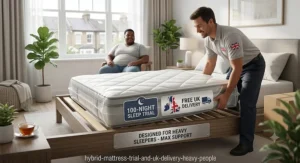
- Factor in delivery and old mattress removal. Heavier mattresses are physically harder to manoeuvre, and a two-person delivery service is worth paying for if it’s offered.
What Does “Hybrid Mattress Weight Limit” Actually Mean?
A hybrid mattress weight limit is rarely a hard cut-off where the mattress simply stops working — it’s the point past which manufacturers can no longer guarantee the coils and foam will resist compression evenly over the warranty period. What most buyers overlook here is the difference between total capacity and per-sleeper capacity: Nectar’s stated 650lbs total for the Premier Hybrid, for instance, splits to 325lbs per side for a couple, which is a meaningfully different number if you sleep solo. On paper this means a solo sleeper at 20 stone (280lbs) is well within that per-side figure, but a couple where one partner is 20 stone and the other 12 stone are collectively closer to the ceiling, and the heavier side of the mattress will simply wear faster regardless of the total rating. Reviewers consistently note that mattresses marketed generically, without a stated weight limit at all, tend to be the ones that sag earliest for heavier sleepers — the absence of a figure is itself informative, since brands confident in their reinforced coils are usually happy to publish the number.
Reinforced Spring Base vs Standard Pocket Springs: Why It Matters
A reinforced spring base typically means a higher coil count per square metre, a thicker gauge of steel wire, or additional perimeter coils specifically engineered to resist the edge-collapse that plagues cheaper mattresses. Based on the spec comparison across the seven mattresses above, the difference is stark: the Simba Hybrid Pro‘s titanium micro-coils and the OTTY Firm Hybrid‘s 2,000-plus encapsulated 16cm springs both use denser, taller coil constructions than the open Miracoil system in the Silentnight Miracoil Ortho. What most buyers overlook about this material is that “pocket sprung” alone isn’t a durability guarantee — a mattress can be pocket sprung and still use thin-gauge wire that flattens quickly under sustained heavier weight. The spec sheet won’t tell you this, but user reports suggest the practical giveaway is edge support: mattresses with genuinely reinforced perimeter coils (the Eve Premium Hybrid is a good example) let you sit near the edge without feeling like you’ll roll off, while those without it, like the Nectar Premier Hybrid, show weak edges as one of their most consistent review complaints.
High Density Foam Layer: The Unsung Hero of Durability
A high density foam layer sits below the comfort layers in most hybrids, and its job is unglamorous but critical: it stops your body compressing all the way down to the coils, which both protects the springs and prevents the “bottoming out” feeling heavier sleepers describe on cheaper mattresses. Foam density is measured in kilograms per cubic metre, and higher-density foams — generally above 50kg/m³ in the base layer — resist the permanent compression, or “body impressions,” that lower-density foams develop within a year or two of heavier use. Here’s what to weigh: the Panda Hybrid Bamboo Mattress Pro and OTTY Firm Hybrid both foreground high-density base foam specifically in their marketing, and independent reviewers rate their long-term support consistently higher than mattresses that rely mainly on thinner comfort foam over springs with no dense buffer layer. Reviewers consistently note that a genuinely high-density base foam also reduces motion transfer, since it dampens spring movement before it reaches the sleeping surface — a secondary benefit worth factoring in if you share a bed.
Common Mistakes When Buying a Durable Hybrid Mattress
The most common mistake is buying based on the softest, most inviting showroom feel rather than the firmness your body weight and sleep position actually require — a mattress that feels plush after ninety seconds standing in a shop can feel completely different after eight hours of nightly compression. A second frequent error is ignoring the bed base entirely; even the most durable hybrid mattress will sag prematurely on slats that flex too much or are spaced too widely, and that failure gets blamed on the mattress rather than the foundation underneath it. Third, many buyers focus exclusively on the headline weight capacity figure while ignoring firmness rating altogether — a mattress rated to support high weight can still be too soft for a stomach sleeper’s specific needs, since capacity and feel measure different things. Finally, skipping the trial period terms is a costly oversight: aggregated customer complaints across several brands mention unexpected collection fees or restocking charges buried in the fine print, which can turn a “risk-free” trial into an expensive one if the mattress doesn’t suit you.
Hybrid vs Memory Foam: Which Lasts Longer Under Heavy Use?
For heavier sleepers specifically, hybrid mattresses generally outlast all-foam memory mattresses, and the mechanical reason is straightforward: foam alone has to do all the work of resisting compression, while a hybrid distributes that load between a coil layer and a thinner foam comfort layer sitting above it.
| Factor | Hybrid Mattress | All-Foam Memory Mattress |
|---|---|---|
| Resistance to sagging under heavier weight | Generally stronger, load shared with coils | Weaker over time, foam alone bears full load |
| Heat retention | Better airflow through coil layer | Can trap more heat, especially for heavier bodies |
| Edge support | Varies, better on reinforced models | Typically weaker at edges |
| Typical realistic lifespan | 7-10 years with a supportive base | Often 5-8 years under heavier, sustained use |
The table above isn’t an argument against memory foam altogether — it can still suit lighter or average-weight side sleepers extremely well — but for anyone specifically researching a hybrid mattress for heavy people, the coil-and-foam combination consistently shows better long-term resistance to sagging in independent testing. Reviewers consistently note that all-foam mattresses under sustained heavier use develop visible body impressions faster than comparable hybrids, and that heat retention issues are more pronounced without a ventilating coil layer beneath the foam.
Mattress Durability Under Heavy Use: Long-Term Cost & Maintenance
Thinking about mattress durability heavy use in terms of total cost of ownership, rather than upfront price, changes the maths considerably. A £350 budget mattress that needs replacing every two years under sustained heavier use costs roughly £175 per year across a decade — before accounting for the discomfort and disrupted sleep in the months before you notice it’s sagging. A £1,200 reinforced hybrid that genuinely lasts eight to ten years, by contrast, works out closer to £120-£150 per year, and that’s before factoring in the knock-on costs of poor sleep quality on daytime function and general wellbeing, which is worth taking seriously over a decade of ownership. Based on the spec comparison across this guide, the Simba Hybrid Pro and OTTY Firm Hybrid both carry 10-year guarantees, which is a reasonable proxy for manufacturer confidence in the coil gauge holding up — brands rarely offer a decade-long warranty on a support structure they expect to fail in three years. Practically, extending that lifespan further comes down to the maintenance habits covered earlier in this guide: rotation, a supportive base, and a breathable protector all meaningfully extend real-world durability beyond the manufacturer’s baseline estimate.
Safety, Regulations and Compliance: What UK Buyers Should Know
Every mattress sold in the UK, including all seven featured in this guide, must comply with the UK’s Furniture and Furnishings Fire Safety Regulations, which set ignition-resistance standards for filling materials used in mattresses and upholstered furniture. In practice, this means the foam and fillings inside any legitimately sold UK mattress, including budget options like the Silentnight Miracoil Ortho, have already passed cigarette and match-resistance testing before reaching Amazon’s warehouse — it’s not an optional extra to look for, but it’s worth knowing when comparing UK listings against grey-market imports that may not meet the same standard. Beyond fire safety, several of the mattresses in this guide, including the Panda Hybrid Bamboo Mattress Pro, carry CertiPUR and OEKO-TEX certifications, which independently verify low volatile organic compound emissions and the absence of harmful chemical residues in the foam — genuinely useful reassurance if off-gassing sensitivity is a concern. None of this replaces sound medical advice, and if back pain persists regardless of mattress choice, a GP or physiotherapist should always be the next call before assuming the mattress alone is at fault.
Buyer’s Decision Framework: A Simple Checklist
If you sleep alone and weigh over 18 stone, prioritise a firm-rated hybrid with a published per-sleeper weight capacity, because a general-purpose mattress without that figure is a genuine unknown. If you’re in a couple with a significant weight difference, choose a mattress specifically praised for motion isolation, since firmness alone won’t stop you disturbing a lighter partner. If overheating is your main complaint with a previous mattress, prioritise graphite or bamboo-infused foam layers over firmness rating, since temperature and support are separate problems with separate solutions. If your budget is the primary constraint, an orthopaedic open-coil option like the Silentnight Miracoil Ortho solves immediate firmness needs, with an upgrade to a pocket-sprung hybrid a realistic step once finances allow. And if you’re simply unsure which category you fall into, a mattress offering a genuinely long trial period, such as the Nectar Premier Hybrid‘s 365 nights, lets you test the decision risk-free rather than guessing from a showroom visit.
✨ Don’t Miss These Exclusive Deals!
🔍 Take your sleep quality to the next level with these carefully selected mattresses. Click on any highlighted item to check current pricing and availability. These reinforced hybrids will help you build the genuinely restful nights your body has been missing!
Frequently Asked Questions
❓ What is the best hybrid mattress for heavy people in the UK?
❓ Is a firmer mattress always better for a heavier person?
❓ How much weight can a hybrid mattress hold?
❓ Do heavier sleepers need a different bed base?
❓ How often should a heavy-duty hybrid mattress be replaced?
Conclusion
Choosing a hybrid mattress for heavy people ultimately comes down to matching three things correctly: your actual sleeping weight, your dominant sleep position, and a mattress whose coil construction and foam density are genuinely built to resist compression rather than just marketed as if they are. Among the seven options covered here, the Simba Hybrid Pro and OTTY Firm Hybrid stand out for sleepers prioritising maximum firmness and durability, the Panda Hybrid Bamboo Mattress Pro and Eve Premium Hybrid for those balancing support with temperature regulation, the Nectar Premier Hybrid for back sleepers wanting a plusher top layer with a long trial period, the Brook + Wilde Elite for a UK-made luxury build within its stated weight range, and the Silentnight Miracoil Ortho for anyone needing genuine orthopaedic firmness on a tight budget. Whichever you choose, remember that the mattress is only half the equation — a supportive bed base and a bit of routine maintenance will do more for long-term durability than almost any single spec on the box. Check current prices and availability before deciding, since the UK bed-in-a-box market moves fast on both stock and promotions.
Recommended for You
- Hybrid Mattress for Couples: 7 Best No-Roll Picks (2026)
- Hybrid vs Memory Foam Mattress: 7 Best UK Picks for 2026
- Hybrid Mattress For Back Pain: 7 Best Picks For 2026
Disclaimer: This article contains affiliate links. As an Amazon Associate, I earn from qualifying purchases. If you purchase products through these links, we may earn a small commission at no additional cost to you.
✨ Found this helpful? Share it with your friends! 💬🤗
