
In This Article
Three a.m., staring at the ceiling, one hand jammed under the small of your back like that’s somehow going to help. Sound familiar? If you’ve been Googling hybrid mattress for back pain at an hour when no sensible person should be awake, you’re not alone, and you’re not being dramatic. Roughly a third of UK adults report ongoing back pain, and an old, saggy, or simply wrong mattress is one of the most common (and most fixable) culprits behind it.
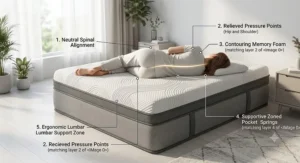
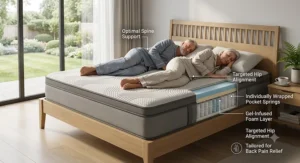
According to NHS guidance on back pain, a supportive sleep surface is one of the simplest, evidence-backed ways to ease non-specific back pain without medication. Here’s the good news: hybrid mattresses have become the go-to answer for exactly this problem, and there’s a decent scientific reason why. They pair the structure of pocket springs with the cushioning of foam, which in plain English means your hips and shoulders sink in just enough while your lower back stays properly held up. Neither the concrete-slab firmness your gran swore by, nor the marshmallow softness that lets your spine bow in the middle.
This guide digs into seven real mattresses currently sold in the UK, spanning proper budget buys through to the sort of premium beds you save up for. We’ll walk through the zoned support systems that actually make a difference, the aggregated review sentiment from real owners (not invented five-star quotes), and the honest trade-offs nobody puts on the box. Whether you’re chasing a supportive hybrid mattress under £400 or eyeing something with a dedicated lumbar zone hybrid design, there’s a pick here worth your attention. Let’s get into it.
What Is A Hybrid Mattress For Back Pain?
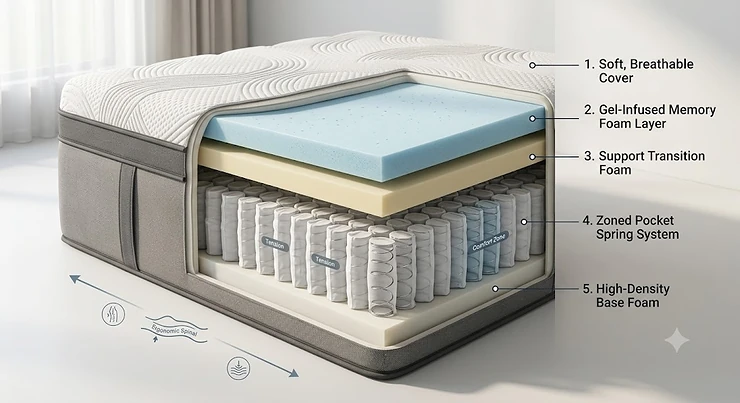
A hybrid mattress for back pain combines a coil or pocket-spring support layer with one or more foam comfort layers, often arranged in zones that firm up under the hips and lower back while softening around the shoulders. The spring base keeps the spine level; the foam absorbs pressure points. Together, they aim to prevent the two most common causes of morning stiffness: sagging in the middle and pressure build-up at the joints.
Quick Comparison Table
| Mattress | Firmness | Best For | Price Range |
|---|---|---|---|
| Otty Original Hybrid | Medium-firm | Best all-rounder, Which? Best Buy | Around £370-£800 |
| REM-Fit Pocket 1000 | Medium | Best true budget hybrid | Under £400 |
| Emma Hybrid Comfort | Firm | Heavier sleepers, back/stomach sleepers | Mid-£400s-£600s |
| Silentnight Lift Replenish Hybrid 2000 | Firm | Average-weight back and front sleepers | Mid-£500s-£700s |
| Panda Hybrid Bamboo Mattress Pro | Medium-firm | Hot sleepers wanting cooling + support | £600s-£800s |
| Brook + Wilde Lux | Medium (adjustable) | Combination sleepers, couples | £900s-£1,400s |
| Simba Hybrid Pro | Medium-firm | Restless partners, heavier back sleepers | £800s-£1,000s |
Looking at the table, the pattern is clear: firmness climbs roughly in line with price up to a point, but the real differentiator is zoning sophistication rather than pure cost. The Otty Original Hybrid earns its spot through sheer consistency and independent Best Buy status, while the Simba Hybrid Pro justifies its higher price with genuinely engineered motion isolation that budget beds simply can’t replicate. If your budget caps out under £400, the REM-Fit Pocket 1000 is the standout, proving you don’t need four figures to get meaningful spinal support.
💬 Just one click — help others make better buying decisions too!😊
Top 7 Hybrid Mattresses For Back Pain: Expert Analysis
Coverage below spans budget, mid-range and premium options, with variants and lesser-known alternatives included so you can match a mattress to your actual sleep style, not just your bank balance.
1. Otty Original Hybrid — best all-round Which? Best Buy
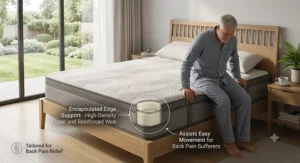
The standout here is that this isn’t just marketing puff — it’s an actual Which? Best Buy, which is a rarer badge than the mattress industry would like you to believe. The Otty Original Hybrid pairs 16cm of pocket springs with temperature-regulating memory foam, landing on a medium-firm feel with noticeably reinforced edges that don’t collapse when you perch on the side to put your socks on.
Based on the spec comparison, that 16cm spring depth is deeper than most beds in this price bracket, which is exactly why it holds its shape under the hips rather than letting them dip. The foam layer is there purely for surface comfort, not spinal support, so side sleepers aren’t left feeling every coil. Good Housekeeping Institute approval and a GQ mention for aches and pains back up what testers consistently report.
Reviewers consistently note that the edge support is a genuine highlight, rare at this price, and that the cover’s washability is more than a token gesture. A recurring complaint is that returning a full mattress under the 100-night trial can feel like a faff logistically, even when the process itself is free.
Pros:
- ✅ Which? Best Buy status with independent lab backing
- ✅ Reinforced edges that hold up under regular use
- ✅ 15-year warranty, among the longest in this bracket
Cons:
- ❌ Firm-leaning feel may not suit lightweight side sleepers
- ❌ Trial returns require some logistical patience
Prices run roughly £370-£800 depending on size, and given the 200-night trial and 15-year warranty, this represents strong value for anyone who wants proven, board-certified support without premium pricing.
2. REM-Fit Pocket 1000 — best true budget hybrid
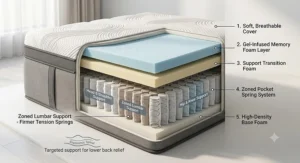
The standout feature is 1,000 individually wrapped pocket springs standing 12-16cm tall, which is genuinely above-average sizing for a mattress that regularly sells under £400. In practice, taller, more numerous springs mean each one flexes independently around your body rather than the whole surface sagging as one unit — a big factor in preventing that hammock effect that wrecks lower backs.
An open-cell foam comfort layer sits on top, officially rated 7 out of 10 for firmness though independent testers consistently peg it closer to 6-6.5, effectively medium-firm. What most buyers overlook about budget hybrids is that spring count matters more than foam thickness for back support, and the REM-Fit Pocket 1000 gets that balance right despite its price point.
Aggregated review sentiment is strongly positive on motion isolation, making it a sound pick for couples on a budget, though owners do note it isn’t the coolest mattress after a few hours under a heavy duvet, and edge support is noticeably weaker than pricier hybrids.
Pros:
- ✅ Above-average 12-16cm pocket springs at a budget price
- ✅ Strong motion isolation for the cost
- ✅ 15-year guarantee alongside a 100-night trial
Cons:
- ❌ Edge support is a known weak point
- ❌ Sleeps warmer than premium cooling hybrids
Prices typically sit under £400 for a double, occasionally dropping into the £220s during sales, making it arguably the smartest entry point into hybrid support without financing a bed.
3. Emma Hybrid Comfort — best zoned hybrid mattress for heavier sleepers
The standout here is a genuinely engineered 7-zone pocket coil layer, mapped to firm up beneath the lower back and hips while easing off around the shoulders. This zoned hybrid mattress design is the whole point of the category: rather than one uniform spring tension trying to serve every part of the body equally badly, each zone does a specific job.
Based on the spec comparison, the coils sit atop a high-density polyfoam stabiliser more than three inches thick, unusually robust for a base layer, which is precisely why testers rate it well for heavier stomach and back sleepers who need the midsection kept level. The overall feel lands medium-firm to firm, officially rated around 6.5-7 out of 10.
Here’s what to weigh honestly: reviewers report genuine improvements in morning stiffness and describe the zoned support as doing what it says on the tin, but a recurring, credible complaint across multiple owner reports is sagging developing in the centre after extended use, alongside heat retention that the synthetic foam doesn’t fully solve.
Pros:
- ✅ Genuine 7-zone pocket coil engineering, not just marketing
- ✅ Strong support for heavier-bodied back and stomach sleepers
- ✅ 200-night trial with a 10-year guarantee
Cons:
- ❌ Some owners report centre sagging over time
- ❌ Runs warmer than cooling-focused alternatives
Prices sit roughly in the mid-£400s to £600s for a double, positioning it as one of the more accessible genuinely zoned hybrids on the market.
4. Silentnight Lift Replenish Hybrid 2000 — best supportive hybrid mattress for back sleepers
The standout feature is 2,000 zoned pocket springs paired with a latex comfort layer, firmer in the centre third to specifically counter hip sink. Silentnight, a name most Brits already trust from the high street, has built this one around orthopaedic-style spinal alignment rather than plush hotel comfort.
What most buyers overlook is that latex behaves differently to memory foam under pressure. Reviewers consistently note the Lift Replenish sleeps notably cooler than foam-heavy competitors, and testers found motion transfer surprisingly minimal given the springy latex construction, a genuine win for couples. Average-weight back sleepers and front sleepers benefit most, as the zoned firmness keeps the spine level in exactly the positions where sagging causes the most damage.
A candid downside worth flagging: this is a firm mattress, and testers agree lightweight side sleepers may find pressure building at the shoulder and hip rather than being cushioned by it. If that’s you, the medium-soft variant Silentnight also offers is the better call.
Pros:
- ✅ 2,000 zoned pocket springs firmer through the centre third
- ✅ Excellent temperature regulation thanks to latex construction
- ✅ Minimal motion transfer for a spring-heavy bed
Cons:
- ❌ Too firm for lightweight or dedicated side sleepers
- ❌ Deep 30.5cm profile needs correctly deep-fitted sheets
At around £550-£700 for a double, this sits mid-market, and the honest trade-off is simple: exceptional back-sleeper support in exchange for reduced side-sleeper comfort.
5. Panda Hybrid Bamboo Mattress Pro — best zoned support system for hot sleepers
The standout advantage is a bamboo-infused cover and BioCell foam combined with a 7-zone pocket spring layer and a proprietary OrthoAlign foam designed specifically for orthopaedic support. This zoned support system is where Panda earns its Good Housekeeping Institute approval, and it shows in how consistently testers rate the temperature control.
Based on the spec comparison, the OrthoAlign layer has a noticeably firmer character than standard memory foam, engineered to work with the zoned coils rather than undermine their support with excessive sinkage. Panda rates the firmness at 7 out of 10, though independent testing panels consistently nudge that closer to 7.5, meaning it leans firmer than its official rating suggests.
Reviewers consistently praise the cooling performance as genuinely class-leading among hybrids, crediting both the bamboo cover and the ventilated spring layer. Back and stomach sleepers report excellent lumbar support with no dip around the hips, though multiple lightweight side sleepers flag the mattress as a touch too firm for full pressure relief at the shoulder.
Pros:
- ✅ Best-in-class cooling among hybrid mattresses tested
- ✅ Genuine orthopaedic-grade OrthoAlign support layer
- ✅ Good Housekeeping Institute approved
Cons:
- ❌ Firmer than its stated 7/10 rating for many sleepers
- ❌ Off-gassing smell reported lasting up to a week after unboxing
Expect to pay in the £600s to £800s for a double, with a 100-night trial and 10-year guarantee softening the commitment.
6. Brook + Wilde Lux — best lumbar zone hybrid for combination sleepers
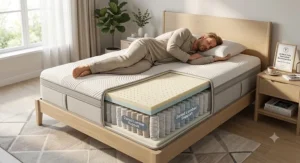
The standout feature is a genuinely four-zone wave foam layer with a dedicated lumbar zone providing targeted lower-back support, sitting above dual spring layers: fine micro-coils for precise contouring and full-sized coils beneath for structural resistance. Few mattresses in this guide get as specific about lumbar geometry as this one.
Based on the spec comparison, that dedicated lumbar zone hybrid design explains why testers repeatedly single this bed out for back and neck pain improvement, spotting genuine customer feedback trends echoing the same theme. The medium firmness setting suits back, side and combination sleepers particularly well, and testers rated motion isolation as good enough that couples barely notice a restless partner shifting position.
Here’s what to weigh: this is a plusher-feeling hybrid than most on this list, thanks to the generous memory foam layer, so stomach sleepers may find it slightly softer than ideal for hip support. Aggregated review sentiment on Trustpilot is largely positive on comfort and customer service, though a minority of long-term owners have reported sagging developing around the two-year mark, worth factoring into your expectations for a mattress at this price.
Pros:
- ✅ Dedicated four-zone wave foam with true lumbar targeting
- ✅ Excellent motion isolation for couples
- ✅ Multiple firmness options to match your body type
Cons:
- ❌ Softer feel may under-support committed stomach sleepers
- ❌ A minority of owners report sagging after roughly two years
At £900-£1,400+ depending on firmness and size, this is a genuine investment piece, best suited to buyers who’ve identified lumbar support as their specific pain point.
7. Simba Hybrid Pro — best premium pick for restless partners
The standout feature is up to 4,800 titanium Aerocoil microsprings, cone-shaped and independently flexing, layered over a multi-zoned base built from sleep-pattern data gathered across millions of Simba sleepers. At 28cm deep with a British wool and graphite-foam top, this is a substantial, engineered bed rather than a simple foam-on-springs affair.
Based on the spec comparison, those cone-shaped microsprings are the reason movement barely transmits across the mattress: each coil compresses in isolation, so your partner turning over doesn’t ripple through to your side. The construction leans medium-firm and sleeps notably cool thanks to the graphite foam, making it particularly well suited to heavier back sleepers who tend to run hot.
Reviewers consistently report a dramatic reduction in feeling a partner’s movement, and Good Housekeeping Institute approval in 2026 backs up the brand’s own testing claims. The trade-off is straightforward: this is one of the pricier options on this list, and the depth means you’ll want a suitably tall fitted sheet.
Pros:
- ✅ Titanium Aerocoil microsprings deliver outstanding motion isolation
- ✅ Sleeps cool thanks to the graphite-foam top layer
- ✅ Good Housekeeping Institute approved in 2026
Cons:
- ❌ One of the pricier hybrids in this guide
- ❌ 28cm depth requires deep-fit bedding
Expect around £899 for a double at regular sale pricing, with a 200-night trial giving you ample time to confirm it suits your back before committing.
Practical Usage Guide: Getting The Most From Your New Mattress
Unboxing day matters more than most people assume. Once your rolled hybrid arrives, cut the packaging carefully away from any protruding staples, lay it flat on its final base, and allow 24-72 hours for full expansion before judging the feel — testing it on day one is like reviewing a loaf of bread mid-prove. During the first 30 days, a common mistake is rotating the mattress (head to foot) too early or too often; most modern zoned hybrids are designed not to need rotating at all, and doing so can actually disrupt the zoning alignment relative to where you sleep.
Give your body two to three weeks to adjust before deciding a firmness feels wrong, since sleepers used to an old, sagging mattress often initially perceive correct support as “too firm.” For maintenance, vacuum the cover monthly to manage dust and allergens, and always use a fitted sheet appropriate to the mattress depth (many hybrids in this guide run 28cm-30cm, deeper than older beds). Avoid folding or standing a pocket-sprung hybrid on its side for storage, as this can permanently damage the internal coil structure. Finally, check your bed base: an unsupportive slatted base with wide gaps can undermine even the best zoned hybrid mattress by allowing unsupported dipping between slats.
Real-World Scenarios: Which Mattress Suits Your Sleep Style?
If you’re a night-shift nurse in your late 20s sharing a bed with a partner who tosses constantly, motion isolation matters as much as spinal support — the Simba Hybrid Pro‘s titanium microsprings are built precisely for this, isolating disturbance while still supporting your side-sleeping shifts between long stretches on your feet.
If you’re a heavier-set tradesperson in your 40s who runs hot and sleeps mostly on your back, prioritise firm, well-ventilated support over plush contouring. The Panda Hybrid Bamboo Mattress Pro or Silentnight Lift Replenish Hybrid 2000 both suit this profile, offering genuine orthopaedic-style firmness with strong temperature regulation, avoiding the overheating that heavier sleepers on foam-dominant beds frequently report.
If you’re a student or first-time renter furnishing a flat on a tight budget, with a naggy but manageable lower-back ache from an old, worn mattress, the REM-Fit Pocket 1000 delivers genuine spring-based support without the premium price tag, ideal for a few years of use before your circumstances (and budget) change.
Buyer’s Decision Framework
If your main complaint is stiffness on waking rather than pain during the day, choose a firmer zoned hybrid like the Otty Original Hybrid, because morning stiffness typically points to inadequate overnight support rather than daytime posture. If you share a bed and disturbance wakes you, choose a microspring or pocket-coil design like the Simba Hybrid Pro, because isolated coil flex is the single biggest lever against motion transfer. If budget is the binding constraint, choose the highest spring count you can afford over the thickest foam layer, since coils do more long-term structural work than foam depth. If you sleep predominantly on your side, prioritise softer zoning at the shoulder over overall firmness, since side sleeping concentrates pressure at a single point rather than spreading it.
How To Choose A Supportive Hybrid Mattress: 7 Expert Steps
- Identify your dominant sleep position — back and stomach sleepers generally need firmer zoned support, while side sleepers need more shoulder give.
- Check the spring count and depth, not just the marketing name — more, taller pocket springs (12cm+) generally outperform shallow coil layers.
- Look for genuine zoning, not just a “zoned” label — ask whether the firmness actually varies by body region or is uniform throughout.
- Match firmness to bodyweight — heavier sleepers typically need firmer support to avoid excess sinkage; lighter sleepers often prefer more give.
- Prioritise a trial period of 100 nights or more — back pain relief is rarely obvious within the first week, so a short trial risks a premature verdict.
- Weigh cooling performance if you run hot — foam-heavy hybrids trap more heat than those with ventilated coil layers or natural fibres.
- Factor in total cost of ownership, not just sticker price — a longer warranty and slower sagging rate often make a pricier mattress cheaper per year of use.
Common Mistakes When Buying A Hybrid Mattress For Back Pain
The most frequent error is assuming “firm” automatically means “supportive.” As the landmark Lancet-published randomised trial on mattress firmness and chronic low-back pain makes clear, excessive firmness can actually worsen pain outcomes compared with medium-firm support. A second common mistake is buying based on a single night’s feel in a shop, which tells you almost nothing about how a mattress performs after weeks of settling. Shoppers also frequently ignore bed base compatibility, pairing a zoned hybrid with an old, sagging base that undermines the mattress’s own support structure from underneath. Finally, many buyers skip checking the depth against their existing fitted sheets, only to discover a 28cm-30cm profile needs entirely new bedding — a genuinely avoidable expense with five minutes of measuring beforehand.
Zoned Hybrid Mattress vs Traditional Pocket Sprung: Which Wins For Back Pain?
Independent testers at Which? note that lab-tested spinal support varies enormously between mattress types, which is exactly why the construction underneath the cover matters more than the brand name on it. A traditional pocket-sprung mattress typically uses uniform spring tension throughout, meaning the same resistance under your shoulders as under your hips. A zoned hybrid mattress, by contrast, engineers different firmness levels by body region, generally firmer through the lumbar and hip area and softer at the shoulders. For back pain specifically, this distinction matters enormously: uniform springs tend to let heavier hip areas sink further than the shoulders, tilting the spine out of alignment overnight, exactly the mechanism experts point to when explaining chronic morning stiffness.
That said, traditional pocket-sprung mattresses aren’t obsolete. They’re often cheaper, and for lighter sleepers whose weight doesn’t create significant differential sinkage between body regions, uniform tension can feel perfectly comfortable. According to NHS guidance on managing back pain, the priority is a mattress that supports the spine’s natural curve and evenly distributes weight — which zoned systems are specifically engineered to achieve, but which a well-chosen traditional mattress can still deliver for the right body type.
Hybrid Mattress For A Bad Back: What To Expect In Real-World Performance
Specs on a product page rarely translate directly into how your back actually feels at 6 a.m. In practice, a genuinely supportive hybrid mattress for back pain should mean your hips don’t sink noticeably deeper than your shoulders when lying on your side, and no perceptible dip forms under your lower back when lying flat. Reviewers across the products in this guide consistently describe a similar arc: the first few nights can feel unfamiliar, sometimes firmer than expected, followed by a gradual sense of “waking up straighter” over the following fortnight as both body and mattress settle in together.
What the spec sheet won’t tell you, but reviewers note repeatedly, is that improvement is rarely instant. A hybrid mattress for bad back symptoms tends to show its real value over three to four weeks, not the first three nights, which is precisely why a generous trial period is worth prioritising over a marginally lower price.
Zoned Support Systems For Different Body Types And Audiences
For lightweight sleepers (under roughly 65kg), a zoned support system with softer shoulder zones matters more than sheer firmness, since less body weight means less natural sinkage into any given layer. For average and heavier sleepers, the lumbar and hip zones need genuine firmness to prevent the pelvis dropping below spine level, which several products here, including the Simba Hybrid Pro and Panda Hybrid Bamboo Mattress Pro, are specifically engineered around. For older sleepers managing arthritis alongside back pain, a slightly softer surface layer over firm zoned support (as seen in the Brook + Wilde Lux‘s wave foam) often eases joint pressure without sacrificing spinal alignment. For younger, active sleepers without significant joint sensitivity, firmer options like the Otty Original Hybrid typically deliver the most consistent overnight support.
Long-Term Cost & Maintenance: Is A Pressure Relief Spring Combo Worth It?
A pressure relief spring combo, foam layered over zoned coils, tends to cost more upfront than a basic all-foam or all-spring mattress, but the total cost of ownership calculation often favours it. Consider a £700 hybrid with a genuine 10-year lifespan against a £250 basic mattress needing replacement every three to four years: over a decade, the cheaper option can actually cost more once you factor in two or three replacement purchases, plus the accumulated nights of poor sleep and potential physiotherapy costs from unresolved back pain. Reviewers across brands in this guide consistently note that genuine pocket-spring construction, rather than basic open-coil designs, holds its shape considerably longer, meaning the support you pay for in year one is still doing its job in year eight. Maintenance costs stay low regardless of price point: a washable cover, occasional vacuuming, and avoiding folding the mattress are typically all that’s required.
Safety, Fire Regulations & Compliance For UK Mattress Buyers
Every mattress legally sold in the UK, hybrid or otherwise, must comply with the Furniture and Furnishings (Fire) (Safety) Regulations 1988, as amended, which set ignition-resistance standards for fillings and covers. This isn’t a marketing checkbox; it’s a genuine legal safety requirement, and reputable brands featured in this guide all state compliance clearly. Beyond fire safety, look for OEKO-TEX or similar certifications on foam components, confirming the materials have been tested for harmful substances, particularly relevant given how much time your body spends in direct contact with the surface each night.
Features That Actually Matter (And Those That Don’t)
Genuine zoning, verified spring count, and trial length are features that consistently correlate with better back-pain outcomes across the reviews aggregated in this guide. Marketing terms like “orthopaedic” and “medical grade,” by contrast, carry no regulated meaning in the UK mattress industry and shouldn’t be taken as a substitute for checking actual construction details. Cooling technology matters considerably if you run hot, but adds little value for naturally cool sleepers paying a premium for a feature they won’t notice. Edge support is a genuinely underrated feature worth checking, since a collapsing edge effectively shrinks your usable sleeping surface over time.
FAQ
❓ What is the best hybrid mattress for back pain in the UK?
❓ Is a firm or medium mattress better for back pain?
❓ How long do hybrid mattresses last?
❓ Do zoned hybrid mattresses really work for back pain?
❓ How firm should a mattress be for lower back pain?
Conclusion
There’s no single perfect hybrid mattress for back pain, only the right match for your body, budget and sleep style. If you want the safest, most independently verified all-rounder, the Otty Original Hybrid earns its reputation honestly. If motion transfer from a restless partner is your specific nightly battle, the Simba Hybrid Pro’s microspring engineering solves a real problem rather than a marketing one. And if budget is genuinely tight, the REM-Fit Pocket 1000 proves that meaningful spinal support doesn’t require a four-figure spend. Whichever you choose, give it the full trial period before judging: real spinal relief tends to arrive in weeks, not nights.
✨ Don’t Miss These Exclusive Deals!
🔍 Take your search for a pain-free night’s sleep to the next level with these carefully researched picks. Click through to check current pricing and availability, and give your back the support it’s been asking for.
Recommended for You
- Best Hybrid Mattress UK 2026: 7 Top Picks Reviewed
- 7 Best Luxury Pocket Spring Mattress Picks for 2026 (UK Guide)
- 3000 Pocket Spring Mattress: 7 Best Picks Reviewed for 2026
Disclaimer: This article contains affiliate links. As an Amazon Associate, I earn from qualifying purchases. If you purchase products through these links, we may earn a small commission at no additional cost to you.
✨ Found this helpful? Share it with your friends! 💬🤗
