
In This Article
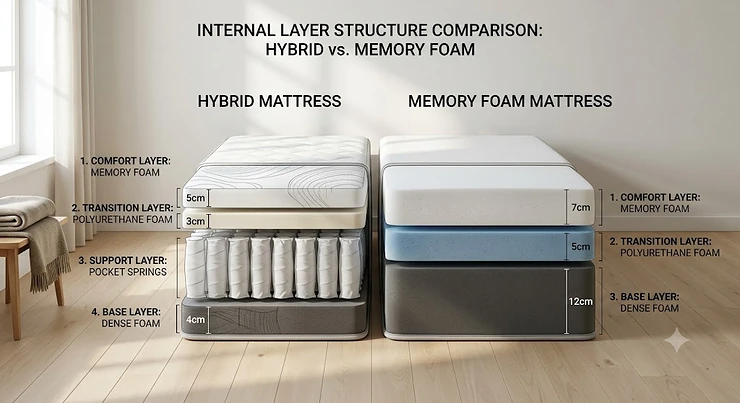
Somewhere around 2am, staring at the ceiling with a hot neck and a numb shoulder, most of us have the same thought: it’s the mattress, isn’t it. It’s always the mattress. And once you start shopping for a new one, you hit the same wall almost immediately — hybrid vs memory foam mattress, which one actually solves your problem? A hybrid mattress combines pocket springs with layers of foam on top, giving you bounce and airflow alongside contouring comfort, while a memory foam mattress is built entirely from viscoelastic foam that slowly moulds to your body heat and weight. Neither is objectively “better” — they solve different sleep problems, and the right one depends on how you sleep, who you sleep next to, and how warm you run at night.
This guide leans on real UK products, aggregated review sentiment from trusted testers, and independent buying advice — including guidance from the NHS on building better sleep habits — rather than recycled spec sheets. We’ve picked seven genuine mattresses sold in the UK, spanning budget, mid-range and premium, split fairly between hybrid and all-foam builds, and we’ve analysed what each one actually does for different bodies and budgets. If you’ve been circling the “should I get hybrid or memory foam” question for weeks without a straight answer, you’re in the right place. By the end, you’ll know exactly which build suits your sleep style — and which specific mattress to shortlist.
Quick Comparison Table
| Mattress | Type | Firmness | Best For | Price Guide |
|---|---|---|---|---|
| Silentnight Mirapocket 1000 | Hybrid | Medium | Budget hybrid buyers | Under £400 |
| Zinus Green Tea Memory Foam | Memory foam | Medium-soft | Tightest budgets | Under £150 |
| Nectar Memory Foam | Memory foam | Medium-firm | Solo sleepers wanting a hug | £350-500 range |
| Panda Hybrid Bamboo | Hybrid | Medium-firm | Back pain and lumbar support | £450-650 range |
| Eve Premium Hybrid | Hybrid | Firm | Back and stomach sleepers | £450-900 range |
| Emma Hybrid Airgrid | Hybrid | Medium-firm | Best all-round cooling comfort | £700-1,000 range |
| Simba Hybrid Pro | Hybrid | Firm | Premium support and sustainability | £900-1,500 range |
Look closely and a pattern emerges: five of the seven products here are hybrids, which roughly mirrors the UK market itself, where hybrid designs have quietly become the default choice for anyone shopping mid-range and up. But the two all-foam options — the Zinus Green Tea Memory Foam and the Nectar Memory Foam — aren’t afterthoughts. They’re genuinely the better pick for anyone sleeping alone, on a tight budget, or specifically chasing that sink-in, cocooned feeling that springs simply can’t replicate. Price and firmness only tell you so much, though; the real decision comes down to sleeping position, body heat, and whether you’re sharing a bed with someone who tosses and turns.
💬 Bookmark this table — you’ll want to scroll back to it once you’ve read the reviews below.
Top 7 Hybrid and Memory Foam Mattresses: Expert Analysis
1. Silentnight Mirapocket 1000 — best genuine hybrid under £400
The clue’s in the name: 1,000 individually wrapped pocket springs, topped with a comfort foam layer, from a brand that’s been in British bedrooms for decades. That spring count matters less as a marketing number and more as a floor — 1,000 pockets in a UK king size gives reasonably even weight distribution without the springs feeling sparse or “boardy” underfoot. On top sits a modest foam comfort layer, enough to soften the surface without erasing the springy responsiveness hybrids are known for. This is a mattress built for people who grew up on traditional pocket-sprung beds and want a gentle nudge towards foam comfort without fully committing to the “sinking in” sensation. Reviewers consistently describe it as reliable rather than luxurious — a “does exactly what it says” bed rather than one that reinvents the category, and it’s one of the most widely stocked mattresses on the British high street, turning up in sales at Argos, Dreams and Mattressman almost year-round. That widespread availability is itself a form of trust signal: a mattress doesn’t stay in every major retailer’s catalogue for years by disappointing customers.
Pros:
- ✅ Genuinely springy hybrid feel at a budget price point
- ✅ Widely stocked, so replacement parts and comparisons are easy
- ✅ Reliable, consistent firmness that suits back and stomach sleepers
Cons:
- ❌ Only one firmness option, so side sleepers may find it firm
- ❌ Thinner comfort layer than pricier hybrids, less pressure relief
At under £400 for a king size, the Silentnight Mirapocket 1000 is hard to beat if your main goal is a dependable spring-and-foam bed without premium extras — it’s the value benchmark the rest of this list gets measured against.
2. Zinus Green Tea Memory Foam Mattress — cheapest genuine memory foam feel
There’s a reason this one keeps appearing in “best budget mattress” round-ups: it’s a proper all-foam build, not a thin foam topper glued to a cheap base. The green tea and charcoal infusion in the top layer is largely a freshness and odour-control feature rather than a performance one, but the underlying gel memory foam does the real work, softening under body heat and slowly contouring around hips and shoulders. At 12 inches, it has enough depth to avoid the “bottoming out” feeling that plagues thinner foam mattresses under £150. This is squarely a budget-conscious pick, and it’s honest about that positioning — it isn’t chasing hybrid buyers, it’s chasing anyone who wants the classic memory foam hug without hybrid pricing. Aggregated review sentiment flags it as a strong first-mattress or spare-room option, CertiPUR-US certified and marketed as resistant to dust mites and allergens, though — as with most soft all-foam beds — reviewers note it isn’t the right call for stomach sleepers or heavier bodies needing firmer lift.
Pros:
- ✅ Genuine memory foam contouring at an entry-level price
- ✅ CertiPUR-US certified foam, reassuring on chemical safety
- ✅ 12-inch depth avoids the thin, “sleeping on the floor” feeling
Cons:
- ❌ Too soft for stomach sleepers or heavier body types
- ❌ Retains more heat than any hybrid on this list
If your budget caps out around £100-150 for a double, the Zinus Green Tea Memory Foam Mattress is the honest, no-frills way into memory foam comfort — just go in expecting a softer, warmer sleep than a hybrid would give you.
3. Nectar Memory Foam — best all-foam hug for solo sleepers
This is the mattress most people picture when they hear “memory foam mattress” — a multi-layer, all-foam build with a denser support core underneath a plush, body-hugging top layer. What most buyers overlook about all-foam construction is that it’s actually the best-performing option for motion isolation, full stop, hybrid or otherwise: without springs to transmit movement, a restless partner rolling over at 3am barely registers on your side of the bed. The gel-infused top layer helps offset the classic memory foam complaint of trapped heat, though it won’t sleep as cool as a hybrid with an open coil base. Reviewers consistently rate it among the more comfortable budget-to-mid all-foam mattresses on the UK market, and it’s frequently found discounted well below its RRP, making the effective price-to-comfort ratio genuinely competitive. Based on the spec comparison with the Zinus above, the extra investment buys a noticeably denser, longer-lasting support core — this is the tier where foam starts to compete seriously with entry-level hybrids on durability, not just price.
Pros:
- ✅ Excellent motion isolation for light sleepers and couples
- ✅ Denser support core than budget foam alternatives
- ✅ Frequently available well under its listed price
Cons:
- ❌ Sleeps warmer than any hybrid on this list
- ❌ Limited edge support compared with spring-based builds
For solo sleepers or couples who prioritise “not feeling your partner move” over airflow, the Nectar Memory Foam earns its spot as the mid-tier all-foam pick — check current price, as it’s regularly discounted from its RRP.
4. Panda Hybrid Bamboo — best for lumbar support on a mid-range budget
Bamboo-infused BioCell foam sits at the top of this build, working as both a temperature-regulating layer and a genuinely soft first point of contact, while a dual layer of orthopaedic-grade memory foam beneath it does the heavier lifting for spinal alignment. Underneath that sits up to 960 pocket springs, a healthy count for a mid-range hybrid and enough to provide zoned support that lifts the lumbar region specifically rather than letting the whole mattress sag as one flat plane. That’s the detail worth dwelling on: “orthopaedic-grade” gets thrown around loosely in mattress marketing, but a genuinely zoned support layer combined with a meaningful spring count is what actually translates into fewer 3am lower-back wake-ups, not just a label on the box. Reviewers commonly highlight the lumbar support specifically, describing comfortable, pressure-relieved sleep for most body types alongside decent airflow from the bamboo-infused cover. It sits in an interesting middle ground — firmer and more structured than the Nectar, cooler-running than either foam option, but not quite as plush as the premium hybrids further down this list.
Pros:
- ✅ Strong lumbar and lower-back support from zoned springs
- ✅ Bamboo-infused cover noticeably cooler than all-foam builds
- ✅ Good value for a genuinely orthopaedic-leaning hybrid
Cons:
- ❌ Firmer feel may not suit lighter side sleepers
- ❌ Fewer size options than the bigger hybrid brands
If lower-back comfort is your main complaint with your current bed, the Panda Hybrid Bamboo deserves a serious look — it’s built around exactly that problem rather than treating it as an afterthought.
5. Eve Premium Hybrid — best for back and stomach sleepers who share a bed
Eve pitches this as a firmer hybrid than most of its UK rivals, and that firmness is the whole story here — it’s specifically tuned for back and stomach sleepers who need their hips and shoulders lifted rather than cradled. Reviewers testing it found the firmer feel sleeps cooler by default (firmer foams compress less, trapping less body heat) and isolates motion surprisingly well for a spring-based hybrid, which is unusual since springs typically transmit more movement than solid foam. That combination — firm support plus decent motion isolation — is genuinely hard to find in the same mattress, and it’s why this one lands specifically in the “couples who don’t sleep in the same position” category, where one partner wants firm support and the other doesn’t want to feel every shift. On the practical side, it’s only sold in double, king and super king, so smaller rooms or single sleepers will need to look elsewhere on this list. Based on the spec comparison, the firmness here sits closer to the Silentnight than the plusher Emma or Panda beds, which is worth knowing before you buy if you associate hybrids with soft, cloud-like comfort.
Pros:
- ✅ Genuinely firm support ideal for back and stomach sleepers
- ✅ Sleeps cool thanks to firmer, less heat-trapping foam
- ✅ Solid motion isolation for a spring-based hybrid
Cons:
- ❌ Not available in single or small double sizes
- ❌ Too firm for side sleepers wanting a plush contour
Couples with mismatched sleep positions but a shared need for a stable, cool-running bed should shortlist the Eve Premium Hybrid — it’s a specialist’s mattress rather than a crowd-pleaser, and that’s exactly its strength.
6. Emma Hybrid Airgrid — best overall cooling comfort and pressure relief
This is the mattress that keeps topping independent “best mattress in the UK” round-ups, and the reasoning holds up under scrutiny: a 27cm profile combining an airgrid layer, soft contouring foams and a supportive base creates what testers repeatedly describe as a “floating” feel — cushioned enough to relieve pressure at the shoulders and hips, without the sunken, trapped sensation that gives memory foam its reputation among hot sleepers. What most buyers overlook about airgrid technology specifically is that it’s essentially a 3D-knitted layer designed to move air rather than trap it, which is why hot sleepers on review panels consistently report it staying fresh through the night in a way flatter foam layers simply can’t match. It sits at medium-firm, which reads as genuinely versatile rather than a marketing compromise — testers found it comfortable for light-to-average body weights across most sleep positions, though heavier sleepers may want the extra support of the Simba below. The standard package (200-night trial, 10-year warranty) is also worth factoring into any price comparison, since a longer trial effectively reduces your risk if the firmness doesn’t suit you.
Pros:
- ✅ Excellent pressure relief with a genuinely “floating” feel
- ✅ Airgrid layer measurably improves airflow versus plain foam
- ✅ Long 200-night trial reduces the risk of a wrong firmness call
Cons:
- ❌ May feel too soft for heavier stomach sleepers
- ❌ Sits at the upper end of mid-range pricing
For anyone who wants the closest thing to a universally comfortable hybrid — cooling, contouring, and backed by a genuinely long trial — the Emma Hybrid Airgrid is the safest all-round bet on this list.
7. Simba Hybrid Pro — best premium pick for support and sustainability
At 28cm tall, this is the most structurally complex mattress here: layers of wool, responsive foams and micro-coils sit above a base that’s mostly full-size springs, a construction aimed squarely at buyers who want the pressure relief of foam without losing the traditional, slightly bouncier feel of a proper sprung bed. Independent testing found it particularly supportive for average-to-heavy body types, delivering firm cushioning that holds its shape rather than compressing into a hammock shape over months of use — a common failure point for cheaper hybrids. The wool layer isn’t just a comfort gimmick either; it’s genuinely better at wicking moisture than synthetic covers, and Simba’s B-Corp certification signals a level of supply-chain scrutiny that’s still rare in this market. Reviewers rated it highly for motion isolation given how many springs are involved, though the same testers flagged edge support as merely average and noted the mattress runs firm enough that lighter side sleepers may find it unforgiving without a topper. On paper this means it’s less a “buy this for everyone” recommendation and more a precision pick for people who specifically want firm, durable, ethically-produced support and are prepared to pay premium prices for it.
Pros:
- ✅ Highly supportive, durable construction for heavier sleepers
- ✅ Strong motion isolation despite a spring-heavy base
- ✅ B-Corp certified with genuine sustainability credentials
Cons:
- ❌ Edge support rated only average in independent testing
- ❌ Too firm for lighter side sleepers without an added topper
If budget isn’t the deciding factor and you want the most structurally robust, ethically-made hybrid on this list, the Simba Hybrid Pro is worth the premium — just be honest with yourself about whether you’re a side sleeper first.
Hybrid vs Memory Foam Mattress: The Real Differences
Strip away the marketing and a hybrid mattress comparison really comes down to one mechanical fact: springs move independently and reset instantly, while foam compresses slowly and releases slowly. That single difference cascades into almost everything else you’ll notice in daily use. Springs create airflow — air moves between each pocket every time you shift position, carrying heat away — which is why hybrids like the Emma Hybrid Airgrid and Panda Hybrid Bamboo consistently test cooler than pure foam beds like the Zinus Green Tea Memory Foam. Foam, meanwhile, has no moving parts to transmit motion, which is exactly why the Nectar Memory Foam isolates a restless partner’s movements better than any spring-based bed on this list, hybrid or otherwise.
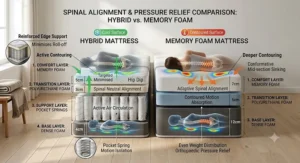
Support works differently too. A hybrid’s springs give you point-by-point response — heavier areas like your hips compress their local springs more, while your lighter shoulders barely move theirs, creating a kind of automatic zoning. Memory foam achieves a similar end result through slow, heat-activated moulding rather than mechanical response, which is why it feels more like “sinking in” than “being held up.” Neither approach is wrong; they’re just solving the support problem with completely different tools, and your body weight, sleep position and heat tolerance decide which tool suits you better.
| Factor | Hybrid | Memory Foam |
|---|---|---|
| Airflow / cooling | Strong — springs allow air movement | Weaker — dense foam traps heat |
| Motion isolation | Moderate to good, varies by model | Excellent, best-in-class |
| Edge support | Generally stronger | Generally weaker |
| Typical lifespan | 8-12 years | 7-10 years |
| Feel | Bouncy, responsive | Slow-moving, contouring |
Neither column is a straight upgrade over the other — the table above simply confirms that hybrids and memory foam mattresses are optimised for genuinely different priorities, which is precisely why this guide features both rather than crowning one category the outright winner.
Should I Get Hybrid or Memory Foam? A Decision Framework
Rather than reading another ten paragraphs of pros and cons, run through this quick framework and see where you land.
- If you sleep hot and wake up sweaty, choose a hybrid — the airflow difference is the single most reliably reported improvement across review panels.
- If you share a bed with someone who moves a lot at night, choose memory foam, or a foam-forward hybrid like the Nectar Memory Foam, for the best motion isolation.
- If you have chronic lower back pain, look at zoned hybrids like the Panda Hybrid Bamboo first, since targeted spring zoning plus orthopaedic foam tends to outperform flat foam slabs for spinal alignment.
- If your budget is under £200, memory foam gives you a more convincing “premium feel” per pound than a budget hybrid, because thin springs in cheap hybrids can feel unsupportive in a way thin foam doesn’t.
- If you weigh over roughly 16 stone, prioritise a firmer hybrid such as the Simba Hybrid Pro, since heavier bodies compress foam more deeply and can bottom out on softer all-foam builds over time.
- If you’re furnishing a spare room or a first flat on a tight budget, the Zinus Green Tea Memory Foam or Silentnight Mirapocket 1000 both do the job without the higher trial-and-error cost of a premium bed.
Here’s what most of these frameworks leave out, though: firmness preference is genuinely personal and can’t be fully predicted by a checklist. Use this as a shortlist tool, not a final verdict — then lean on a long sleep trial to confirm the fit.
Hybrid vs Foam Mattress: Pros and Cons Breakdown
Laid out side by side, the hybrid vs foam mattress pros and cons picture looks like this. Hybrids generally win on temperature regulation, edge support, and that “held up” bounce that makes getting in and out of bed easier, particularly for anyone with mobility concerns. They also tend to last slightly longer on paper — the spring core resists sagging over time in a way foam layers, which slowly lose density, eventually can’t. Where hybrids lose ground is price: because they combine two manufacturing processes (spring assembly plus foam layering), they’re rarely cheap, and budget hybrids can feel like a compromise on both fronts rather than the best of both worlds.
Memory foam’s strongest card is pressure relief through full-body contouring, plus that near-total motion isolation that makes it the default recommendation for light sleepers sharing a bed. It’s also usually the more affordable route into a genuinely comfortable mattress, and it packs down smaller for delivery. The trade-offs are heat retention, weaker edge support (foam alone can’t hold your weight the same way as springs when you sit near the mattress edge), and a shorter typical lifespan before the foam starts losing its recovery bounce. Reviewers consistently note that all-foam beds also take longer to “unpack” the initial off-gassing smell after unboxing — a minor point, but one worth knowing before you sleep on it the first night.
Edge Support Compared: Hybrid vs Memory Foam
Edge support rarely makes anyone’s shortlist of mattress features until they’ve lived without it — then it becomes the thing they complain about most. It’s the difference between confidently sitting on the side of your bed to put your socks on, and feeling like you’re about to roll onto the floor. Springs, by their construction, hold their shape right to the perimeter of the mattress, especially in hybrids with reinforced edge coils; that’s why even the Silentnight Mirapocket 1000, a budget pick, offers more usable edge-to-edge space than a premium all-foam bed. Memory foam, by contrast, compresses more freely near the edges precisely because there’s no rigid structure resisting the compression, which is why the Nectar Memory Foam and Zinus Green Tea Memory Foam both lose a noticeable strip of usable sleeping surface around the perimeter.
That said, not all hybrids ace this test either — independent testers rated the Simba Hybrid Pro‘s edge support only “average” despite its otherwise robust spring base, a reminder that spring count and construction quality matter more than simply being a hybrid. If you regularly sit on the edge of the bed to dress, or share a smaller mattress and need every inch of surface usable, prioritise reinforced-edge hybrids over foam, full stop — this is one area where the mattress type genuinely predicts the outcome more reliably than most other comparisons in this guide.
Temperature Regulation: Finding a Temperature Neutral Mattress
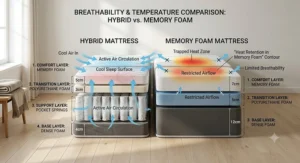
If you’ve ever flipped your pillow to the “cool side” at 2am, you already understand why so many buyers search specifically for a temperature neutral mattress rather than just “a comfortable one.” The physics here are straightforward: memory foam is dense and has no internal air channels, so body heat gets trapped rather than dispersed, and the denser or thicker the foam, the warmer it tends to sleep. Hybrids solve this mechanically rather than chemically — the gaps between pocket springs act as air channels, letting warm air escape as you move through the night, which is precisely why hot sleepers on review panels consistently rate airgrid and open-coil hybrids like the Emma Hybrid Airgrid as noticeably cooler than any all-foam bed.
Cover materials add a second layer to this story. Bamboo-infused fabrics, like the one on the Panda Hybrid Bamboo, and gel-infused foams, like the top layer on the Zinus Green Tea Memory Foam, are designed to offset foam’s natural heat retention rather than eliminate it entirely — think of them as damage control rather than a genuine fix. If overheating is your single biggest sleep complaint, the honest advice is to prioritise construction (springs and open layers) over marketing claims about “cooling gel,” which help marginally but can’t out-engineer the fundamental density difference between foam and springs.
Bounce vs Contouring Sleep: Which Feel Suits You?
This is really a question about how your body wants to be supported, and it splits people more decisively than almost any other mattress preference. Bounce — the springy, responsive feel you get from hybrids like the Eve Premium Hybrid or Simba Hybrid Pro — suits people who move around a lot during sleep, since the mattress resets instantly rather than holding the shape of your last position. It also tends to suit couples, since a responsive surface makes it easier to reposition without feeling stuck, and it makes getting in and out of bed noticeably easier for older sleepers or anyone with joint stiffness.
Contouring — the slow, body-hugging sink you get from memory foam like the Nectar Memory Foam — suits people who find one comfortable position and stay there most of the night, since the foam gradually moulds to exactly that shape and holds it. It’s particularly well-suited to side sleepers who need the mattress to cradle the shoulder and hip rather than push back against them, which is part of why memory foam retains such a loyal following among side sleepers with joint pain. Neither feel is more “correct” than the other; this is genuinely one of the few mattress decisions that comes down to pure preference rather than measurable performance, and it’s worth testing both feels in a showroom before committing to a boxed mattress you’ll only unbox at home.
How to Choose a Hybrid or Memory Foam Mattress
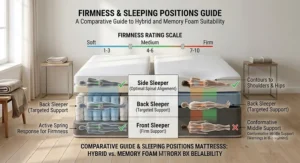
- Identify your dominant sleep position first. Side sleepers generally do better with contouring foam or plush hybrids; back and stomach sleepers usually need the firmer support of a structured hybrid.
- Be honest about your body temperature. If you already sleep with a fan on in winter, rule out all-foam mattresses entirely and focus on hybrids with open coil bases.
- Factor in who else is in the bed. A restless partner makes motion isolation your top priority, which usually points towards foam or a foam-heavy hybrid.
- Set a realistic budget band before you start browsing. According to independent buying guidance from Which?, double mattresses at UK high street retailers typically start around £200-250, so treat anything wildly cheaper with caution.
- Check the trial period, not just the warranty. A 100+ night trial matters more than a 10-year warranty, because firmness mismatches usually surface in the first few weeks, not years down the line.
- Weigh delivery logistics. Boxed mattresses (Emma, Simba, Nectar) are easier for solo delivery; heavier premium beds may need two-person courier access.
- Test edge support and firmness together, not separately. A mattress that feels firm in a showroom for five minutes can feel completely different after eight hours of body heat softening the top layer.
Common Mistakes When Buying a Hybrid or Memory Foam Mattress
The single most common mistake is shopping on firmness label alone — “medium” from one brand can feel completely different from “medium” at another, since there’s no industry-standard firmness scale in the UK mattress market. A second frequent error is judging a mattress purely by spring count or foam density printed on the box; as we noted with the Silentnight Mirapocket 1000 and Simba Hybrid Pro, quality of individual springs and foam layering matters more than raw numbers. Buyers also regularly skip the sleep trial entirely, assuming that if it feels fine in the first three nights it’ll feel fine forever — but most foam and hybrid mattresses need two to three weeks to fully “break in” and reveal their true feel.
Another mistake worth flagging: adding a topper immediately to “fix” firmness before actually sleeping on the bare mattress for a couple of weeks. Toppers mask genuine construction issues rather than solving them, and if you need one on day one, you may have bought the wrong firmness entirely rather than found a workaround. Finally, plenty of buyers underestimate delivery logistics — assuming a premium mattress will arrive boxed and liftable by one person, when in fact non-boxed premium beds often require two-person courier delivery with proper access clearance booked in advance.
Real-World Scenarios: Matching Sleepers to Mattress Types
The student in a shared house, budget under £200: A first-year sharing a house with thin walls and a tight budget doesn’t need premium cooling tech — durability and basic comfort matter more. The Zinus Green Tea Memory Foam or Silentnight Mirapocket 1000 both cover this brief without a four-figure commitment, and both are easy to resell or dispose of at the end of a tenancy.
The couple with mismatched sleep needs: One partner runs hot and sleeps on their back; the other is a light-sleeping side sleeper easily woken by movement. Here, a firmer, cooler hybrid with decent motion isolation earns its keep — the Eve Premium Hybrid was specifically built around exactly this combination of firmness and motion control.
The chronic lower-back-pain sufferer working from home: Someone spending more hours than ever sitting and lying down needs zoned, orthopaedic-leaning support rather than a plush hug that lets the spine sag. The Panda Hybrid Bamboo‘s zoned spring layout under orthopaedic-grade foam directly targets this use case, and its bamboo cover helps offset the extra heat that comes from spending more daytime hours in bed too.
Each of these profiles shares one underlying lesson: the “best” mattress is entirely dependent on context, and copying a friend’s five-star recommendation without matching your own sleep position, body heat and household situation is one of the fastest ways to end up disappointed with an expensive purchase.
Setting Up and Settling In: Your First 30 Nights
Unboxing day matters more than most buyers expect. Once you cut the packaging, a compressed foam or hybrid mattress needs roughly 24-72 hours to fully expand to its true height and firmness — sleeping on it within the first night will give you a distorted first impression, so resist judging it too early. Ventilate the room well during this period; both foam and hybrid mattresses can carry a temporary “new mattress” smell from the manufacturing process, which typically fades within a week with regular airing rather than being a defect.
For the first month, avoid adding a topper straight away, no matter how firm the mattress feels on night one — your body needs time to adjust, and foam layers specifically need repeated body heat exposure to start conforming properly. A useful trick borrowed from independent testers: rotate the mattress head-to-foot after the first week to check whether one side feels noticeably different, which can reveal early manufacturing inconsistencies while you’re still within your trial window. Around the two-week mark, sit deliberately on the edge of the mattress to assess real-world edge support, since springs and foam both need time to “settle” before edge performance stabilises. If you’re still uncomfortable after three full weeks of proper adjustment, that’s a genuine signal to use your sleep trial and return it — not a sign you simply need to push through.
Long-Term Cost & Maintenance: Hybrid vs Memory Foam
Sticker price only tells half the story; the real cost comparison happens over the mattress’s working lifetime. A pocket-sprung hybrid typically lasts 8-12 years with reasonable care, provided the springs are well-gauged and the mattress is rotated occasionally, while memory foam mattresses average a shorter 7-10 years, especially at lower foam densities where the material loses its recovery bounce faster. Run the maths per year of use rather than upfront cost, and a £900 hybrid lasting 11 years (roughly £82 a year) can genuinely out-value a £400 all-foam bed that needs replacing after 7 years (roughly £57 a year) — the gap narrows considerably once you factor in that the cheaper bed may also need an earlier topper purchase to compensate for sagging.
Maintenance requirements differ too. Memory foam mattresses need comparatively little upkeep — no flipping, minimal rotation, and they’re generally more resistant to dust mites and allergens according to aggregated manufacturer and reviewer reports. Hybrids benefit from occasional rotation (head-to-foot every few months) to even out wear across the springs, and their washable, zip-off covers — a common feature on brands like Panda Hybrid Bamboo — make long-term hygiene noticeably easier than a sealed foam cover. Neither category needs professional cleaning under normal use, but a UK-based independent brand survey found that customer satisfaction differs meaningfully between mattress brands even within the same construction type, reinforcing that brand quality control matters as much as the hybrid-versus-foam decision itself.
Safety, Certifications & UK Regulations
Every mattress legally sold in the UK, hybrid or memory foam, must meet fire safety standards under the Furniture and Furnishings (Fire) (Safety) Regulations 1988, most recently amended in 2025. In practice this means the complete mattress construction — cover, fillings and all — has to pass ignition-resistance testing rather than relying on a single fire-retardant layer, and the government publishes updated guidance on exactly which products fall in and out of scope, including recent changes affecting certain baby and children’s mattress products. Look for mattresses that reference compliance with these regulations in their listing or documentation, even though — unlike other upholstered furniture — mattresses aren’t required to carry a visible point-of-sale fire label.
On the materials side, certifications like CertiPUR-US (seen on the Zinus Green Tea Memory Foam in this guide) indicate the foam has been independently tested for harmful chemicals, ozone depleters and heavy metals, which is a genuinely useful shortcut when comparing foam quality across brands that don’t otherwise publish detailed chemical breakdowns. None of this replaces good judgement, though — buying from an established retailer with a proper returns process remains your best practical safeguard against counterfeit or non-compliant products, particularly on third-party marketplace listings.

Frequently Asked Questions
❓ Is a hybrid mattress better than memory foam for back pain?
❓ Do hybrid mattresses sleep cooler than memory foam?
❓ How long does a hybrid or memory foam mattress last?
❓ Can I put a memory foam topper on a hybrid mattress?
❓ Which is better for couples, hybrid or memory foam?
Conclusion
If this guide has one honest takeaway, it’s that “hybrid vs memory foam mattress” was never really a fair fight — they’re built to solve different problems, and pretending one universally wins does readers a disservice. Hot sleepers, couples needing edge support, and anyone who values a bouncier, easier-to-move-on surface will consistently do better with a hybrid, whether that’s the value-focused Silentnight Mirapocket 1000 or the premium Simba Hybrid Pro. Solo sleepers, tight budgets, and anyone chasing that specific contouring hug should look seriously at the Zinus Green Tea Memory Foam or Nectar Memory Foam instead.
What actually matters more than the category label is matching the specific mattress to your specific sleep profile — body weight, sleep position, typical body temperature, and who (if anyone) shares the bed with you. Use the decision framework and scenario matching above as your shortlist tool, lean on a genuine multi-week sleep trial rather than a five-minute showroom test, and resist the urge to buy based on spring count or foam density alone. Get that matching right, and either category — hybrid or memory foam — can deliver genuinely better sleep than whatever you’re currently lying on.
✨ Ready to stop guessing and start sleeping better? Compare current prices on tonight’s top picks and check availability before the next sale ends! 🛏️
Recommended for You
- Hybrid Mattress For Back Pain: 7 Best Picks For 2026
- Best Hybrid Mattress UK 2026: 7 Top Picks Reviewed
- 7 Best Luxury Pocket Spring Mattress Picks for 2026 (UK Guide)
Disclaimer: This article contains affiliate links. As an Amazon Associate, I earn from qualifying purchases. If you purchase products through these links, we may earn a small commission at no additional cost to you.
✨ Found this helpful? Share it with your friends! 💬🤗
