
In This Article
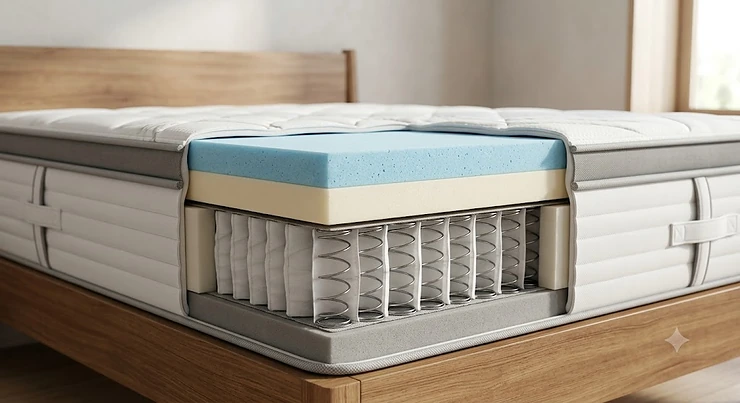
A foam and spring hybrid mattress is exactly what it sounds like: a comfort layer of memory foam, latex or gel foam sitting on top of a support core of individually wrapped pocket springs, combined to deliver pressure relief without sacrificing bounce, airflow or edge support. If you’ve spent any time browsing Amazon UK’s mattress section, you’ll have noticed hybrids dominate the bestseller lists, and there’s a decent reason for that — they’re the compromise mattress that rarely feels like a compromise at all.
Here’s the bit nobody tells you at the point of sale: not all hybrids are built the same, and the difference between a “budget hybrid” and a “premium hybrid” often comes down to a handful of measurable things — spring count, spring height, foam density and how the layers are stacked. Get those wrong for your body weight and sleep position, and you’ll end up with a mattress that either sags within eighteen months or never quite lets you sink in. NHS guidance on posture and pain also flags a supportive sleep surface as one of the simple things worth checking if you wake up with a stiff neck or back, so this isn’t purely a comfort question.
This guide walks through seven genuine, currently available UK hybrid mattresses spanning budget, mid-range and premium price points, breaks down what their specs actually mean in practice, and gives you a proper decision framework so you’re not just guessing based on a five-star average.
Quick Comparison Table
| Mattress | Best For | Firmness | Depth |
|---|---|---|---|
| Amazon Basics Hybrid Mattress | Tightest budgets, guest rooms | Medium-soft | 22cm |
| Silentnight 800 Pocket Memory Foam Mattress | UK-made value, side sleepers | Medium | ~24cm |
| Emma Original Hybrid Mattress | Combination sleepers, first-time hybrid buyers | Medium | 22cm |
| Otty Original Hybrid Mattress | Hot sleepers wanting deep springs | Medium-firm | 25cm |
| Nectar Premier Hybrid Mattress | Couples, motion isolation | Medium-firm | 28cm |
| Simba Hybrid Mattress | Hot sleepers, zoned support | Medium | 25cm |
| Simba Hybrid Pro Mattress | Premium buyers, back and stomach sleepers | Medium-firm | 28cm |
Looking at the spread above, there’s a clear correlation between depth and price: the thinner budget models top out around 22cm, while the premium end pushes past 28cm with multiple spring layers doing the heavy lifting. That extra depth isn’t just marketing padding — it translates into better weight distribution for heavier sleepers and couples, and generally a longer functional lifespan before the foam starts to lose its rebound. If you’re under 13 stone and sleeping solo, the thinner end of this table will likely serve you just as well as the premium models, so don’t assume more centimetres automatically means better sleep for your specific situation.
💬 Already got a favourite from the table? Scroll down to see exactly why it made the cut — or jump straight to the full breakdown below!😊
Top 7 Foam and Spring Hybrid Mattresses: Expert Analysis
1. Amazon Basics Hybrid Mattress — best budget pick under £250
The Amazon Basics Hybrid Mattress strips the category back to its essentials, and that’s precisely why it’s worth a look if you just need a decent bed without the marketing gloss. At 8.66 inches (roughly 22cm), it pairs a plush quilted top with pocket springs and pressure relief foam, and it’s manufactured in the UK to BS7177 low-hazard fire safety requirements. What most buyers overlook about own-brand mattresses like this is that the fundamentals — spring encapsulation and a genuine foam comfort layer rather than a thin quilted skin — are present here, even if the layer count and zoning sophistication of pricier hybrids isn’t.
Based on the spec sheet, this is a straightforward two-layer construction rather than the five-to-eight-layer builds you’ll see further down this list, which keeps the price down but also caps how much pressure relief it can offer heavier or side-sleeping bodies. Reviewers consistently note that it performs well as a guest room or first-flat mattress, with solid short-term comfort, though several mention firmness softening faster than premium alternatives after a year or so of nightly use. It’s a sensible pick for students, spare rooms, or anyone testing whether hybrid construction suits them before committing to a bigger spend.
Pros:
- ✅ One of the cheapest genuine hybrids on Amazon UK
- ✅ BS7177-compliant and made in the UK
- ✅ Breathable quilted finish suits most sleeping positions
Cons:
- ❌ Thinner foam layer than mid-range and premium hybrids
- ❌ Less durable long-term support for heavier sleepers
At under £250 for most sizes, the Amazon Basics Hybrid Mattress represents solid value if your budget is the deciding factor and you don’t expect a decade of use from it.
2. Silentnight 800 Pocket Memory Foam Mattress — best UK-made budget hybrid
The Silentnight 800 Pocket Memory Foam Mattress uses Silentnight’s Mirapocket spring system with 800 individually wrapped springs beneath a memory foam comfort layer, and it’s handmade in the UK by one of the country’s longest-established bed brands. In practice, 800 springs at this price point is a genuinely respectable count — enough for the springs to respond individually to your body weight rather than working as one rigid unit, which is the whole point of choosing a pocket-sprung construction over an old-style continuous coil.
What the spec sheet won’t tell you, but reviewers note, is how noticeably this mattress reduces “roll-together” compared with a basic foam mattress, making it a sensible choice for couples on a budget who don’t want to feel every movement their partner makes. The medium comfort grade suits side sleepers particularly well, cushioning the shoulder and hip without the springs pushing back too hard. Aggregated customer feedback on Amazon and Silentnight’s own site tends to highlight the soft-knit cover and hypoallergenic finish as pleasant extras, with a smaller number of reviewers noting the memory foam layer runs warmer than the fully sprung Miracoil range in Silentnight’s line-up.
Pros:
- ✅ 800 Mirapocket springs at a genuinely budget price
- ✅ Handmade in the UK to BS7177 low-hazard standards
- ✅ Strong motion isolation for the price bracket
Cons:
- ❌ Memory foam layer can sleep warmer in summer
- ❌ Firmness may feel too soft for larger stomach sleepers
Priced in the £200-£300 range depending on size, the Silentnight 800 Pocket Memory Foam Mattress is one of the more credible budget hybrids currently available on amazon.co.uk.
3. Emma Original Hybrid Mattress — best all-rounder for combination sleepers
The Emma Original Hybrid Mattress is one of Emma’s best-selling models for good reason: it pairs Airgocell foam with a 3-zone pocket spring layer at 22cm total depth, aiming squarely at buyers who switch positions through the night. Airgocell is Emma’s own open-cell foam, designed to move more air through the structure than standard memory foam, and based on the spec comparison, that’s a meaningful difference for anyone who currently overheats on an all-foam bed.
The 3-zone spring layout gives firmer support under the hips and shoulders while staying softer at the head and legs, which is the kind of targeted zoning that used to be reserved for premium mattresses. Reviewers consistently note that the medium feel strikes a genuinely neutral balance — not too soft for back sleepers, not too firm for side sleepers — which explains why it’s frequently recommended as a first hybrid purchase for people unsure of their preferred firmness. A smaller cluster of aggregated reviews flag that heavier stomach sleepers (16 stone plus) may find it lacks the firmness needed to prevent hip sink.
Pros:
- ✅ Airgocell foam noticeably reduces heat build-up
- ✅ 3-zone springs suit combination sleepers well
- ✅ 200-night trial and 10-year guarantee as standard
Cons:
- ❌ Too soft for heavier stomach sleepers
- ❌ Edge support weaker than deeper premium hybrids
Typically found in the £250-£400 range for a double, the Emma Original Hybrid Mattress is a dependable mid-range entry point into hybrid sleeping.
4. Otty Original Hybrid Mattress — deepest springs for the price
The Otty Original Hybrid Mattress is built around up to 2,000 encapsulated pocket springs measuring a full 16cm in height, topped with heat-regulating, high-density memory foam across a 25cm total depth. Here’s what most buyers overlook: spring height matters almost as much as spring count, because taller springs compress over a longer distance, giving more nuanced, incremental support as your body sinks in, rather than bottoming out quickly against a shallow spring bed.
Based on the spec comparison with rivals at a similar price, Otty’s 16cm springs genuinely stand out — most competitors in this bracket use 12-14cm springs. Reviewers consistently report the mattress “holds its shape” for years rather than developing the visible body impressions common with all-foam alternatives, and the brand’s own airflow system does seem to earn its keep, with aggregated feedback describing it as noticeably cooler than typical memory foam mattresses. On the downside, several reviewers note the medium-firm feel edges towards firm, which won’t suit every side sleeper.
Pros:
- ✅ Full 16cm pocket springs, taller than most rivals
- ✅ Bamboo and charcoal foam variants add antibacterial properties
- ✅ Frequently discounted well below RRP
Cons:
- ❌ Firmer feel may not suit lighter side sleepers
- ❌ Shorter 100-night trial than most direct competitors
Sold from around £400-£600 at typical sale pricing for a double, the Otty Original Hybrid Mattress offers some of the deepest, most substantial springs you’ll find below the premium tier.
5. Nectar Premier Hybrid Mattress — best motion isolation for couples
The Nectar Premier Hybrid Mattress takes a genuinely unusual approach among hybrids: it stacks two separate spring layers — a layer of smaller micro springs and a second layer of up to 832 individually wrapped 12cm pocket springs — beneath gel-infused memory foam, across a substantial 28cm depth. What the spec sheet doesn’t immediately convey is why two spring layers beats one: each layer compresses independently, so pressure gets absorbed in stages rather than all at once, which is a large part of why this model tests so well for motion isolation.
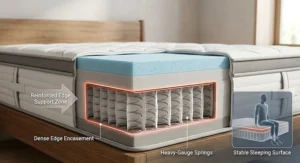
Reviewers consistently note that partners can move, turn over or get out of bed without disturbing the other sleeper nearly as much as on single-spring-layer hybrids — a genuinely useful trait if you share a bed with a restless sleeper. Independent testing has found the reinforced edge coils create a more usable sleeping surface, since the perimeter doesn’t collapse when you sit on the side of the bed. The trade-off, based on aggregated feedback, is that edge support while lying (rather than sitting) is still weaker than some rivals, and the cover isn’t machine washable, only removable during manufacturing.
Pros:
- ✅ Dual spring layers deliver excellent motion isolation
- ✅ Reinforced edge coils improve usable sleeping surface
- ✅ Long trial period gives genuine time to adjust
Cons:
- ❌ Cover isn’t washable at home
- ❌ Edge support while lying down is only average
Positioned in the £600-£900 range for a double, the Nectar Premier Hybrid Mattress earns its upper-mid-range price through genuinely differentiated spring engineering rather than marketing alone.
6. Simba Hybrid Mattress — best airflow for hot sleepers
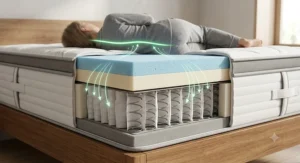
The Simba Hybrid Mattress uses Simba’s own graphite-infused Simbatex foam as its comfort layer, sitting on top of up to 2,000 conical Aerocoil mini pocket springs across a 25cm depth with nine zones of support. Simbatex is an open-cell foam, and based on the spec comparison, open-cell structures allow substantially more airflow than closed-cell memory foam — Simba themselves claim roughly thirty times the airflow, which lines up with what reviewers consistently report about this mattress sleeping notably cooler than traditional memory foam beds.
The conical shape of the Aerocoil springs is worth understanding in practical terms: a cone compresses more easily at the narrow top than a straight-sided coil, so the springs respond individually to lighter pressure points (like a shoulder) while still providing firmer resistance as body weight increases. Nine zones of support means the springs are engineered to feel different under your hips versus your legs, aiming to keep the spine aligned regardless of position. Aggregated reviews are largely positive on comfort and cooling, though a recurring theme is that this mattress is genuinely heavy to manoeuvre once assembled, which matters if you’re setting it up alone.
Pros:
- ✅ Graphite-infused foam sleeps noticeably cooler
- ✅ Up to 2,000 conical mini springs, nine support zones
- ✅ Washable, removable cover
Cons:
- ❌ Heavy and awkward to move or rotate solo
- ❌ Pricier than most mid-range hybrid competitors
Generally priced in the £700-£900 bracket for a double, the Simba Hybrid Mattress is a strong pick specifically for anyone whose main complaint about foam mattresses is overheating.
7. Simba Hybrid Pro Mattress — best premium multi-zone support
The Simba Hybrid Pro Mattress sits at the top of Simba’s hybrid range: a 28cm-deep, seven-internal-layer construction featuring a top layer of British wool, graphite-infused Simbatex foam, and a dual layer of up to 4,800 titanium alloy Aerocoil microsprings split across thirteen zones. Here’s what most buyers overlook — doubling the spring layer (rather than just increasing the count within one layer) changes how the mattress behaves under load, since the top spring layer handles fine-grained pressure relief while the second layer underneath provides the structural backbone that stops you bottoming out.
Based on the spec comparison against the standard Simba Hybrid Mattress, the Pro’s extra spring layer and natural wool topper are the two biggest functional upgrades, and reviewers consistently note the wool adds a genuinely different, more breathable surface feel than foam-only tops. Independent testing has rated this model highly for edge support and durability, attributing that to the reinforced perimeter coils. The thirteen support zones are arguably more granular than most sleepers need — even reviewers who rate the mattress highly note that the difference between, say, zone six and zone seven is barely perceptible in practice, which is worth bearing in mind before paying a premium purely for zone count.
Pros:
- ✅ Dual Aerocoil spring layers, up to 4,800 springs
- ✅ Natural wool top layer improves breathability
- ✅ Strong edge support and 10-year guarantee
Cons:
- ❌ Among the heaviest hybrids to lift and rotate
- ❌ Highest price point in this line-up
Typically retailing from around £900 and upward for a double, the Simba Hybrid Pro Mattress is the mattress to choose if budget isn’t the limiting factor and you want the most engineered hybrid construction available.
Setting Up and Caring for Your New Hybrid Mattress
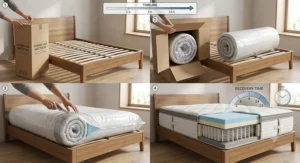
Getting a boxed hybrid right in the first month makes a real difference to how it performs for the following decade, so it’s worth doing properly rather than just unrolling it and climbing straight in. First, unbox the mattress in the room it’ll actually be used in — compressed hybrids are heavy and awkward to carry once expanded, and manoeuvring a 25kg-plus mattress up a staircase is far harder than carrying the compressed roll.
Once unwrapped, most hybrids need 24 to 72 hours to fully expand and off-gas any manufacturing smell, so resist sleeping on it immediately even if it looks ready after a few hours. Use a solid platform or a close-slatted base with gaps no wider than roughly 7.5cm; wider slats allow pocket springs to push through over time, which is a surprisingly common cause of premature sagging that has nothing to do with the mattress itself. In the first 30 days, rotate the mattress head-to-foot every couple of weeks (not side-to-side, since hybrids aren’t usually designed to be flipped) to encourage even settling across the spring layer.
A common first-month mistake is judging firmness too early — foam needs a short adjustment period to reach its intended feel, and several nights of “this feels harder than expected” is normal before it settles. Keep a breathable mattress protector on from day one, since most warranties are void if stains or damage affect the cover, and vacuum the surface every couple of months to reduce dust mite build-up, which particularly matters for anyone with allergies or asthma.
Which Hybrid Suits You? Real Sleeper Profiles
If you’re a student moving into your first flat on a tight budget, sleeping alone, and mainly need something that won’t fall apart within a year, the Amazon Basics Hybrid Mattress or Silentnight 800 Pocket Memory Foam Mattress cover the basics without overspending on features you won’t use, like elaborate multi-zone support designed for shared beds.
If you’re a couple in your thirties sharing a bed, one of you runs hot at night, and you’re tired of feeling every time your partner turns over, look toward the Nectar Premier Hybrid Mattress or Simba Hybrid Mattress. The dual-spring motion isolation and graphite cooling foam in these models are specifically engineered for exactly this scenario, and the extra spend is justified by genuinely different sleep quality for two people rather than one.
If you’re in your fifties or sixties, dealing with the beginnings of hip or shoulder discomfort, and prioritising long-term support over price, the Simba Hybrid Pro Mattress or Otty Original Hybrid Mattress offer the deepest, most zoned spring construction in this line-up. Both have been engineered specifically around pressure point relief through varied spring compression, which matters more the longer you spend lying on your side.
Understanding Hybrid Mattress Construction: The Terms Worth Knowing
Mattress listings throw around a lot of jargon, so here’s what the recurring terms actually mean when you’re comparing a foam and spring hybrid mattress against the alternatives.
Foam Top Spring Mattress
A foam top spring mattress simply describes the basic hybrid layout: a foam comfort layer sitting directly above a spring support core, rather than springs alone or foam alone. The key variable buyers should check is foam thickness — a foam top spring mattress with only 2-3cm of foam will feel far closer to a traditional pocket-sprung bed, while 6cm or more starts to feel genuinely close to an all-foam mattress with springs underneath for support.
Spring Base Memory Foam Mattress
Sometimes marketed the other way around, a spring base memory foam mattress puts the emphasis on the foam as the dominant comfort material, with the spring base doing structural work rather than shaping feel. This construction tends to suit people who love the “hug” of memory foam but were previously put off by poor airflow, since the spring base underneath restores much of the ventilation that pure foam blocks.
Comfort Layer Depth
Comfort layer depth is arguably the single most useful spec to compare across mattresses, and it’s frequently buried in product descriptions rather than headlined. A comfort layer under 4cm generally won’t provide meaningful pressure relief for anyone over 12 stone, while depths of 6-8cm (as seen on several premium models above) allow genuine body contouring without the sleeper bottoming out against the firmer support layer beneath.
Pocket Spring Foam Hybrid
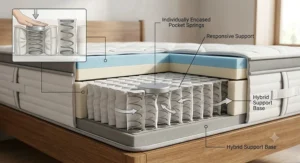
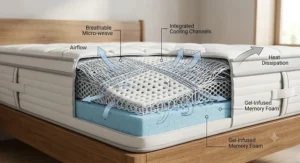
The term pocket spring foam hybrid specifically refers to individually wrapped (encapsulated) springs, as opposed to older interconnected coil systems. Individual encapsulation is what allows each spring to compress independently in response to localised pressure, which is the entire mechanical reason hybrids reduce motion transfer and contour to body shape better than continuous-coil designs.
Dual Layer Mattress Construction
Dual layer mattress construction, seen in models like the Nectar Premier Hybrid Mattress and Simba Hybrid Pro Mattress, means two distinct spring layers rather than one. This is a genuine engineering upgrade rather than a marketing flourish: the upper layer (often smaller micro springs) handles fine pressure adaptation, while the lower layer provides the structural depth that prevents sagging over years of use.
How to Choose a Foam and Spring Hybrid Mattress
- Start with your sleeping position, not the mattress firmness rating. Side sleepers generally need medium to medium-soft hybrids for shoulder and hip relief, while back and stomach sleepers usually need medium-firm to firm for spinal support.
- Check comfort layer depth before spring count. A high spring count with a thin foam layer will feel firmer and less contoured than moderate springs paired with 5cm-plus of quality foam.
- Match spring height to your body weight. Taller springs (14cm-plus, as in the Otty Original Hybrid Mattress) compress more gradually, which benefits heavier sleepers who need support without harsh pushback.
- Consider whether you sleep with a partner. Dual-layer spring construction meaningfully reduces motion transfer, which matters far more for couples than solo sleepers.
- Factor in heat regulation if you run hot. Graphite-infused or open-cell foams (Simbatex, Airgocell) genuinely outperform standard memory foam on temperature, based on aggregated reviewer feedback across multiple brands.
- Read the trial period and returns policy carefully. A 100-night trial (Otty) versus 200 nights (Emma, Simba, Nectar) is a meaningful difference given how long foam takes to fully reveal its long-term feel.
- Check the base compatibility before buying. Slat spacing wider than roughly 7.5cm can cause premature spring failure regardless of how good the mattress itself is.
Foam and Spring Hybrid vs All-Foam Mattress: What Really Changes
| Factor | Foam and Spring Hybrid | All-Foam Mattress |
|---|---|---|
| Airflow | Generally cooler, springs allow air movement | Can trap heat, especially closed-cell memory foam |
| Edge Support | Stronger, especially with reinforced perimeter coils | Weaker, foam compresses at edges |
| Motion Isolation | Good with encapsulated/dual springs | Excellent, foam absorbs movement well |
| Responsiveness | Bouncier, easier to move on | Slower-moving, can feel like sinking in |
| Typical Lifespan | 8-15 years depending on spring quality | 6-10 years, foam compresses over time |
The clearest takeaway from this comparison is that hybrids win decisively on airflow and edge support — the two areas where all-foam mattresses have historically struggled the most, and which matter enormously if you sleep hot or perch on the edge of the bed to get dressed. All-foam mattresses still edge ahead on pure motion isolation, since there’s no spring mechanism at all to transmit movement, which is why a genuinely restless partner might still prefer something like the Amazon Basics Hybrid Mattress upgraded with a thicker topper rather than a spring-heavy premium hybrid. If you’ve previously owned an all-foam bed and found it too warm, a hybrid is very likely to solve that specific complaint without you having to sacrifice much pressure relief.
✨ Ready to compare real prices on today’s picks? Tap any highlighted mattress above to check current availability!
Common Mistakes When Buying a Foam and Spring Hybrid Mattress
Buying based on spring count alone, ignoring depth, is the most frequent mistake — a mattress boasting “2,000 springs” tells you very little if those springs are only 8mm tall and paper-thin foam sits on top. Equally common is guessing firmness from a star rating rather than checking the brand’s own firmness scale, since “medium” from one manufacturer can feel notably different from “medium” at another.
Many buyers also skip checking their bed base compatibility entirely, then blame the mattress when it sags within a year on an incompatible slatted frame. Another recurring error is buying based purely on the lowest price without checking trial length — a mattress that feels fine in week one but wrong by week six is a false economy if the return window has already closed. Finally, some buyers assume “hybrid” always means better than all-foam or all-spring alternatives; as the comparison table above shows, it’s a genuine trade-off rather than a universal upgrade, and the right choice always depends on your specific sleeping position and body weight.
Long-Term Cost, Lifespan and Maintenance
Budget hybrids under roughly £400 typically last around six to eight years before the foam compression becomes noticeable enough to affect support, while mid-range models in the £500-£900 bracket generally hold up for eight to twelve years thanks to deeper, better-encapsulated spring layers. Premium hybrids with reinforced coils and higher-density foams, such as the Simba Hybrid Pro Mattress, can realistically stretch toward fifteen years with regular rotation and a supportive base.
Working out cost-per-use makes the maths clearer than sticker price alone: an £800 hybrid lasting twelve years (roughly £67 a year, or about 18 pence a night) is arguably better value than a £250 mattress replaced every six years (roughly £42 a year, but with the hassle and disruption of more frequent replacement, plus a worse sleep surface toward the end of its life). Maintenance costs stay low across the board — a breathable protector, occasional vacuuming and periodic rotation are the only real ongoing requirements — but disposal is a genuine long-term consideration too. The National Bed Federation’s own data shows real recycling rates for old mattresses have climbed sharply in recent years, though a majority still end up landfilled or incinerated, so checking your local council’s mattress recycling options before replacement day is worth the ten minutes it takes.
Safety, Fire Regulations and Compliance
Every mattress legally sold in the UK, hybrid or otherwise, must meet flammability requirements originally set out under the Furniture and Furnishings (Fire) (Safety) Regulations, with BS 7177 governing the specific ignition-resistance testing for mattresses, mattress pads and bed bases. The government’s own guidance confirms that recent updates to these regulations still expect manufacturers to demonstrate compliance with recognised standards even as the regulatory framework evolves, so it’s worth checking that any hybrid you’re considering explicitly states BS7177 or equivalent compliance on its listing.
In practice, every mattress featured in this guide is BS7177-compliant, as required for any product legally sold in the UK. It’s a detail worth actively checking on lesser-known or unbranded listings, since imported mattresses without proper UK compliance labelling have occasionally turned up on third-party marketplace listings. Beyond fire safety, look for CertiPUR or OEKO-TEX certification on the foam layers specifically, which confirms the foam has been independently tested against a list of regulated chemicals rather than simply trusting a manufacturer’s own safety claims.
Frequently Asked Questions
❓ Is a foam and spring hybrid mattress good for back pain?
❓ How long does a foam and spring hybrid mattress last?
❓ What's the difference between a hybrid and a pocket sprung mattress?
❓ Do foam and spring hybrid mattresses sleep hot?
❓ Can I use a foam and spring hybrid mattress on a slatted bed frame?
Conclusion
Choosing a foam and spring hybrid mattress ultimately comes down to matching spring depth, foam thickness and zoning to your specific body weight, sleeping position and budget, rather than chasing the highest spring count or the flashiest marketing claims. Budget options like the Amazon Basics Hybrid Mattress and Silentnight 800 Pocket Memory Foam Mattress genuinely deliver for solo sleepers and spare rooms, while couples or hot sleepers are better served stepping up to the Nectar Premier Hybrid Mattress or Simba Hybrid Mattress for their motion isolation and airflow advantages respectively.
For anyone prioritising long-term durability and willing to pay for it, the Simba Hybrid Pro Mattress and Otty Original Hybrid Mattress offer the deepest, most engineered spring systems in this line-up. Whichever you choose, remember that fire safety compliance (BS7177), foam certification (CertiPUR or OEKO-TEX), and an appropriate bed base matter just as much as the headline comfort specs — get those fundamentals right, and any of the seven mattresses above should serve you well for years to come.
Recommended for You
- Hybrid Mattress Under £500: 7 Genuinely Comfy Picks (2026)
- 7 Best Hybrid Mattress for Heavy People Picks
- Hybrid Mattress for Couples: 7 Best No-Roll Picks (2026)
Disclaimer: This article contains affiliate links. As an Amazon Associate, I earn from qualifying purchases. If you purchase products through these links, we may earn a small commission at no additional cost to you.
✨ Found this helpful? Share it with your friends! 💬🤗
