
In This Article
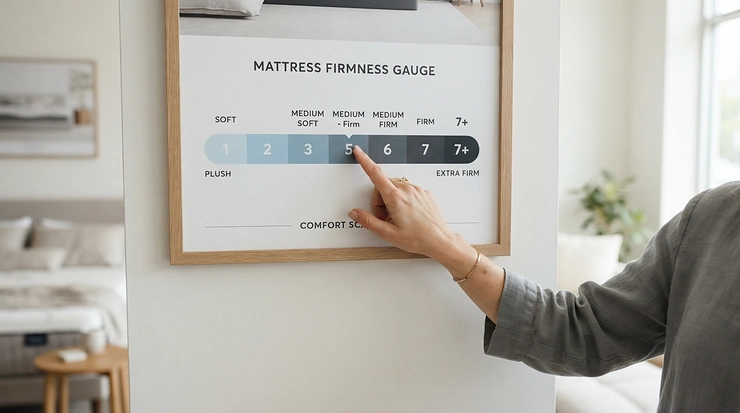
Three in the morning, and you’re doing that slow, careful roll onto your side because your lower back has locked up again. Sound familiar? You’re not imagining it — what you sleep on for seven or eight hours a night has a genuine, measurable effect on how your spine feels by breakfast. A medium firm mattress for back pain is generally defined as a sleep surface rated around 5.5-7 out of 10 on the firmness scale, cushioned enough to relieve pressure at the shoulders and hips, yet supportive enough to stop the lumbar spine sinking out of alignment. It’s the “just right” bed that Goldilocks would have approved of, and it’s backed by more clinical research than almost any other mattress claim on the market.

This guide walks through seven real, currently available medium firm mattress for back pain options sold in the UK — from £170 budget picks to premium hybrids — alongside the honest analysis, comparison data, and practical guidance you need to actually choose well. We’ve dug through verified specs, aggregated review sentiment, and peer-reviewed sleep research rather than repeating marketing copy, because your back deserves better than a rewritten product listing.All seven sit in the medium-firm window sleep scientists recommend, but they get there in very different ways — foam versus springs, budget versus premium build quality.
Quick Comparison
| Mattress | Type | Firmness | Price Range | Best For |
|---|---|---|---|---|
| Zinus Green Tea Memory Foam | All-foam | Medium-firm | Around £170-£400 | Tightest budgets |
| Silentnight Memory 7 Zone | Zoned memory foam | Medium/firm | Around £190-£320 | Orthopaedic support on a budget |
| Emma Original | All-foam | Medium (6.5/10) | Around £310-£900 | All-round back and side sleepers |
| Nectar Memory Foam | Memory foam | Medium-firm (6.5/10) | Around £400-£900 | Long risk-free trial |
| Simba Hybrid | Pocket spring + foam | Medium | Around £430-£740 | Couples, temperature control |
| Otty Original Hybrid | Pocket spring + foam | Medium-firm (7/10) | Around £500-£950 range | Firmer lumbar support |
| Panda Hybrid Bamboo | Pocket spring + foam | Medium-firm (6.5-7/10) | Around £650-£960 | Premium natural materials |
Looking at the spread above, the budget end (Zinus Green Tea Memory Foam and Silentnight Memory 7 Zone) proves you don’t need to spend hundreds to get genuine medium-firm orthopaedic support, but you do trade away some durability and edge support. The mid-range hybrids — Simba Hybrid, Nectar Memory Foam, and Emma Original — represent the sweet spot most back-pain sufferers land on, balancing pressure relief with structural support. At the premium end, Otty Original Hybrid and Panda Hybrid Bamboo justify their higher price tags with denser spring counts and more sophisticated zoning, which matters most if you’re a heavier sleeper or share a bed.
💬 Found this comparison useful? A quick share helps other back-pain sufferers find the right mattress too!
Top 7 Medium Firm Mattresses for Back Pain: Expert Analysis
1. Zinus Green Tea Memory Foam Mattress — best budget entry point for back pain relief
If you’ve ever hesitated to spend £700 on a mattress you’re not sure will suit you, the Zinus Green Tea Memory Foam Mattress is where cautious back-pain sufferers often start. Its memory foam core uses what Zinus calls zoned pressure relief technology, designed to soften under the shoulders and hips while staying denser under the lumbar region — the same basic principle premium brands charge four times as much for.
Available in 15, 20, 25, and 30cm depths, the thicker 25cm and 30cm versions are the ones worth considering for full-time adult use; the shallower options are really too thin to stop you bottoming out on the base. Green tea and charcoal infusions are marketed as odour control rather than anything spine-related, so don’t let that feature sway your firmness decision. On the spec sheet, it’s rated medium-firm, and reviewers largely agree, though the 20cm version runs firmer than the 30cm.
Aggregated Amazon review sentiment for this mattress is unusually large — it consistently ranks among Amazon’s best-selling mattresses, and a majority of reviewers rate it five stars, frequently citing comfort for the price. A recurring theme in lower-starred reviews is weak edge support: sitting near the border of the mattress produces noticeable sinkage, which matters if you perch on the edge to put your socks on each morning.
Pros:
- ✅ Genuinely low entry price for medium-firm support
- ✅ Zoned foam targets hips and shoulders specifically
- ✅ Ships compressed for easy delivery and setup
Cons:
- ❌ Weak edge support compared with hybrid rivals
- ❌ Foam can sleep warmer than pocket-spring alternatives
At around £170-£400 depending on size and depth, this is one of the cheapest routes into a genuine medium-firm sleep surface, and it represents solid value if your budget is the primary constraint rather than luxury features.
2. Silentnight Memory 7 Zone Mattress — best budget orthopaedic zoning
Silentnight has been manufacturing mattresses in the UK for more than 60 years, and the Silentnight Memory 7 Zone Mattress is its answer to targeted lumbar support at a genuinely accessible price. The name refers to seven distinct support zones running head to toe, softer at the shoulders, firmer through the lower back, designed so your spine doesn’t dip out of its natural curve while you sleep.
At roughly 20cm deep, it’s built around a Miratex foam core topped with a memory foam comfort layer, and it carries National Bed Federation approval along with Allergy UK certification for its hypoallergenic cover. What that means in practice: the mattress meets recognised UK manufacturing and hygiene standards rather than relying purely on marketing claims. It’s rated medium to firm — reviewers on Amazon place it firmly in the “supportive” camp rather than plush.
Aggregated customer reviews describe a mattress that performs well above its price point for back and joint discomfort, with several buyers specifically comparing it favourably to premium memory foam brands costing several times as much. A common complaint in user reviews is that the mattress needs a full 48 hours to decompress and reach its true feel after unboxing, and first impressions during that window can be misleadingly firm.
Pros:
- ✅ Seven-zone design targets the lower back specifically
- ✅ National Bed Federation and Allergy UK approved
- ✅ Removable, washable cover for hygiene
Cons:
- ❌ Needs 48 hours to fully expand and soften
- ❌ Guarantee period shorter than premium rivals (typically 5 years)
Priced from around £190 up to the low £300s depending on size, this is arguably the best-value orthopaedic-style option on this list for anyone who wants zoned support without hybrid-mattress pricing.
3. Emma Original Mattress — Which? Best Buy with proven all-round support
Few mattresses in the UK carry the independent credibility of the Emma Original Mattress, which has been named a Which? Best Buy for six consecutive years. That’s not an award Emma gives itself — Which? runs its own lab and panel testing, which lends real weight to the medium-firm claim rather than it being purely brand messaging.
Constructed from three foam layers under a temperature-regulating UltraDry cover, the Emma Original uses Point Elastic Airgocell foam paired with Halo Memory Foam and a High Resiliency Extra (HRX) support base. Independent weight testing found the mattress sank around 7-8cm under a 25kg load at both the centre and edge — a small gap between those two figures indicates fairly even support across the usable surface, useful if you don’t always sleep dead-centre. Firmness sits around 6-6.5 out of 10, technically medium rather than medium-firm, though most testers describe it as sitting right at the boundary.
Reviewers consistently note strong pressure relief and excellent motion isolation, making it a popular choice for couples where one partner has back pain and the other doesn’t want to feel every toss and turn. A recurring theme in aggregated feedback is that the mattress can retain some warmth overnight, and edge support is softer than the hybrid options on this list — useful context if you tend to sit on the mattress edge.
Pros:
- ✅ Six-time Which? Best Buy, independently verified
- ✅ Excellent motion isolation for shared beds
- ✅ 200-night trial and 10-year guarantee included
Cons:
- ❌ Can sleep warmer than hybrid alternatives
- ❌ Softer edge support than pocket-spring designs
Prices typically range from the low £300s for a single up to the high £800s for a super king, with frequent promotional discounts bringing the RRP down considerably — always check current pricing before buying.
4. Nectar Memory Foam Mattress — longest trial period for testing your back’s response
Choosing a mattress for chronic back pain is a gamble unless you can actually sleep on it for weeks, which is exactly the problem the Nectar Memory Foam Mattress addresses with its 365-night trial — a full year, compared with the 100-200 nights most competitors offer. For back pain specifically, where improvement research shows benefits building progressively over the first month, that extended window has genuine practical value rather than being a marketing gimmick.
The mattress is built from CertiPUR-certified memory foam across a 25cm profile, rated medium-firm at roughly 6.5 out of 10. Unlike some all-foam beds, Nectar pairs its comfort layer with a cooling cover engineered to offset the heat retention memory foam is traditionally known for. Reviewers report that it sleeps noticeably cooler than older-generation foam mattresses, though it’s still not as breathable as a pocket-spring hybrid.
Aggregated review sentiment across UK and US buyers is strongly positive, with many customers specifically citing reduced back, hip, and shoulder discomfort after the switch. What most buyers overlook about the Nectar is its “Forever” warranty structure, which covers the mattress for as long as you own it rather than a fixed 10-year term — a detail worth factoring into long-term value calculations even though it doesn’t affect night-to-night comfort.
Pros:
- ✅ 365-night trial, longest of any mattress on this list
- ✅ Forever warranty rather than a fixed term
- ✅ Cooling cover addresses typical foam heat retention
Cons:
- ❌ No side handles, making rotation trickier
- ❌ Sits at the pricier end for an all-foam mattress
Expect to pay from roughly £400 for a single up to the high £800s for a super king, though Nectar rarely sells at full RRP and regular promotions are common.
5. Simba Hybrid — best pocket-spring support for temperature-sensitive sleepers
If pure foam beds have ever left you overheating at 2am, the Simba Hybrid solves that with its combination of graphite-infused Simbatex foam and up to 1,900 titanium alloy Aerocoil pocket springs arranged across nine zones. The springs do the structural heavy lifting for spinal support, while the thinner foam layer on top contours around pressure points without smothering airflow the way an all-foam bed can.
At 25cm deep and rated medium, this is a genuinely British-made product, manufactured domestically with a removable, washable knitted cover. The nine-zone spring layout is specifically engineered to provide firmer support under the lumbar region and hips, while remaining softer under the shoulders — precisely the zonal principle spinal-alignment research points to as beneficial. Reviewers consistently note the mattress feels noticeably cooler overnight than comparable foam-only beds, a direct result of the open coil structure allowing air to circulate.
Aggregated customer feedback is very strong, with an average rating around 4.8 out of 5 across thousands of verified reviews. A common theme among back-pain sufferers specifically is that couples appreciate the low motion transfer despite the spring construction — you’d expect springs to bounce more than foam, but Simba’s independently pocketed design largely prevents that.
Pros:
- ✅ British-made with nine-zone spring support
- ✅ Sleeps notably cooler than all-foam rivals
- ✅ Strong motion isolation despite spring construction
Cons:
- ❌ Heavier than foam-only mattresses, harder to rotate
- ❌ Firmer feel may not suit lighter side sleepers
Pricing for the standard Hybrid ranges from around £430 for a single to the mid-£700s for a king, with the step-up Hybrid Pro and Luxe models costing considerably more for additional spring layers.

6. Otty Original Hybrid — firmest option for dedicated lumbar support
Among the mattresses on this list, the Otty Original Hybrid sits at the firmer end of medium-firm, rated around 7 out of 10 by independent testers — noticeably firmer than the Emma or Simba. For back-pain sufferers who’ve found softer medium mattresses let their hips sink too far, this extra structure is often exactly what closes the gap.
Its 25cm construction layers up to 2,000 encapsulated pocket springs beneath heat-regulating memory foam and a high-density support layer, finished with a removable, washable cover. Independent reviewers who tested it specifically for back pain reported that the firmer surface supported the hips and lumbar area well when lying on the back, though it took an adjustment period for sleepers used to plusher beds. The AirFlow perforation system is designed to counteract the heat retention typical of denser foam layers.
Reviewers consistently frame this as a mattress built for combatting back pain rather than simply a comfortable all-rounder, with several noting it rivals far more expensive premium hybrids on support alone. A recurring theme in aggregated feedback is that it may feel too firm for petite or lightweight side sleepers, who report pressure build-up at the shoulder without the same forgiving sink that a softer medium bed provides.
Pros:
- ✅ Firmest medium-firm option, ideal for hip/lumbar support
- ✅ Up to 2,000 encapsulated pocket springs
- ✅ Strong motion isolation for shared beds
Cons:
- ❌ May feel too firm for lightweight side sleepers
- ❌ Heavier construction makes rotation more effort
At full RRP the Otty Original Hybrid runs from around £500 to the mid-£900s for larger sizes, though it is very frequently discounted, so it’s worth checking current pricing before committing.
7. Panda Hybrid Bamboo Mattress — premium natural-material hybrid for long-term investment
For back-pain sufferers ready to treat their mattress as a long-term health investment rather than a budget purchase, the Panda Hybrid Bamboo Mattress brings together six layers of construction, including up to 960 individually encapsulated pocket springs and Panda’s proprietary BioCell bamboo-infused foam. The bamboo cover isn’t just cosmetic — it’s genuinely cooler to the touch than the synthetic knits used on cheaper beds, addressing the heat complaints that dog many foam-heavy mattresses.
Rated 6.5-7 out of 10 for firmness, the mattress uses a DualFlex foam layer specifically positioned for spinal alignment above the spring core, following the same zonal logic as the cheaper options on this list but with denser, longer-lasting materials underneath. At 25cm deep with strong edge support reviewers describe as a standout feature, this is one of the few mattresses on this list rated highly for sitting near the mattress edge — a detail that matters if you have mobility considerations alongside back pain.
Aggregated review sentiment is consistently positive on support and cooling, with independent testers specifically praising it for spinal support and pressure relief for back and stomach sleepers. What the spec sheet won’t tell you, but reviewers note, is that unboxing this mattress is more physically demanding than lighter foam-only beds, simply due to its weight and density.
Pros:
- ✅ Bamboo-infused cover genuinely sleeps cooler
- ✅ Strong, reviewer-praised edge support
- ✅ Six-layer build designed for durability
Cons:
- ❌ Among the priciest options on this list
- ❌ Heavy and cumbersome to unbox and rotate
Prices start from around £650 for a single and climb into four figures for larger sizes, positioning it firmly as the premium pick for buyers prioritising materials and longevity over upfront cost.
Practical Usage Guide: Getting the Most From Your New Mattress
Buying the right mattress is only half the job — how you use it in the first month determines whether your back pain actually improves. Fresh out of the box, most memory foam and hybrid mattresses need 24-72 hours to fully decompress and reach their intended firmness; lying on it within the first few hours can feel misleadingly different from how it settles.
For the first 30 days, resist the urge to add a soft topper immediately if the bed feels firmer than expected — research on medium-firm bedding introduction shows that perceived back pain and stiffness continue improving progressively between week one and week four as your body adjusts. A common first-30-days mistake is judging the mattress too early and returning it before the adaptation period completes.
Rotate foam mattresses head-to-toe every three months for the first year (check your specific model’s care guide, as spring hybrids sometimes need less frequent rotation than all-foam beds). Pair your new mattress with supportive pillow placement: a pillow under the knees for back sleepers, or between the knees for side sleepers, meaningfully improves spinal alignment on top of whatever the mattress itself provides.

Real-World Scenarios: Which Mattress Fits Your Situation?
Sarah, 34, side sleeper with sciatica, renting a flat, budget under £300: The Silentnight Memory 7 Zone Mattress suits this profile well — its zoned lumbar support addresses sciatic flare-ups, and the lower price point makes sense for a renter who may need to move the mattress again within a few years.
James, 45, back sleeper, shares a bed, moderate budget around £700: The Simba Hybrid is a strong match here — its motion isolation prevents a restless partner from disturbing sleep, while the medium firmness and cooling springs suit a back sleeper who runs warm at night.
Priya, 58, heavier build, stomach-occasional sleeper, willing to invest £900+: The firmer Otty Original Hybrid or premium Panda Hybrid Bamboo both provide the additional structural support a heavier frame needs to avoid excessive sinkage at the hips, which is the main driver of morning stiffness for stomach and combination sleepers of above-average weight.
Is a Medium Firm Mattress Actually Good for Back Pain? What the Research Says
The short answer, based on the available clinical evidence, is yes — with caveats. A widely cited randomised controlled trial published in The Lancet followed 313 adults with chronic non-specific low back pain and found that medium-firm mattresses outperformed firm mattresses across pain intensity, morning pain, and everyday disability scores. A broader 2021 systematic review covering 39 studies on mattresses and low back pain concluded that medium-firm surfaces consistently promoted better comfort, sleep quality, and spinal alignment across the available literature, regardless of a sleeper’s age, weight, or BMI.
That said, honesty matters here: the review’s authors were explicit that research in this area remains limited relative to how confidently mattresses are marketed as “orthopaedic” solutions. The NHS’s own guidance on back pain doesn’t single out mattress firmness as a primary treatment, instead emphasising staying active, appropriate use of anti-inflammatory medicine, and targeted exercises — a useful reminder that a mattress swap complements rather than replaces those core self-management steps. If your pain persists beyond a few weeks, worsens at night, or comes with numbness, the NHS advises seeing a GP rather than relying on a new bed to resolve it.
Medium vs Firm Mattress for Back Pain: Which Actually Wins?
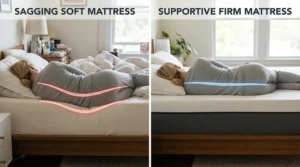
This is one of the most persistent myths in the mattress industry: that a rock-hard bed is automatically better for a bad back. The clinical evidence points the other way. In the Lancet trial referenced above, a genuinely firm mattress performed worse than medium-firm across every measured outcome, likely because excessive firmness prevents the hips and shoulders from sinking enough to keep the spine in its natural, gently curved alignment — instead, it can force the lower back into an unsupported gap.
| Factor | Medium Firm | Firm |
|---|---|---|
| Pressure relief (hips/shoulders) | Strong | Weak to moderate |
| Spinal alignment (side sleepers) | Strong | Often poor — hips can’t sink enough |
| Spinal alignment (stomach sleepers) | Moderate | Better for this position specifically |
| Clinical evidence for back pain | Favourable in RCTs | Less favourable overall |
| Best For | Most back and side sleepers with LBP | Heavier stomach sleepers only |
The exception worth noting: genuinely firm mattresses can still suit specific groups, particularly heavier-build stomach sleepers who need extra resistance to stop their hips sinking into hyperextension. But for the majority of people dealing with lower back pain, particularly side and back sleepers, medium-firm remains the better-supported choice by the available research.
What Firmness Mattress Is Best? A 6-Step Decision Framework
- Identify your dominant sleep position. Side sleepers generally benefit from softer-medium settings that cushion the shoulder and hip; back and stomach sleepers usually need firmer support to prevent lumbar sag.
- Factor in body weight honestly. Heavier bodies compress foam and springs further, so a mattress rated “medium” by the manufacturer may feel closer to “soft” in practice for a larger frame — consider sizing up the firmness rating.
- Consider whether you sleep with a partner. Couples with different firmness preferences or significant weight differences often do better with a hybrid that offers zoned support rather than a single uniform foam slab.
- Check the trial period, not just the firmness number. A longer trial (Nectar’s 365 nights, for example) gives your body genuine time to adapt, since perceived comfort on medium-firm bedding tends to improve over the first month.
- Review real buyer feedback for your body type. Aggregated reviews from sleepers of a similar weight and sleep position are far more predictive of your experience than the marketed firmness number alone.
- Match your budget to your expected lifespan. A well-built medium-firm mattress used nightly for 8 years works out to pennies per night — spending slightly more upfront for durable materials is often the better long-term decision.
Medium Firm Spinal Support: How Zoning Actually Works
The phrase “spinal alignment” gets used loosely in mattress marketing, so it’s worth explaining what’s actually happening mechanically. When you lie on your side, your shoulder and hip are the widest points of your body and need to sink slightly into the mattress surface; if they don’t, your spine bends sideways to compensate, creating strain. When you lie on your back, the lower back needs just enough push-back support to prevent it dropping into an unsupported gap between the mattress and your lumbar curve.
Zoned medium-firm mattresses — like the seven-zone Silentnight, the nine-zone Simba, or the layered foam-over-springs Panda — are engineered with firmer material directly under the lumbar region and softer material under the shoulders, distributing support unevenly on purpose rather than presenting one uniform firmness across the whole surface. This is why a genuinely zoned medium-firm mattress can outperform a uniformly firmer mattress for back pain specifically: it’s solving for pressure distribution, not just overall hardness. Reviewers consistently note this zoning is most noticeable in hybrid designs, where the spring layer itself is arranged into distinct firmness sections, compared with all-foam beds that rely purely on foam density gradients to achieve the same effect.

Sleep Quality on a Medium Firm Mattress: What to Expect
The transition to a new medium-firm mattress rarely feels perfect on night one, and understanding the typical adjustment curve helps set realistic expectations. Based on the sleep-quality research referenced earlier, most sleepers report noticeable but partial improvement within the first week, with the fuller benefit — reduced morning stiffness, fewer night-time position changes, less reported pain — building progressively over the following three weeks as muscles and joints adapt to the new support pattern.
Expect some initial off-gassing smell with new foam mattresses (harmless but noticeable for 24-48 hours), a settling-in period where the mattress may feel firmer than its rated number until foam fully expands, and possibly a few nights of unfamiliar sensation as your body recalibrates to a different pressure distribution than your old mattress provided. Sleepers switching from a very soft or very firm old mattress to medium-firm typically report a bigger adjustment period than those making a smaller firmness change. If your back pain or sleep quality hasn’t improved at all after a full month on the new mattress, that’s a genuine signal to reconsider firmness or construction type, not just push through further.
Common Mistakes When Buying a Medium Firm Mattress for Back Pain
Even well-intentioned buyers fall into predictable traps when shopping for back-pain relief. First, judging firmness purely from a manufacturer’s numeric scale rather than accounting for body weight: a “medium” foam bed under a heavier frame behaves like a much softer mattress, while the same bed under a lighter frame behaves firmer than advertised. Second, buying based on a single showroom lie-down test — five minutes of lying on a mattress in a shop tells you almost nothing about how it performs after eight hours, which is precisely why long home trials matter so much for this category.
Third, ignoring your dominant sleep position entirely and choosing whatever firmness a friend or review site rated “best overall” without checking it against your own habits. Fourth, expecting instant results: as covered above, genuine improvement on a new medium-firm mattress tends to build over several weeks, and abandoning a good mattress after three uncomfortable nights often means returning a bed that would have worked. Finally, neglecting the base or foundation underneath the mattress — even the best medium-firm mattress will underperform on a sagging, unsupportive divan or slatted base with wide gaps.
Long-Term Cost & Maintenance: What You’re Really Paying For
A mattress priced at £700 with a genuine 8-year lifespan works out to roughly 24 pence per night — cheaper than a coffee, and arguably better value given how much of your daily function depends on quality sleep. Compare that to a £250 budget mattress that sags and needs replacing after 3 years: at roughly 23 pence per night, the raw cost-per-use is similar, but you’ve absorbed the hassle, landfill impact, and disrupted sleep of two purchases and two adjustment periods instead of one.
Maintenance genuinely extends lifespan across every mattress type on this list. Rotating foam mattresses every three months for the first year prevents uneven body-impression wear; using a breathable mattress protector prevents moisture damage that voids most warranties; and vacuuming the surface periodically keeps allergen buildup down, particularly relevant for the Allergy UK-approved Silentnight model. Guarantee length is also a genuine cost signal worth weighing: Nectar’s Forever warranty and the 10-year terms on Simba, Emma, Otty, and Panda all suggest manufacturer confidence in long-term durability, whereas shorter 3-5 year terms on some budget lines are worth factoring into your real cost-per-year calculation.
Safety, Regulations & Fire Compliance Guide
All mattresses sold in the UK, including every product featured in this guide, must comply with the UK’s furniture fire safety regulations, which govern flammability standards for fillings and covers. Look for UKFR certification or explicit fire-retardant claims in the product listing, as this confirms compliance rather than assuming it by default. Foam mattresses sold in the UK should also carry CertiPUR or equivalent certification, confirming the foam is manufactured without certain restricted chemicals and meets specific durability and emissions standards.
For anyone with allergies or asthma, Allergy UK approval (as carried by the Silentnight model featured above) provides an additional layer of assurance around dust mite resistance and hypoallergenic material claims, independently assessed rather than self-certified by the manufacturer. Beyond product certification, the NHS advises seeking urgent medical attention if back pain is accompanied by numbness around the genitals, loss of bladder or bowel control, or sudden severe pain — no mattress, however well-suited, is an appropriate response to those red-flag symptoms.

Frequently Asked Questions
❓ Is a medium firm mattress good for back pain?
❓ What firmness mattress is best for lower back pain?
❓ How long does it take to adjust to a new medium firm mattress?
❓ Can a mattress that's too soft cause back pain?
❓ Should side sleepers choose a softer mattress than back sleepers?
Conclusion
Choosing a medium firm mattress for back pain isn’t about chasing a single “best” product — it’s about matching genuine spinal-support research to your own sleep position, body weight, and budget. The evidence is reasonably consistent: medium-firm surfaces, particularly those with zoned lumbar support like the Silentnight Memory 7 Zone, Simba Hybrid, or Panda Hybrid Bamboo, outperform both very soft and very firm alternatives for most people dealing with chronic low back pain. Budget shouldn’t be a barrier either — the Zinus Green Tea Memory Foam Mattress delivers a legitimate medium-firm feel for a fraction of premium pricing.
Whichever option you choose from this list, give it the full adjustment window before judging it, pair it with sensible pillow placement, and keep an eye on the NHS’s guidance for when back pain warrants a GP visit rather than a new bed. Sleep is one of the few genuinely free treatments available for back pain — it’s worth getting the surface right.
✨ Don’t Miss These Exclusive Deals!
🛏️ Check current pricing and availability on any of the picks above, and take the first step toward pain-free mornings tonight!
Recommended for You
- Medium Orthopaedic Mattress: 7 Best UK Picks for Back Support (2026)
- Mattress for Stomach Sleepers: 7 Genuinely Firm Picks for 2026
- Firm vs Medium Orthopaedic Mattress: 7 Best UK Picks (2026)
Disclaimer: This article contains affiliate links. As an Amazon Associate, I earn from qualifying purchases. If you purchase products through these links, we may earn a small commission at no additional cost to you.
✨ Found this helpful? Share it with your friends! 💬🤗
