
In This Article
Somewhere around 2am, half-asleep and slightly too warm, most of us have had the same thought: is this mattress actually working against me? If you’ve landed on the latex hybrid vs memory foam hybrid debate while trying to answer that question, you’re in good company — it’s one of the most searched mattress comparisons in the UK right now, and for good reason. Both types pair a pocket spring base with a comfort layer on top, but the material sitting under your hips and shoulders changes everything from how quickly you sink in to how warm you wake up.
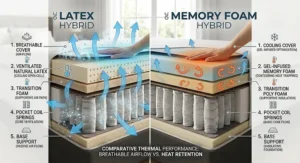
Here’s the short version: a latex hybrid uses natural or synthetic latex — springy, quick to respond, naturally breathable — over a spring core, while a memory foam hybrid uses viscoelastic foam that slowly moulds to your shape and holds it. Neither is objectively “better.” One suits people who want to feel supported on the mattress; the other suits people who want to feel cradled in it. Sleep posture matters here too — the NHS notes that a supportive, well-aligned sleeping surface plays a role in managing back pain, which is exactly why the material under your comfort layer isn’t a trivial detail.
In this guide, we’ve pulled together seven real, currently available UK mattresses spanning both types — budget, mid-range and premium — and broken down exactly what the spec sheets don’t tell you: how each one actually behaves once you’re lying on it, what reviewers consistently report, and which type fits which kind of sleeper. We’ll also get into bounce, response time, long-term cost, and the buying mistakes that trip people up most often. By the end, you should know exactly which side of the latex hybrid vs memory foam hybrid divide you belong on.
Quick Comparison Table: Latex Hybrid vs Memory Foam Hybrid
| Factor | Latex Hybrid | Memory Foam Hybrid |
|---|---|---|
| Response time | Near-instant rebound | Slower, moulds and holds |
| Bounce | High — easier to move on | Low — more “sinking” feel |
| Sleeps cool | Naturally breathable, open-cell | Can run warm without gel/graphite infusion |
| Best for | Back/stomach sleepers, couples, hot sleepers | Side sleepers, pressure-point pain, motion isolation |
| Typical price range | £700–£1,600+ | £150–£1,500+ |
| Longevity | Often 10–15 years | Usually 7–10 years |
Looking at the table, the split really comes down to two things: how fast you need the surface to respond, and how much heat retention you’re willing to tolerate. Dunlopillo Elite Comfort 1400 and Simba GO Hybrid, our latex picks, win on responsiveness and temperature — genuinely useful if you share a bed or run hot at night. On the memory foam side, Simba Hybrid Pro and Emma Premium Hybrid trade some of that bounce for deeper, more targeted pressure relief, which matters more if you carry pain in your hips or shoulders. Budget shoppers shouldn’t assume they’re locked out of hybrid comfort either — Silentnight Mirapocket 1000 and Zinus Cool Support Hybrid both deliver a genuine spring-plus-foam construction well under £500.
💬 Found this comparison useful? A quick share helps other sleepless scrollers find it too!
Top 7 Latex Hybrid and Memory Foam Hybrid Mattresses: Expert Analysis
We’ve deliberately mixed both mattress types below so you can see, product by product, how the material choice plays out in practice — not just in theory.
1. Dunlopillo Elite Comfort 1400 Latex Hybrid — best natural bounce for back and stomach sleepers
Dunlopillo effectively invented latex foam in the late 1920s, and the Dunlopillo Elite Comfort 1400 Latex Hybrid is where that heritage shows most clearly: a generous layer of natural Talalay latex sits over roughly 1,400 individually pocketed springs. In practice, that latex layer contours around your shoulders and hips without the “quicksand” sensation memory foam gives — you rest on top of the surface rather than deep inside it, which is exactly why latex fans describe it as supportive rather than cushioned.
Based on the spec comparison, this is a medium-firm mattress, and the zoned spring layout is genuinely doing work — it’s firmer under the lumbar region and softer at the shoulders, which suits back and stomach sleepers particularly well. Reviewers consistently report that the latex stays cool through the night, a real point of difference from foam-only alternatives, and several buyers specifically mention it as a solid pick for people with mild lower-back stiffness who found traditional pocket sprung beds too unforgiving.
Pros:
- ✅ Natural Talalay latex gives fast, springy rebound
- ✅ Breathable open-cell structure sleeps notably cool
- ✅ Long guarantee period reflects genuine build durability
Cons:
- ❌ Sits at the premium end of the latex hybrid category
- ❌ Heavier construction makes rotating a two-person job
Expect to pay in the region of £900–£1,600 depending on size, and for buyers who specifically want the latex feel rather than foam contouring, Dunlopillo Elite Comfort 1400 Latex Hybrid represents genuinely strong long-term value given latex’s typically longer lifespan.
2. Simba Hybrid Pro — best pressure relief for side sleepers with joint pain
The Simba Hybrid Pro takes the opposite approach: five layers of foam, including a memory-foam-adjacent comfort layer, sit above roughly 5,000 zoned Aerocoil springs. What most buyers overlook about this model is that the coil count isn’t just a marketing number — more, smaller springs mean more precise zoning, so the mattress can be genuinely softer under your shoulders and firmer under your lower back within the same product.
Here’s what to weigh: that foam-forward comfort layer moulds closely around pressure points, which is precisely why side sleepers with hip or shoulder pain tend to respond well to it — the slower response time means less pressure build-up over a full night, at the cost of the quicker “bounce back” you’d get from latex. Reviewers frequently note the wool-and-bamboo cover keeps it sleeping cooler than older all-foam Simba models, though a small number of heavier reviewers describe it as running slightly warm compared with sprung-only mattresses.
Pros:
- ✅ 5,000 zoned Aerocoil springs give targeted support
- ✅ Foam comfort layer excels at hip and shoulder relief
- ✅ Strong motion isolation for couples
Cons:
- ❌ Premium price point compared with other hybrids here
- ❌ Some heavier side sleepers report a warmer feel than latex rivals
Priced roughly £900–£1,500, the Simba Hybrid Pro earns its place as the memory-foam-hybrid benchmark against which the latex options in this list are worth measuring.
3. Emma Premium Hybrid (Hybrid Airgrid) — best all-rounder for cool, even sleep
Marketed under Emma’s Hybrid Airgrid range, the Emma Premium Hybrid pairs seven zones of pocket springs with an airgrid-style cooling foam comfort layer. On paper this means a medium-firm feel engineered to suit “average to light” body weights, and that’s borne out in independent testing: it’s frequently rated as one of the more balanced hybrids on the UK market, doing well across side, back and combination sleeping positions rather than excelling narrowly in one.
The airgrid foam is the interesting bit — it’s designed to move air through the comfort layer rather than trap it, addressing the classic memory foam complaint of sleeping hot. Reviewers consistently note that hot sleepers found it noticeably cooler than typical dense memory foam, even if it can’t quite match latex’s natural breathability. Heavier sleepers (240lb+) may find it a touch soft, and Emma themselves point buyers over that weight toward the firmer Simba alternative instead — a good example of a brand being honest about its own product’s limits.
Pros:
- ✅ Seven-zone springs plus airgrid foam balance support and softness
- ✅ Noticeably cooler than standard memory foam hybrids
- ✅ Well-suited to combination sleepers who change position often
Cons:
- ❌ Only available in one firmness setting
- ❌ Less ideal for sleepers over roughly 240lb
Typically priced from the mid-£300s up to around £1,200 across sizes (watch for seasonal sales, which are frequent), Emma Premium Hybrid is a sensible middle-ground pick if you can’t decide between latex’s coolness and foam’s contouring.
4. Simba GO Hybrid — best eco-conscious latex pick
The Simba GO Hybrid is Simba’s answer to the growing demand for sustainable materials: six layers built around organic latex, GOTS-certified organic cotton, and a mix of new and recycled fibres, all wrapped in a fully recyclable design. What most buyers overlook here is that “eco-friendly” doesn’t come at the cost of performance — the latex layer still delivers the characteristic quick-response bounce that separates this category from foam-only beds.
Based on the spec comparison, the GO Hybrid sits in a similar firmness bracket to the pricier Dunlopillo option but at a more accessible mid-range price, making it a genuine entry point into latex hybrids rather than a premium-only category. Reviewers highlight the breathability of the organic cotton cover and the fact that the mattress arrives via a carbon-neutral delivery service, which matters more to some buyers than others but is a legitimate differentiator in a crowded market.
Pros:
- ✅ Organic, GOTS-certified and fully recyclable materials
- ✅ Genuine latex bounce at a mid-range price point
- ✅ Carbon-neutral delivery is a rare, verifiable eco claim
Cons:
- ❌ Narrower UK retail availability than mainstream Simba lines
- ❌ Costs more than Simba’s standard all-foam mattresses
At roughly £700–£1,200, Simba GO Hybrid is arguably the strongest value pick if “latex hybrid” and “sustainable” both matter to your decision.
5. Panda Hybrid Bamboo Mattress — best for hot sleepers on a budget
The Panda Hybrid Bamboo Mattress blends a bamboo-infused BioCell memory foam comfort layer with seven zones of individually enclosed springs. The bamboo angle isn’t just cosmetic — the open-cell foam structure is specifically engineered to disperse heat, and it’s one of the few memory foam hybrids that consistently earns “sleeps cool” verdicts from independent UK testers, which is normally latex’s home turf.
What the spec sheet won’t tell you, but reviewers note, is that this mattress runs firmer than its “6.5/10” brand rating suggests — testers commonly describe it closer to a 7/10, which makes it a stronger fit for back and stomach sleepers than for lightweight side sleepers, who may find it under-cushioned at the shoulder. The bamboo cover is machine-washable at 30°C, a genuinely practical touch that most competitors in this price bracket don’t offer.
Pros:
- ✅ Excellent, well-documented temperature regulation
- ✅ Washable bamboo cover aids long-term hygiene
- ✅ Seven-zone orthopaedic spring layout for back support
Cons:
- ❌ Firmer in practice than its stated firmness rating
- ❌ Initial off-gassing smell can take several days to clear
Priced from around £550–£1,000 depending on size, Panda Hybrid Bamboo Mattress is the pick if you want memory foam’s contouring but refuse to compromise on sleeping cool.
6. Silentnight Mirapocket 1000 — best genuine hybrid under £400
Not every buyer needs (or wants) to spend four figures on a mattress, and the Silentnight Mirapocket 1000 proves a real spring-and-foam hybrid can exist at true budget prices. It combines roughly 1,000 pocket springs with a foam comfort layer, and its main strength is availability — it’s stocked widely at Argos, Dreams and Mattressman, so it’s rarely hard to find in a sale.
Here’s what to weigh: at this price, you’re getting a thinner comfort layer than the premium options above, so pressure relief is noticeably less pronounced, and there’s only one firmness setting available. That said, reviewers consistently describe it as solid, unremarkable support — exactly what you’d want from an entry-level hybrid rather than a mattress trying to punch above its price bracket with marketing claims it can’t back up.
Pros:
- ✅ Genuine hybrid construction at a true budget price
- ✅ Widely stocked, so sales and discounts are frequent
- ✅ Straightforward, no-frills medium-firm feel
Cons:
- ❌ Only one firmness option available
- ❌ Comfort layer is thinner than mid-range and premium rivals
Typically priced under £500, Silentnight Mirapocket 1000 earns its spot as the sensible first hybrid for anyone upgrading from an old-style spring mattress without wool.
7. Zinus Cool Support Hybrid — cheapest way to try hybrid sleep
The Zinus Cool Support Hybrid is a boxed mattress built around CertiPUR-US-certified cooling gel memory foam over individually wrapped steel coils, and it’s one of the most accessible hybrid entry points available through Amazon. What most buyers overlook is that “boxed and cheap” doesn’t automatically mean flimsy — the certified foam and OEKO-TEX-compliant fabric are the same quality standards used in far pricier mattresses, just applied to a leaner construction.
Based on the spec comparison, the coil gauge is lighter than what you’d find in the premium hybrids above, which is the trade-off for the price: expect a shorter realistic lifespan and a slightly less durable edge. Reviewers commonly describe the unboxing and expansion process as straightforward, and most report the gel-infused foam sleeping cooler than older non-infused memory foam, even if it doesn’t match latex or bamboo-cover alternatives for breathability.
Pros:
- ✅ Genuinely low entry price for a real hybrid build
- ✅ CertiPUR-US certified, OEKO-TEX compliant materials
- ✅ Convenient boxed delivery and straightforward setup
Cons:
- ❌ Lighter coil gauge means a shorter expected lifespan
- ❌ Shorter trial and warranty support than premium UK brands
At around £150–£350 for a double, Zinus Cool Support Hybrid is the mattress to buy if you need hybrid comfort now and simply can’t stretch to the mid-range brands above.
What Is a Latex Hybrid Mattress (and How Does It Differ From Memory Foam)?
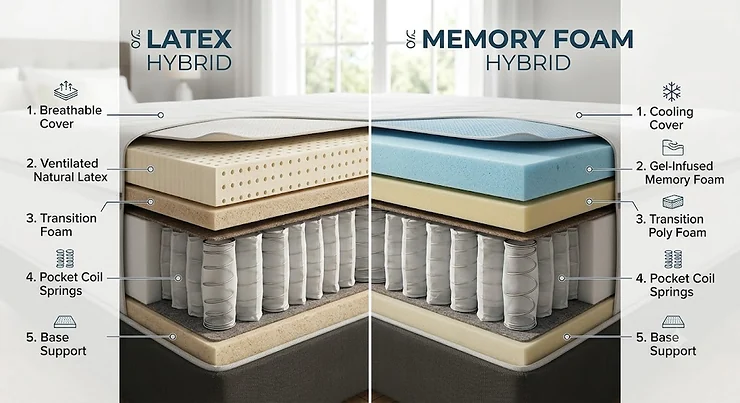
A latex hybrid mattress combines a pocket spring base with a comfort layer made from natural or synthetic latex, giving fast rebound, natural breathability and a supportive “on-top” feel. A memory foam hybrid swaps that comfort layer for viscoelastic foam, which slowly moulds around the body and holds its shape, offering deeper contouring at the cost of some responsiveness and airflow.
The distinction matters because the comfort layer is doing almost all the work your body actually feels — the spring base underneath is broadly similar between the two types. Latex is manufactured either via the Dunlop process (denser, more traditional) or the Talalay process (lighter, more consistent cell structure), while memory foam is a polyurethane foam formulated to be temperature-sensitive, softening slightly where body heat is applied. That’s the source of the “sinking” sensation people either love or hate.
Latex vs Foam Bounce: The Response Time That Actually Matters
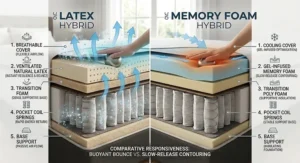
If you’ve ever pressed your hand into a latex mattress and watched it spring back almost instantly, then done the same on memory foam and watched the indentation slowly fill in over several seconds, you’ve already felt the core difference in this comparison. Response time isn’t a marketing footnote — it directly affects how easy a mattress is to move on.
Latex typically recovers its shape in well under a second, which is why couples with different sleep schedules often prefer it: less energy gets absorbed and held, so shifting position (or getting in and out of bed) takes less effort. Memory foam, by contrast, is engineered to respond slowly — that’s precisely what creates its signature “hug.” The trade-off is that a slower response time can make repositioning feel like more work, something reviewers of mattresses like Simba Hybrid Pro occasionally mention, particularly among combination sleepers who move frequently through the night. Neither is a flaw exactly — it’s a design choice, and the right one depends entirely on whether you want a mattress that pushes back or one that holds still.
Hybrid Mattress Type: How the Layers Are Actually Built
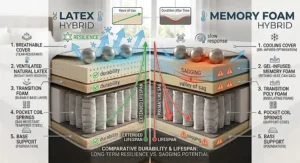
Every hybrid in this guide follows a broadly similar architecture, even though the materials differ. At the base sits a layer of individually pocketed coil springs — typically between 1,000 and 5,000+ depending on the mattress — each wrapped in its own fabric pocket so it moves independently rather than pulling on its neighbours. This is what gives modern hybrids their motion isolation, a meaningful upgrade over older open-coil sprung mattresses.
Above the springs sits the comfort layer: latex, memory foam, or increasingly a blend of both in the same mattress (a “double hybrid,” if you like). Some models, including Emma Premium Hybrid and Panda Hybrid Bamboo Mattress, add a transition layer between spring and comfort foam specifically to prevent the springs being felt through the top layer — a subtle engineering detail that separates well-built hybrids from cheaper imitations. Finally, the cover fabric itself increasingly does real functional work, not just aesthetics: bamboo, wool and phase-change materials are all used specifically to manage temperature, which is why two hybrids with near-identical foam specs can sleep at noticeably different temperatures.
How to Choose Between a Latex Hybrid and a Memory Foam Hybrid
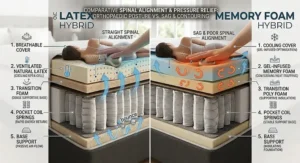
- Check your dominant sleep position first. Side sleepers generally benefit from memory foam’s deeper contouring at the shoulder and hip; back and stomach sleepers usually do better on latex’s firmer, more even support.
- Be honest about how hot you sleep. If you regularly wake up too warm, prioritise latex or a foam hybrid with genuine cooling infusions (gel, graphite, bamboo) — don’t rely on marketing claims alone.
- Factor in your budget realistically. Genuine hybrids exist from roughly £150 upward, so there’s no need to overspend, but expect a real jump in comfort layer quality above the £700 mark.
- Consider who else is in the bed. Latex’s faster response and better motion isolation from independent coils both help couples with mismatched schedules or restless sleepers.
- Think about longevity, not just price. Latex hybrids often last 10–15 years against 7–10 for many foam hybrids, which changes the real cost-per-year even when the upfront price looks higher.
- Read aggregated review sentiment, not star ratings alone. A 4.5-star average tells you little; recurring specific complaints (heat, sagging, firmness mismatch) tell you much more.
- Match firmness to bodyweight, not preference alone. Heavier sleepers generally need a firmer comfort layer and a higher coil count to avoid premature sagging, regardless of material type.
Latex Hybrid Mattress Pros and Cons
Pulling the specific product analysis above into a general verdict: latex hybrids consistently outperform on temperature regulation, responsiveness and estimated lifespan, which is exactly why Dunlopillo Elite Comfort 1400 Latex Hybrid and Simba GO Hybrid carry premium-leaning price tags — the material itself costs more to produce and lasts longer once installed. The trade-off is weight (latex mattresses are notably heavier to rotate) and a firmer, more “on-top” feel that doesn’t suit everyone, particularly petite side sleepers who want deeper cradling.
Where latex hybrids fall short is upfront cost and availability — you’ll find far fewer latex hybrids under £500 than memory foam equivalents, and UK stock tends to concentrate around a handful of specialist brands like Dunlopillo rather than being spread across every mainstream retailer. If budget is the primary constraint, that scarcity alone often settles the latex hybrid mattress pros and cons debate in favour of memory foam by default, regardless of which material would otherwise suit your sleep style better.
Common Mistakes When Buying a Hybrid Mattress
The single most common mistake is chasing firmness numbers rather than firmness feel — a “7/10” from one brand can feel completely different from a “7/10” at another, since there’s no independent industry standard behind the scale. Independent buying guides such as Which?’s mattress reviews exist largely because brand-reported firmness so rarely matches tester experience, which is exactly what several reviewers found with Panda Hybrid Bamboo Mattress running firmer than advertised.
The second frequent error is ignoring trial length and return logistics until after purchase. A 100-night trial sounds generous until you realise most mattresses need 30 nights minimum just to “break in,” leaving a genuinely useful evaluation window far shorter than it first appears. Buyers also commonly under-budget for a mattress protector and proper base — pairing a premium hybrid with an unsuitable divan or slatted base can void warranties and cause premature sagging regardless of how good the mattress itself is.
Hybrid Comparison Guide: Latex vs Memory Foam Head-to-Head
| Criteria | Dunlopillo Elite Comfort 1400 (Latex) | Simba Hybrid Pro (Memory Foam) | Best For |
|---|---|---|---|
| Firmness feel | Medium-firm, springy | Medium, contouring | Back pain vs joint pressure |
| Heat retention | Very low | Low-moderate | Hot sleepers → latex |
| Motion isolation | Good | Very good | Couples → foam |
| Estimated lifespan | 12–15 years | 8–10 years | Longevity → latex |
Read side by side, the table makes the decision fairly concrete: if hip and shoulder pressure relief is your priority, Simba Hybrid Pro‘s deeper contouring and superior motion isolation make it the stronger pick despite a shorter expected lifespan. If you’re a hot sleeper who wants a mattress to last well over a decade, Dunlopillo Elite Comfort 1400 Latex Hybrid‘s combination of breathability and durability justifies the higher upfront cost through a genuinely lower cost-per-year.
🛏️ Ready to Try the Real Thing?
✨ Comparing specs only gets you so far — the fastest way to know which side of the latex hybrid vs memory foam hybrid debate you’re on is a proper night’s sleep. Check current pricing and availability on the mattresses above and see which one actually earns a spot in your bedroom. 🌙
Practical Usage Guide: Breaking In, Rotating and Maintaining Your Hybrid
Both mattress types need a genuine break-in period, and expecting instant perfection is one of the most common sources of disappointed first impressions. Boxed mattresses like Zinus Cool Support Hybrid need up to 72 hours to fully expand, and even non-boxed latex or foam hybrids typically need 30 nights before the comfort layer has fully “settled” to your body and sleep pattern — don’t judge firmness in week one.
Rotation schedules differ by material. Latex hybrids generally only need rotating (head to foot) every 3–6 months rather than flipping, since most are one-sided by design; foam hybrids follow the same rule but benefit from slightly more frequent rotation in the first year while the foam is still fully settling. In both cases, pairing the mattress with a breathable, washable protector from day one is the single highest-value maintenance habit — it prevents moisture and body oils reaching the comfort layer, which is the leading cause of premature sagging in both latex and memory foam alike.
Real-World Scenarios: Which Hybrid Actually Suits Your Life?
If you’re a side-sleeping couple in a warm bedroom with mismatched schedules, Simba Hybrid Pro‘s zoned foam and excellent motion isolation solve two problems at once — hip pressure relief for the side sleeper and undisturbed sleep for the partner who goes to bed later. If you’re a hot-sleeping back or stomach sleeper on a tight student or first-flat budget, Zinus Cool Support Hybrid or Silentnight Mirapocket 1000 deliver genuine hybrid comfort without the premium price tag, even if longevity is more modest.
For an eco-conscious buyer furnishing a forever home who plans to keep the same mattress for a decade or more, Simba GO Hybrid or Dunlopillo Elite Comfort 1400 Latex Hybrid make the most financial sense once you annualise the cost against latex’s longer realistic lifespan. And for anyone specifically shopping with joint pain or a GP-flagged back issue, Emma Premium Hybrid‘s balanced, medium-firm airgrid foam is a sensible starting point precisely because it doesn’t push hard toward either extreme of firmness.
Problem → Solution: Fixing Common Hybrid Mattress Complaints
Problem: waking up too warm. Solution: prioritise latex over standard memory foam, or choose a foam hybrid with verified gel/graphite/bamboo infusion like Panda Hybrid Bamboo Mattress, and pair it with a breathable, natural-fibre protector rather than a plastic-backed one.
Problem: partner disturbance from movement. Solution: individually pocketed coils plus a foam comfort layer (rather than latex’s higher rebound) generally isolates motion best — Simba Hybrid Pro is a strong example.
Problem: persistent shoulder or hip pain on waking. Solution: look for zoned comfort layers specifically engineered to soften under those pressure points rather than uniform-density foam or latex throughout.
Problem: mattress feels firmer than advertised. Solution: always check independent tester reviews rather than brand firmness ratings alone, and factor in a realistic 30-night settling period before judging.
Problem: sagging within the first two years. Solution: check coil gauge and comfort-layer density specs before buying, and ensure the base underneath is compatible and properly supportive — an unsuitable base voids most warranties.
Long-Term Cost & Maintenance: What a Hybrid Really Costs Over 10 Years
Sticker price alone is a misleading way to compare mattresses, because latex and memory foam hybrids age at meaningfully different rates. A £1,200 latex hybrid lasting 14 years works out to roughly £86 per year of use, while a £500 memory foam hybrid replaced after 8 years works out to about £63 per year — cheaper overall, but with two more purchase-and-disposal cycles and two more periods of “new mattress adjustment” along the way. Neither answer is universally right; it depends on how much you value avoiding the hassle of replacement versus minimising upfront spend.
Maintenance costs are broadly similar between types: a decent protector (£20–£40), occasional professional cleaning if needed, and — for divan-base owners — periodic base inspection to catch sagging before it damages the mattress above it. The Furniture and Furnishings Fire Safety Regulations also mean any UK-compliant mattress you buy new has already passed mandatory fire-resistance testing, so that particular safety cost is baked into the purchase price rather than something you need to budget for separately.
Safety, Regulations & Certifications to Check Before You Buy
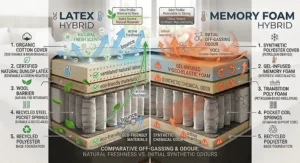
All mattresses sold in the UK, hybrid or otherwise, must comply with the Furniture and Furnishings (Fire) (Safety) Regulations, which set testing standards under BS 7177 specifically for beds and mattresses. Beyond the legal minimum, look for third-party foam certifications like CertiPUR-US or OEKO-TEX (both Zinus Cool Support Hybrid and several premium hybrids in this guide carry them), which confirm the foam is free from specific harmful chemicals and flame retardants beyond the basic legal requirement.
For latex specifically, GOTS (Global Organic Textile Standard) or FSC certification on the latex source is worth checking if sustainability matters to your decision, as seen with Simba GO Hybrid‘s organic and recyclable construction. None of these certifications guarantee comfort or longevity on their own, but they’re a reasonably reliable proxy for a manufacturer that takes material sourcing and safety seriously rather than cutting corners to hit a price point.
Frequently Asked Questions
❓ Is a latex hybrid or memory foam hybrid better for back pain?
❓ Do latex hybrid mattresses sleep cooler than memory foam hybrids?
❓ How long does a hybrid mattress type actually last?
❓ What is the response time difference between latex and foam?
❓ Can I try a hybrid mattress before buying online?
Conclusion
There’s no single winner in the latex hybrid vs memory foam hybrid debate — only a better fit for how you actually sleep. If you run hot, share a bed, or want a mattress built to outlast a decade of hard use, the latex side of this guide — Dunlopillo Elite Comfort 1400 Latex Hybrid and Simba GO Hybrid — deserves serious consideration despite the higher upfront cost. If pressure relief for aching hips and shoulders is your priority, or you’re working with a tighter budget, the memory foam options — Simba Hybrid Pro, Emma Premium Hybrid, Panda Hybrid Bamboo Mattress, Silentnight Mirapocket 1000 and Zinus Cool Support Hybrid — cover every price point from entry-level to premium.
Whichever direction you lean, resist the urge to judge a new mattress in the first week — genuine comfort takes a proper settling period to reveal itself. For further independent guidance on sleep health and mattress choice, The Sleep Council is a genuinely useful, impartial UK resource worth bookmarking alongside this comparison.
Recommended for You
- Latex Hybrid Mattress: 7 Best Picks for Deeper Sleep in 2026
- Memory Foam Pocket Spring Mattress: 7 Best Hybrids UK 2026
- Foam and Spring Hybrid Mattress: 7 Best UK Picks for 2026
Affiliate disclosure: This article contains affiliate links. As an Amazon Associate, I earn from qualifying purchases. If you purchase products through these links, we may earn a small commission at no additional cost to you.
✨ Found this helpful? Share it with your friends! 💬🤗
