

In This Article
Somewhere between the John Lewis showroom and the 2am doom-scroll through mattress reviews, most of us hit the same wall: open coil vs pocket sprung mattress, and nobody in the shop can explain the difference without reaching for a laminated diagram. Fair enough — it’s a genuinely confusing corner of home shopping, mostly because both terms just mean “springs,” and springs all look the same once they’re buried under a layer of quilted fabric.
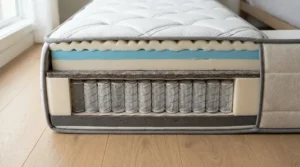
Here’s the short version, because you deserve one before we get into the weeds: an open coil mattress uses a single length of wire twisted into interlinked coils that move as one connected unit, while a pocket sprung mattress houses hundreds or thousands of individual springs, each sewn into its own fabric pocket, moving independently of its neighbours. That one structural choice cascades into everything else — how the mattress feels, how it handles two people of different weights, how long it lasts, and yes, how much it costs.
This guide walks through seven real, currently available mattresses spanning both spring types and every budget bracket, then digs into the mechanics — motion transfer, spring independence, interconnected spring systems, the lot — so you’re choosing based on how you actually sleep, not on whichever salesperson corners you first.
Quick Comparison: Open Coil vs Pocket Sprung at a Glance
Before the full product breakdown, here’s the headline comparison most people are actually searching for.
| Feature | Open Coil (Interconnected) | Pocket Sprung (Independent) |
|---|---|---|
| Spring structure | Single wire, linked coils | Individual fabric-wrapped springs |
| Motion transfer | Higher — partner disturbance likely | Low — springs move alone |
| Typical lifespan | 5-7 years | 7-10+ years |
| Feel | Firmer, more uniform bounce | Contouring, body-responsive |
| Price bracket | Budget-friendly | Wider range, budget to premium |
| Best for | Solo sleepers, guest rooms, firm-support fans | Couples, side sleepers, pressure-relief needs |
Reading that table, the pattern is pretty clear: open coil wins on upfront cost and firm, no-nonsense support, while pocket sprung wins almost everywhere else — provided you’re willing to pay for it. If you share a bed with someone who tosses and turns, the independent-spring advantage alone can be worth the price gap. According to research into sleep stability, poor mattress stability is linked to reduced deep sleep and lower sleep efficiency — which is a fairly compelling reason to care about which spring system is under you.
💬 Just one click — help others make better buying decisions too!😊
Top 7 Mattresses: Expert Analysis
We’ve deliberately mixed open coil and pocket sprung models here, across budget, mid-range, and premium price points, so you can compare like-for-like rather than guessing.
1. Silentnight Miracoil 3 Comfort Mattress — best budget open coil for firm support
The Silentnight Miracoil 3 Comfort Mattress is the mattress equivalent of a reliable hatchback: nothing flashy, does exactly what it says on the tin. It uses Silentnight’s own Miracoil system — an interconnected spring system split into three support zones, running vertically through the mattress rather than side to side.
In practice, that zoning means the middle third (where your hips and lower back sit) gets firmer support than the shoulder and leg zones, which helps with spinal alignment even though the coils themselves are all linked as one unit. It’s a genuinely firm mattress — noticeably firmer than most pocket sprung equivalents at the same price — and the quilted foam topper takes just enough edge off that it doesn’t feel like sleeping on a trampoline frame.
Based on the spec comparison with other open coil models, this is squarely aimed at back and stomach sleepers who find soft mattresses unsupportive, plus anyone furnishing a guest room where “does the job” beats “luxurious.” Reviewers consistently note the firmness holds up well over the first couple of years, though some heavier sleepers report the coils becoming more noticeable with age — a known trade-off of the open coil design.
Pros:
- ✅ Genuinely firm, consistent support across three zones
- ✅ Among the most affordable proper spring mattresses available
- ✅ No-roll edge design stops you sliding off in the night
Cons:
- ❌ Noticeable motion transfer if your partner moves a lot
- ❌ Shorter realistic lifespan than pocket sprung alternatives
Price sits around £180-£250 depending on size, and at the time of research that undercuts most pocket sprung competitors by a wide margin — solid value if firmness and budget matter more than pressure relief.

2. Silentnight Essentials Value Mattress — best entry-level double-sided option
The Silentnight Essentials Value Mattress takes the open coil concept and strips it back even further, with the twist that it’s fully double-sided — you flip it, not just rotate it, which is increasingly rare at this price point.
Its open coil spring system disperses pressure across the full surface area, and because both faces are sleep-ready, you effectively get two mattress lifespans baked into one purchase if you remember to flip it every few months. The hypoallergenic fillings are basic but functional, and the firm, zoned feel is very similar in character to the Miracoil above, just with a slightly thinner comfort layer on top.
What most buyers overlook about a double-sided mattress is the maintenance commitment — you genuinely need to flip it on a schedule, or you lose the main advantage over a single-sided budget mattress. For anyone happy to do that, this is one of the more honestly-priced ways to get a UK-handcrafted spring mattress into a spare room or a first flat without financing it.
Pros:
- ✅ Double-sided design effectively doubles usable lifespan
- ✅ Traditionally handcrafted in the UK
- ✅ Firm, no-roll edge support at a genuinely low price
Cons:
- ❌ Requires regular flipping to get full value
- ❌ Comfort layer is thin compared with mid-range options
At around £199-£280, this sits in the same bracket as the Miracoil, making the choice between them mostly about whether you want double-sided flexibility or a slightly plusher single-sided feel.
3. Dormeo Memory Fresh Pocket — best budget pocket sprung with a foam layer
Stepping into pocket sprung territory, the Dormeo Memory Fresh Pocket proves you don’t need thousands of springs to get the independent-movement benefit — you just need honest engineering. It runs around 800 pocket springs, which is lower than premium competitors but still delivers genuine spring independence rather than the interconnected feel of open coil.
A thin memory-foam-style comfort layer sits on top, adding light pressure relief without the heat retention that thicker foam mattresses are known for. On paper this means you get a noticeably softer, more contouring feel than either Silentnight open coil pick above, while still keeping some bounce and edge support from the spring layer beneath. It arrives vacuum-packed and rolled, which makes getting it up a narrow staircase considerably less of an ordeal.
Reviewers consistently flag that this sleeps a touch firmer than the marketing photos suggest, since the foam layer is genuinely thin — worth knowing if you were expecting a plush, sink-in feel. As a first step up from open coil, though, it’s a smart, low-risk way to trial spring independence.
Pros:
- ✅ Genuine spring independence at a budget price point
- ✅ Easy vacuum-rolled delivery and setup
- ✅ Breathable compared with full memory foam mattresses
Cons:
- ❌ 800 springs is entry-level for pocket sprung
- ❌ Thin comfort layer means it sleeps firmer than expected
Expect to pay somewhere in the £250-£320 range, which makes it one of the more accessible ways to test whether pocket sprung suits you before committing to a pricier model.
4. Silentnight Mirapocket 1000 Mattress — best mid-range true independence
The Silentnight Mirapocket 1000 Mattress is where the “spring independence” argument really starts to earn its keep. With roughly 1,000 individually wrapped springs, each spring compresses and responds to your body shape on its own, rather than pulling on the coils either side of it.
What that means in the bedroom: turn over, and the springs under you move; the springs under your partner largely don’t. It’s the single biggest practical upgrade over any open coil mattress, and it’s the reason “which is better for couples” almost always resolves in pocket sprung’s favour. The support here is also more contouring than the Miracoil’s uniform firmness — it responds to your hips and shoulders individually rather than treating the whole zone the same.
Aggregated reviewer sentiment across UK retailers consistently rates the Mirapocket range highly for reduced partner disturbance, with a smaller number of comments about the medium-firm feel not suiting committed firm-mattress loyalists coming from open coil beds. If you’re upgrading from any Miracoil model and want to keep a recognisably British, traditionally made mattress, this is the natural next step.
Pros:
- ✅ True spring independence reduces partner disturbance
- ✅ Contouring support without sacrificing edge stability
- ✅ Trusted UK manufacturer with a long track record
Cons:
- ❌ Noticeably pricier than any open coil equivalent
- ❌ Feels softer than open coil, which won’t suit everyone
At around £320-£420, it’s a genuine step up in both feel and expected lifespan, and arguably the best all-rounder in this whole line-up for anyone torn between firmness and pressure relief.
5. Silentnight 1400 Pocket Mattress — best mid-premium spring count
The Silentnight 1400 Pocket Mattress takes the same independent-spring principle as the Mirapocket 1000 and simply adds more of them — around 1,400 pocket springs packed into the same footprint, which tightens up the support map considerably.
More springs per square metre means finer contouring — each spring is doing a smaller, more localised job, so the mattress reads your body shape in higher resolution, so to speak. Here’s what the spec sheet won’t tell you, but reviewers note: the practical difference between 1,000 and 1,400 springs is smaller than the number suggests once you’re actually lying on it, though side sleepers with more pronounced hip and shoulder curves tend to notice it most.
This model suits couples of noticeably different body weights particularly well, since the finer spring resolution means one partner’s weight is less likely to create a dip that the other partner rolls into. It’s a mattress built for people who’ve already decided pocket sprung is right for them and are now choosing between “good” and “better.”
Pros:
- ✅ Finer spring resolution for more precise contouring
- ✅ Handles mismatched partner body weights well
- ✅ Strong reputation for edge-to-edge support
Cons:
- ❌ Diminishing returns compared with the 1000-spring model
- ❌ Premium open coil buyers may find it too soft
Pricing generally lands around £400-£550, positioning it as the mattress you buy once you already know spring independence is worth paying for.

6. Simba Hybrid Pro — best premium hybrid for all-round performance
The Simba Hybrid Pro is where pocket springs stop being the whole story. It layers thousands of individually wrapped springs — including a band of smaller “micro-springs” nearer the surface — underneath foam comfort layers, blending the bounce and airflow of pocket sprung construction with the pressure relief people usually associate with memory foam.
What most buyers overlook about hybrids is the complexity trade-off: more components generally means more potential points of failure over a decade of nightly use, and repairs simply aren’t a thing with any spring mattress. In exchange, you get a mattress that breathes noticeably better than pure memory foam models — a real consideration given how uncomfortably warm all-foam beds can feel through a British summer — while still delivering genuine spring independence for motion isolation.
Reviewers consistently praise the combination of responsive bounce and contouring comfort, and the generous trial period Simba offers takes some of the financial risk out of a premium purchase. This is the pick for anyone who’s read this whole article and thought “I want the pocket sprung independence, but I also want a bit of hug.”
Pros:
- ✅ Combines spring independence with foam pressure relief
- ✅ Sleeps cooler than all-foam mattress alternatives
- ✅ Generous home trial reduces buying risk
Cons:
- ❌ Among the most expensive options in this round-up
- ❌ More components mean more that could eventually wear
Expect a price bracket in the £700-£900 range for a double, positioning it firmly as a premium buy rather than an impulse purchase.
7. Hypnos Pocket Sprung Mattress — best premium traditional craftsmanship
The Hypnos Pocket Sprung Mattress represents the other end of the premium spectrum — not hybrid innovation, but old-school British craftsmanship. Hypnos has been hand-building beds since 1904 and holds a Royal Warrant for excellence in design, which is the sort of credential that actually means something in an industry full of marketing fluff.
These mattresses typically use natural fillings — wool, cotton, sometimes horsehair — layered over a high pocket-spring count, hand-tufted rather than machine-stapled together. The result is exceptional breathability and a supportive, slow-responding feel that’s noticeably different from the quicker bounce-back of foam-topped hybrids. Based on the spec comparison with everything else on this list, this is the mattress for buyers prioritising longevity and natural materials over cutting-edge comfort tech.
Some reviewers do flag concerns about long-term durability relative to the price, which is worth weighing given how much more this costs than the Mirapocket or 1400 models above. Still, for buyers who want a genuinely traditional pocket sprung mattress built to last a decade or more, Hypnos remains a benchmark British name.
Pros:
- ✅ Hand-tufted natural fillings improve breathability
- ✅ Royal Warrant-holding British heritage manufacturer
- ✅ Exceptional edge-to-edge pocket spring support
Cons:
- ❌ Among the priciest mattresses in this comparison
- ❌ Some durability concerns reported relative to cost
Pricing typically starts around £900 and climbs well past £1,200 depending on size and filling choice — a genuine investment piece rather than a budget-conscious pick.
Setting Up Your New Mattress: The Practical Usage Guide Amazon Won’t Give You
Getting the box through the door is only step one. Most vacuum-packed mattresses — whether open coil vs pocket sprung — need 24-72 hours to fully expand and off-gas that faint new-mattress smell, so resist the urge to judge firmness on night one. Unroll it in a well-ventilated room if possible.
For the first 30 days, rotate the mattress head-to-toe weekly (not applicable if you’ve bought a one-sided model like most pocket sprung and hybrid options, which are designed to stay face-up). If you’ve gone for a double-sided open coil model like the Silentnight Essentials Value Mattress, set a phone reminder to flip it every three months — this is the single most common mistake first-time open coil buyers make, and skipping it noticeably shortens the mattress’s useful life.
A proper mattress protector is non-negotiable, not just for hygiene but because most warranties are voided by stains. Use a slatted or sprung base rather than a solid platform where possible, since spring mattresses — especially pocket sprung models — need airflow underneath to prevent damp and mould building up in the fillings. Avoid sitting on the edge repeatedly during the first few weeks; both spring types can develop a slight edge dip faster under concentrated, repeated pressure before the fillings have properly settled.

Which One Actually Suits You? Real-World Sleeper Profiles
Specs are one thing; how you actually live is another. Here are three common situations and where they land.
If you’re a couple sharing a bed where one of you is a restless sleeper and the other wakes at the slightest jostle, the Silentnight Mirapocket 1000 Mattress or Simba Hybrid Pro solve the actual problem — independent springs mean one person’s 3am repositioning doesn’t ripple across to the other side.
If you’re furnishing a guest room or a first rental flat and the mattress needs to survive occasional, unpredictable use without costing a fortune, the Silentnight Miracoil 3 Comfort Mattress is the pragmatic choice — firm, durable-enough, and replaceable without heartbreak if it gets a rough few years.
If you’re a side sleeper with shoulder or hip pain who’s tried a firm open coil mattress and woken up sore, the Silentnight 1400 Pocket Mattress or the natural-filled Hypnos Pocket Sprung Mattress offer the fine-grained contouring that firmer, interconnected coils simply can’t replicate.
Solving Common Sprung Mattress Problems
Problem: waking up every time your partner moves. This is almost always a motion-transfer issue rooted in an interconnected spring system. The fix is switching from open coil to a genuine pocket sprung or hybrid model — the Simba Hybrid Pro is built specifically to minimise this.
Problem: the mattress feels like it’s sagging in the middle after 2-3 years. Open coil mattresses are more prone to this because the linked coils share load unevenly over time. Regular rotation slows it down, but if it’s already sagging, it’s usually cheaper to replace than to try and correct.
Problem: sleeping hot. This is more common with thick memory-foam-topped pocket sprung models than with open coil, since foam traps heat. Look for pocket sprung or hybrid designs with breathable covers, or lean towards natural-filled options like the Hypnos Pocket Sprung Mattress.
Problem: edge collapse when sitting to put on shoes. Both spring types can suffer here, but look specifically for “no-roll edge” or reinforced edge support in the product description — both the Silentnight Miracoil 3 Comfort Mattress and Silentnight Essentials Value Mattress are built with this in mind.
What Is the Difference Between Open Coil and Pocket Sprung Mattresses?
An open coil mattress uses one continuous length of wire twisted into linked coils that move together as a single connected unit, giving firm, uniform support at a lower price. A pocket sprung mattress uses hundreds to thousands of individually fabric-wrapped springs that move independently, offering closer body contouring, less partner disturbance, and typically a longer lifespan — at a higher cost.
That’s the textbook answer. In practice, the difference shows up most clearly the moment two people of different weights share a bed: on an interconnected spring system, one person’s weight subtly pulls on springs several inches away, which is what causes that “rolling toward the middle” sensation on older, cheaper mattresses. Pocket springs largely eliminate that, because each spring only answers to the weight directly above it.
Interconnected Spring System vs Independent Springs: What Motion Transfer Really Means
The Interconnected Spring System Explained
An interconnected spring system — the defining feature of open coil construction — links every coil to its neighbours via a single piece of wire, sometimes reinforced with helical connectors along the rows. The whole unit essentially behaves as one mechanical surface. That’s genuinely useful for uniform firmness and edge stability, and it’s cheaper to manufacture, which is exactly why open coil remains the budget entry point into proper spring mattresses.
Motion Transfer on an Open Coil Mattress
Because the coils are linked, movement anywhere on an open coil mattress produces measurable movement elsewhere on the surface — this is motion transfer, and it’s the single biggest practical downside for couples. Sit down hard on one side and you’ll feel the whole mattress respond, not just the section under you. For solo sleepers it’s largely irrelevant; for light sleepers sharing a bed, it can mean waking up every time a partner shifts position.
Spring Independence Comparison: Why Pocket Springs Move Alone
Run a genuine spring independence comparison between the two systems and pocket sprung wins decisively: each spring sits in its own fabric pocket, stitched individually, so it compresses only in response to the weight directly above it. Reviewers and sleep researchers consistently point to this as the main reason pocket sprung mattresses outperform open coil for couples, side sleepers, and anyone sharing a bed with kids or pets who move around during the night.
How to Choose Between Open Coil and Pocket Sprung
- Work out who’s sleeping in the bed. Solo sleeper or minimal partner disturbance concerns? Open coil is a legitimate, cost-effective choice. Sharing with a restless partner? Prioritise pocket sprung.
- Check your sleeping position. Side sleepers generally need more contouring around hips and shoulders — pocket sprung or hybrid designs handle this better than uniform open coil support.
- Set a realistic budget band. Open coil mattresses typically start around £180; genuine pocket sprung starts closer to £250-£300, climbing well past £1,000 for hand-tufted natural-filled models.
- Consider how long you want it to last. Open coil mattresses commonly need replacing every 5-7 years; well-made pocket sprung models often manage 7-10 years or more.
- Think about temperature. Pocket sprung and hybrid designs with breathable covers tend to sleep cooler than heavily foam-topped models.
- Check the spring count, but don’t obsess over it. More springs generally means finer contouring, but spring quality and gauge matter as much as the raw number.
- Use a trial period where offered. Many pocket sprung and hybrid brands offer 60-100 night trials — genuinely useful given how personal mattress feel is.

Open Coil or Pocket Spring: Which Is Better for You?
There’s no universally “better” option — only a better fit for your situation. Open coil wins on price, firmness, and simplicity; it’s a sound choice for guest rooms, growing teenagers, firm-mattress traditionalists, and anyone on a tight budget who still wants proper spring support rather than a basic foam block. Pocket sprung wins on motion isolation, contouring, and typically on longevity, which is exactly why it dominates the mid-to-premium end of the UK market.
If you’re genuinely torn, ask yourself one question: does anyone else share this bed? If the answer is yes, the case for pocket sprung strengthens considerably — the reduced motion transfer alone tends to justify the extra spend for most couples within the first few disturbed-sleep-free weeks.
Common Mistakes When Buying a Sprung Mattress
Buyers regularly fixate on spring count as the single measure of quality, when spring gauge (wire thickness), zoning, and the comfort layer above the springs matter just as much. Another frequent error is buying based on a five-minute shop-floor lie-down — your body needs 15-20 minutes on a genuine trial to reveal pressure points that a quick test won’t show. People also routinely skip checking the base compatibility; a pocket sprung mattress on a solid, non-ventilated base traps moisture and shortens its life considerably. Finally, don’t assume a higher price automatically means a better fit for your body type — a £900 mattress that’s too soft for a heavier sleeper will underperform a well-matched £350 one.
Long-Term Cost & Maintenance: Open Coil vs Pocket Sprung
Run the numbers over a decade and the picture shifts. An open coil mattress at roughly £220, replaced every 6 years, costs around £37 a year. A mid-range pocket sprung mattress at roughly £380, lasting 8-9 years, costs closer to £43-£48 a year — a narrower gap than the sticker prices suggest, and one that closes further once you factor in the improved sleep quality pocket sprung buyers consistently report.
Maintenance costs are broadly similar for both: a decent mattress protector (£20-£40), occasional professional cleaning if needed, and eventual disposal. On that last point, if your council offers a bulky waste collection service, it’s worth checking what your local authority collects and charges for large items before you commit to a new purchase, since most old spring mattresses are recyclable rather than destined for landfill.
Safety, Fire Regulations & Compliance for UK Mattresses
Every mattress sold in the UK — open coil or pocket sprung — must comply with the Furniture and Furnishings (Fire)(Safety) Regulations 1988, as amended, which set ignition-resistance standards for filling materials and covers. You can read the full regulatory text on legislation.gov.uk if you want the technical detail, but the practical takeaway for buyers is simpler: any mattress sold legitimately through a UK retailer, including Amazon UK, has already been tested against these standards, so it’s not something you need to personally verify product by product. It’s still worth avoiding unbranded imports from marketplaces outside this framework, where compliance can’t always be guaranteed.

Frequently Asked Questions
❓ Is open coil or pocket sprung better for back pain?
❓ How long does an open coil mattress last compared to pocket sprung?
❓ Can you feel springs through a pocket sprung mattress?
❓ Is pocket sprung worth the extra money over open coil?
❓ Do pocket sprung mattresses need a special base?
Conclusion
If you’ve made it this far, you already know more about open coil vs pocket sprung mattress construction than most people who’ve bought three mattresses in their lifetime. The honest summary: open coil gives you firm, dependable, budget-friendly support built around an interconnected spring system, while pocket sprung trades some upfront cost for genuine spring independence, better motion isolation, and — in most cases — a longer working life.
Solo sleeper on a budget, or kitting out a guest room? The Silentnight Miracoil 3 Comfort Mattress or Silentnight Essentials Value Mattress will serve you well. Sharing a bed and tired of waking up every time your partner turns over? The Silentnight Mirapocket 1000 Mattress, Silentnight 1400 Pocket Mattress, or Simba Hybrid Pro solve that specific problem, in ascending order of comfort tech and price. Want a mattress built the old-fashioned way, designed to outlast a decade of nightly use? The Hypnos Pocket Sprung Mattress is as close to a lifetime investment as mattresses get.
Whichever way you lean, the improvement in sleep quality from getting the spring type right is well documented — and worth checking further, including the NHS’s own guidance on building better sleep habits, since even the best mattress works better alongside decent sleep hygiene.
Recommended for You
- Open Coil Mattress: 7 Best Budget Picks (Honest UK Guide 2026)
- Medium Firm Mattress for Back Pain: 7 Best UK Picks (2026)
- Medium Orthopaedic Mattress: 7 Best UK Picks for Back Support (2026)
Disclaimer: This article contains affiliate links. As an Amazon Associate, I earn from qualifying purchases. If you purchase products through these links, we may earn a small commission at no additional cost to you.
✨ Found this helpful? Share it with your friends! 💬🤗
