
In This Article
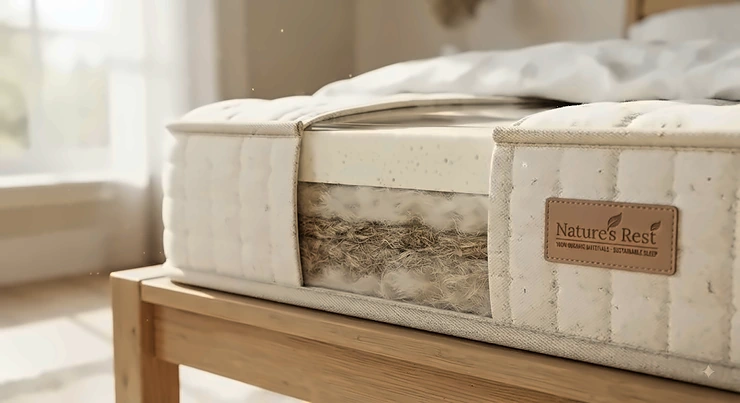
Somewhere between the plastic-wrapped delivery box and the “100% natural!” sticker, most of us lose the plot on what an eco friendly mattress actually is. It’s a fair question, and it deserves a straight answer: an eco friendly mattress is one built from responsibly sourced, low-chemical, ideally biodegradable materials — think organic wool, natural latex or recycled fibres — verified by independent certifications rather than marketing copy, and designed so it doesn’t sit in a landfill for the next ninety years once you’re done with it

That last part matters more than most shoppers realise. Every year, millions of mattresses are discarded across the UK, and a huge chunk of them still end up landfilled or incinerated rather than recycled, according to industry monitoring from the National Bed Federation. So choosing an eco friendly mattress isn’t just a lifestyle flourish — it’s one of the more consequential purchases you’ll make this decade, given you’ll spend roughly a third of your life lying on it.
This guide cuts through the greenwashing. We’ve researched seven real, currently available mattresses sold in the UK, spanning budget recycled-fibre options through to handmade organic wool beds that cost as much as a decent second-hand car. We’ll walk through genuine certifications (GOTS, GOLS, OEKO-TEX and the rest), what “carbon neutral” actually means when a brand slaps it on a product page, and how to avoid the classic first-time buyer mistakes. No invented reviews, no fictional five-star raves — just honest analysis of what’s actually on the market and who each mattress genuinely suits.
Quick Comparison Table
| Mattress | Type | Standout Feature | Price Range | Best For |
|---|---|---|---|---|
| Silentnight Eco Comfort Breathe Pocket 1200 | Foam-free pocket spring | Made from ~150 recycled bottles | Under £400 | Budget-conscious first-timers |
| Simba Hybrid Pro | Hybrid (foam + coil) | UK-made, wool comfort layer | £350-£900 | Couples wanting all-round performance |
| Panda Hybrid Bamboo Mattress | Hybrid bamboo | Cooling bamboo cover | £500-£900 | Hot sleepers |
| Panda Hybrid Bamboo Mattress Pro | Hybrid bamboo, zip-off cover | Washable premium cover | £700-£1,200 | Allergy-prone households |
| Simba Natural Hybrid (Apex) | Foam-free natural hybrid | Wool, hemp & flax, fully recyclable | £1,000-£2,000 | Buyers prioritising biodegradability |
| Naturalmat Organic Mattress | Natural fibre, handmade | GOTS wool, organic coir | £995-£1,720 | Long-term, heirloom-quality buyers |
| Snoozel Green Organic Mattress | Organic latex hybrid | GOTS & GOLS dual certification | From around £699 | Budget-organic seekers |
Look at this table for more than five seconds and a pattern jumps out: price and “eco-ness” aren’t strictly linked. The Silentnight Eco Comfort Breathe Pocket 1200 proves you can hit a genuine sustainability certification without spending four figures, while the Naturalmat Organic Mattress shows what happens when a brand builds sustainability into every stage of manufacture rather than bolting it on. If your budget is capped under £500, don’t assume you’re stuck with a “greenwashed” product — you’re not, provided you check for the right labels (more on that below).
💬 Found a mattress that fits your budget already? Bookmark this page and compare it against our picks before you check out — it only takes a minute and could save you from a mattress that isn’t as green as it claims.
Top 7 Eco Friendly Mattresses: Expert Analysis
We’ve deliberately spread this list across budget, mid-range and premium tiers, plus a couple of variants within brands, so whatever your ceiling is, there’s a genuinely defensible option here — not just the priciest thing with the greenest branding.
1. Silentnight Eco Comfort Breathe Pocket 1200 — best budget pick made from recycled bottles
The clue is in the name: this pocket-sprung mattress is constructed using fibre padding made from roughly 150 recycled plastic bottles per mattress, and it’s entirely foam-free.
Specs-wise, you’re looking at 1,200 individually wrapped pocket springs (in a double), paired with Silentnight’s Eco Comfort Fibre padding, which is engineered to be more breathable than standard polyester fillings. In practice, that breathability matters because foam-free pocket sprung mattresses tend to sleep noticeably cooler than memory foam alternatives — useful if you’ve ever woken up in a puddle of your own regret at 3am in July. The mattress picked up a Good Housekeeping “Getting Greener” award, which is a reasonably credible third-party nod rather than a self-issued badge.
Who’s it for? Honestly, this is the mattress to recommend to a sceptical relative who thinks “eco” automatically means “expensive and uncomfortable.” Reviewers of Silentnight’s Eco Comfort range consistently note that it performs like a conventional mid-range pocket sprung mattress — supportive, unremarkable in a good way — while quietly avoiding the foam and chemical treatments found in cheaper synthetic beds. It’s not going to win awards for luxury feel, but that’s not the brief.
Pros:
- ✅ Genuinely recycled fibre content, independently verifiable
- ✅ Foam-free construction suits hot sleepers and allergy sufferers
- ✅ Fully recyclable at end of life through take-back schemes
Cons:
- ❌ Firmness options are more limited than premium rivals
- ❌ Lacks the organic-material certifications of pricier picks
At under £400 for most sizes, this is the mattress that proves eco friendly mattress shopping doesn’t require a four-figure budget — genuinely good value for anyone testing the waters.
2. Simba Hybrid Pro — best UK-made hybrid with a wool comfort layer
Simba built its reputation on hybrid engineering, and the Hybrid Pro folds a wool-infused comfort layer into that formula for extra temperature regulation.
The mattress is manufactured in the UK — springs from Leeds, foam from Middleton, wool from Yorkshire — which shortens the supply chain considerably compared with mattresses shipped in from overseas factories. Its layered construction combines Simba’s titanium Aerocoil springs with foam that the brand states is free from formaldehyde and heavy metals, and the covers use recycled plastics. What that means in practice: you get the pressure-relieving contouring of a foam mattress with the temperature control and edge support of a coil system, without quite the same chemical load as older-generation memory foam beds.
Simba is B Corp registered and ships via a carbon-offsetting delivery partner, and the brand runs a dedicated mattress recycling and refurbishment scheme rather than simply hoping your old mattress disappears responsibly. Aggregated customer feedback across retailer review sections tends to flag two consistent themes: praise for the cooling performance, and occasional comments that the mattress is heavy and awkward to manoeuvre solo during setup — worth bearing in mind if you live in a third-floor flat with no lift.
Pros:
- ✅ Manufactured in the UK with traceable material sourcing
- ✅ Wool layer meaningfully improves temperature regulation
- ✅ Free mattress recycling and refurbishment scheme
Cons:
- ❌ Very heavy — a two-person job to install
- ❌ Full organic certification not claimed, unlike Naturalmat or Snoozel Green
Prices for the Simba Hybrid Pro typically sit in the £350-£900 range depending on size, and given the UK manufacturing and recycling infrastructure behind it, that’s a reasonable value trade for buyers who want sustainability without going fully organic.
3. Panda Hybrid Bamboo Mattress — best bamboo cover for hot sleepers
Panda’s signature move is right there in the name: a bamboo-infused cover layered over a hybrid foam-and-spring core, aimed squarely at people who run warm at night.
The surface layer blends bamboo yarn with a durability layer made from recycled ocean-bound plastic bottles, sitting above Panda’s proprietary OrthoAlign foam and a seven-zone pocket spring system for targeted spinal support. All foams are CertiPUR-approved and the textiles carry OEKO-TEX Standard 100 certification, meaning every thread and dye has been tested against more than a thousand regulated substances. What that translates to for a buyer: this isn’t a “greenwashed” foam mattress with a bamboo label slapped on the box — the certifications back up the claims on the materials that actually touch your skin.
Independent testers have rated the firmness around 7 to 7.5 out of 10, describing it as particularly well-suited to back and stomach sleepers thanks to the zoned spring support, though lighter side sleepers sometimes find it firmer than expected. A recurring theme in aggregated reviews is genuinely strong temperature regulation — the bamboo cover and cooling foam combination consistently outperform standard memory foam on this specific metric, though several reviewers also mention a noticeable off-gassing smell in the first few days that fades with airing.
Pros:
- ✅ Bamboo-recycled cover blend sleeps noticeably cooler
- ✅ CertiPUR and OEKO-TEX certified foams and fabrics
- ✅ Strong spinal support for back and stomach sleepers
Cons:
- ❌ Too firm for some lightweight side sleepers
- ❌ Initial off-gassing smell can linger for several days
At roughly £500-£900, the Panda Hybrid Bamboo Mattress sits comfortably in the mid-range bracket, and the certification depth justifies the premium over uncertified bamboo-branded competitors.
4. Panda Hybrid Bamboo Mattress Pro — best premium bamboo hybrid with a washable cover
This is Panda’s step-up model, and the headline upgrade is a fully removable, machine-washable zip-off bamboo cover — a genuinely practical feature that budget mattresses rarely offer.
Underneath that cover sits a multi-zonal spring base with seven zones of individually enclosed springs, a high-density memory foam base layer, and an anti-slip lower cover to stop the whole thing migrating around your bed frame overnight. Like the standard Hybrid Bamboo, every foam component is CertiPUR-approved and REACH compliant, meeting EU chemical safety regulations, and the bamboo itself is described by the brand as ethically sourced and organic. What the washable cover means in real terms: allergy-prone households, families with pets, or anyone prone to night sweats gets a maintenance advantage that fixed-cover mattresses simply can’t match — you’re not stuck hoping a mattress protector catches everything.
Testers consistently rate the Pro around 7.5 out of 10 for firmness, describing the feel as supportive with a plusher top layer than the standard model. The trade-off, as with most premium upgrades, is price — you’re paying meaningfully more for the washable-cover convenience and the extra foam layer, and buyers on a tight budget may find the standard Hybrid Bamboo delivers 80% of the benefit for notably less outlay.
Pros:
- ✅ Removable, machine-washable cover — genuinely rare at this level
- ✅ Extra memory foam layer adds plush comfort over the base model
- ✅ Full CertiPUR, OEKO-TEX and REACH certification
Cons:
- ❌ Meaningful price jump over the standard Hybrid Bamboo
- ❌ Heavier construction makes turning or rotating more effort
Expect to pay in the £700-£1,200 range for the Panda Hybrid Bamboo Mattress Pro, positioning it as a genuine upper-mid-range pick rather than an entry-level purchase.
5. Simba Natural Hybrid (Apex) — best fully biodegradable, foam-free construction
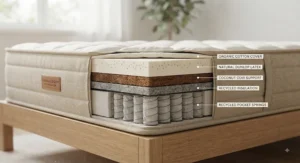
Simba’s natural hybrid range — the successor to its original Earth collection — strips out foam entirely, relying instead on wool, hemp, flax and upcycled cotton layered over titanium alloy or high-carbon steel springs.
That’s a genuinely different construction philosophy from the rest of this list. No glue, no foam, no synthetic bonding agents — just natural fibres mechanically layered and stitched, which means the mattress is designed to be fully recyclable and largely biodegradable at end of life, a claim that’s far harder to substantiate for foam-hybrid beds. The Yorkshire-grown hemp and flax layers add breathability and structure, while the wool provides natural temperature regulation and a degree of fire resistance without chemical treatments — a genuinely useful property, since most mattresses rely on flame-retardant chemicals to meet UK fire safety regulations instead.
Because this range is delivered flat rather than rolled and vacuum-packed, logistics are slightly more involved than a typical boxed mattress delivery, and the brand pairs it with a premium VIP delivery service including old mattress removal. Reviewers who’ve made the switch from conventional hybrids consistently describe a firmer, denser feel than foam-based beds — closer to a traditional natural fibre mattress than a springy modern hybrid — which suits back and stomach sleepers better than committed side sleepers.
Pros:
- ✅ Foam-free and largely biodegradable end-of-life profile
- ✅ Wool-based fire resistance avoids chemical flame retardants
- ✅ Free VIP delivery with old mattress removal included
Cons:
- ❌ Firmer, denser feel won’t suit every side sleeper
- ❌ Delivered flat, which complicates access in tight stairwells
Pricing sits at the premium end, typically £1,000-£2,000 depending on size and tier, which reflects the more complex natural-fibre construction versus a standard foam-and-spring hybrid.
6. Naturalmat Organic Mattress — best handmade organic mattress for long-term buyers
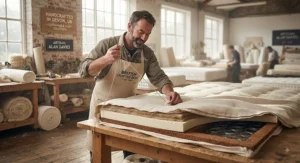
Naturalmat has been hand-building mattresses in a Devon workshop since 1999, and in 2023 became the first B Corp certified bed and mattress company in the UK — a credential that requires meeting a genuinely rigorous, independently audited bar across environmental and social criteria, not a self-awarded label.
The entry-level natural fibre mattress in this range combines the brand’s signature layered wool and coir construction with recycled denim, wrapped in a GOTS-certified organic cotton and wool herringbone cover. That cover fabric is treated with an OEKO-TEX-approved geraniol solution rather than synthetic pesticides, which protects against dust mites and bed bugs without introducing the chemical load typically associated with pest-resistant textiles. Every material — wool, coir, cotton, latex where used — carries independent organic certification from bodies like the Soil Association or Control Union, and the wool itself acts as a natural fire retardant, meaning the mattress meets UK fire safety regulations without added flame-retardant chemicals.
What buyers consistently report, based on aggregated feedback across retailer and independent review platforms, is a firmer, more traditional feel than modern foam hybrids — closer to sleeping on a well-built natural fibre bed than a springy memory foam mattress — plus genuine longevity, with the brand backing its beds with a 10-year guarantee. This is very much a considered, long-horizon purchase rather than an impulse buy.
Pros:
- ✅ B Corp certified with fully traceable organic material sourcing
- ✅ Chemical-free fire resistance via natural wool construction
- ✅ Handmade in the UK with a 10-year guarantee
Cons:
- ❌ Firmer traditional feel may not suit those used to memory foam
- ❌ Among the pricier options on this list
At £995-£1,720 depending on size, the Naturalmat Organic Mattress sits at the premium end of this round-up, but for buyers who want maximum certification depth and UK craftsmanship, it’s arguably the most defensible “genuinely eco” purchase here.
7. Snoozel Green Organic Mattress — best budget-organic pick with dual certification
If Naturalmat represents the ceiling on organic credentials, Snoozel Green Organic Mattress shows you can access a chunk of that same certification depth without the four-figure price tag.
This is a pocket spring hybrid built around organic cotton, organic wool and organic latex, carrying both GOTS (Global Organic Textile Standard) certification for the cotton and wool, and GOLS (Global Organic Latex Standard) certification for the latex layer — a genuinely rare combination at this price point. The natural latex itself is combined with graphite in the construction, which the brand states contributes to fireproofing without chemical flame retardants, echoing the same wool-and-latex-led approach used by pricier natural mattress specialists. It’s handmade in Sri Lanka and backed by a five-year warranty, which is respectable if not class-leading against the ten-year terms offered by premium organic specialists.
Aggregated buyer sentiment on organic mattress comparison sites tends to position Snoozel Green as the accessible entry point into “properly organic” — meaning dual GOTS/GOLS certification — sleep, appealing specifically to buyers who’ve done their certification homework and refuse to pay a premium-brand markup for materials they could source more affordably elsewhere.
Pros:
- ✅ Dual GOTS and GOLS certification at a budget-organic price
- ✅ Graphite-latex fireproofing avoids chemical treatments
- ✅ Genuinely organic cotton, wool and latex throughout
Cons:
- ❌ Five-year warranty trails premium organic competitors
- ❌ Smaller brand footprint means a thinner independent review pool
Starting from around £699, the Snoozel Green Organic Mattress is the pick for buyers who want certified organic materials without stretching into four-figure territory.
Practical Usage Guide: Settling In and Maintaining Your Eco Friendly Mattress
Buying the right eco friendly mattress is only half the job — how you treat it in the first month, and every month after, determines whether it delivers ten years of good sleep or five years of slow disappointment.
Most compressed hybrid or foam-hybrid mattresses, including the Simba Hybrid Pro and both Panda Hybrid Bamboo models, need roughly 24-48 hours to fully expand after unboxing, and a further week or two to fully off-gas any residual manufacturing odour — open a window rather than masking it with air freshener, since ventilation genuinely speeds this up. Natural fibre mattresses like the Naturalmat Organic Mattress and Simba Natural Hybrid (Apex) don’t compress in the same way and arrive flat, so there’s no expansion period, but they do benefit from being aired for a day before use if they’ve spent time in transit packaging.
For ongoing maintenance, rotate foam-free pocket sprung mattresses (Silentnight Eco Comfort Breathe Pocket 1200, Snoozel Green Organic Mattress) head-to-toe every three months to even out wear, and vacuum the surface monthly to shift dust and skin cells before they settle into natural fibre fillings. A common first-30-days mistake is skipping a mattress protector on the assumption that “natural materials don’t need one” — they absolutely do, since spills and sweat degrade organic wool and cotton just as readily as synthetic fillings, and most manufacturer warranties are voided by stains regardless of how eco-friendly the mattress itself is.
✨ Set a phone reminder now for your first rotation — it’s the single easiest way to protect the investment you’ve just made.
Real-World Scenarios: Which Eco Friendly Mattress Actually Suits You?
Specs are useful, but most people make better decisions when they see themselves in a scenario. Here are three genuinely common buyer profiles matched against the products above.
The budget-conscious renter. You’re in a flat share, moving is likely within two years, and you don’t want to sink £1,500 into a mattress you might leave behind. The Silentnight Eco Comfort Breathe Pocket 1200 makes sense here — genuinely recycled materials, a manageable price, and no long-term guilt if it doesn’t come with you to the next place.
The hot-sleeping couple with a mid-range budget. You’ve argued about the thermostat every summer for years, and one of you runs noticeably warmer at night. Either Panda Hybrid Bamboo model earns its keep through the cooling cover and zoned spring support — go for the standard version if budget is the deciding factor, or the Pro if the washable cover matters to you (useful with pets or young kids prone to nighttime accidents).
The long-term homeowner prioritising materials over price. You’ve settled into a forever home, you read ingredient labels on shampoo, and you want a mattress that matches that mindset for the next decade. The Naturalmat Organic Mattress or Simba Natural Hybrid (Apex) both fit — Naturalmat if you want maximum handmade, small-batch craftsmanship; Simba’s natural range if you want a bigger brand’s recycling infrastructure behind the purchase.
Problem → Solution: Fixing the Most Common Eco Mattress Buying Headaches
Problem: You can’t tell if “eco friendly” on a listing is genuine or marketing. Solution: check for a named, verifiable certification — GOTS, GOLS, OEKO-TEX, CertiPUR — rather than taking vague sustainability language at face value. If a brand can’t name a certifying body, treat the claim with scepticism.
Problem: You’re worried about off-gassing smell from a new mattress. Solution: unbox in a well-ventilated room, and give hybrid foam models like the Panda Hybrid Bamboo Mattress several days of airing before you rely on it for a full night’s sleep — this is standard practice with CertiPUR-approved foams and isn’t a sign of a faulty product.
Problem: You want organic materials but the premium prices feel out of reach. Solution: look at dual-certified budget options like the Snoozel Green Organic Mattress, which delivers GOTS and GOLS certification without the handmade-in-Devon price tag of pricier competitors.
Problem: You’re unsure what happens to your old mattress once the new one arrives. Solution: prioritise brands with a genuine take-back or recycling scheme — Simba Hybrid Pro and the Simba Natural Hybrid (Apex) both include this, and it’s worth confirming coverage in your postcode before you buy, since not every scheme runs nationwide.
Problem: You sleep hot and worry natural materials will make it worse. Solution: natural fibres like wool are actually excellent temperature regulators — the Naturalmat Organic Mattress and bamboo-covered Panda models both outperform standard polyester-covered foam on this front, precisely because natural fibres wick moisture rather than trapping it.
How to Choose an Eco Friendly Mattress
Cutting through spec sheets and marketing claims, here’s the actual decision process worth following:
- Check for a named certification first. GOTS, GOLS and OEKO-TEX are independently audited; vague phrases like “eco-conscious materials” with no certifying body attached are a red flag worth investigating further.
- Decide how much you care about biodegradability specifically. Foam-hybrid mattresses (Simba Hybrid Pro, both Panda models) reduce chemical load but aren’t fully biodegradable; foam-free natural fibre beds (Naturalmat, Simba Natural Hybrid) are.
- Match firmness to your sleep position, not the marketing photo. Natural fibre mattresses tend to sleep firmer; foam hybrids offer more contouring — side sleepers generally do better with the latter.
- Confirm the end-of-life plan before you buy, not after. A genuine recycling or take-back scheme is a strong sustainability signal that most listings bury in the small print.
- Weigh total cost of ownership, not just the sticker price. A £700 mattress with a ten-year guarantee often beats a £400 mattress needing replacement in four.
- Read aggregated review themes, not star ratings alone. Look for recurring comments on temperature, firmness and off-gassing rather than headline scores.
- Budget realistically for delivery and old-mattress removal. Natural fibre mattresses in particular can be heavy and are sometimes delivered flat rather than boxed, which affects access in flats and terraced houses.
Sustainable Mattress vs Ethical Mattress vs Green Mattress: What’s the Difference?
These three terms get thrown around interchangeably, but they’re not quite synonyms, and understanding the distinction helps you ask sharper questions when you’re comparing listings.
A sustainable mattress typically refers to environmental impact across the product’s whole lifecycle — sourcing, manufacturing emissions, packaging and end-of-life disposal. The Simba Hybrid Pro‘s carbon-offset delivery and recycling scheme are sustainability credentials in this narrower sense, even though the mattress itself isn’t fully organic.
An ethical mattress shifts the focus to people rather than materials: fair wages, safe working conditions, and supply chain transparency. Naturalmat’s B Corp certification is explicitly an ethical credential as much as an environmental one, since B Corp assessment covers governance and worker welfare alongside environmental performance — it’s a broader bar than most single-issue eco claims.
A green mattress is the loosest of the three terms, often used as a catch-all marketing shorthand for anything touching organic, natural or recycled materials, regardless of depth. This is precisely where greenwashing creeps in — a mattress can be marketed as “green” on the strength of a single recycled-fibre cover while the foam core underneath is entirely conventional. The practical takeaway: when a listing uses “green” without pointing to a specific certification, dig deeper before assuming the whole product matches the claim.
Common Mistakes When Buying an Eco Friendly Mattress
Mistake one: assuming “natural” and “organic” mean the same thing. Natural materials haven’t necessarily been grown or processed without pesticides and chemical treatments; organic materials carry that guarantee through certification. A “natural latex” mattress isn’t automatically GOLS certified.
Mistake two: ignoring firmness in favour of eco-credentials alone. A perfectly certified organic mattress that’s too firm for your sleep position will still wreck your back — sustainability and comfort aren’t mutually exclusive, but they do need separately evaluating.
Mistake three: not budgeting for the trial period return costs. Some brands charge for return collection even within a sleep trial, which can erode the “risk-free” framing on the product page — always check the small print before assuming a full refund is genuinely free.
Mistake four: overlooking delivery logistics for heavier natural fibre beds. Mattresses like the Simba Natural Hybrid (Apex), delivered flat rather than boxed, need more manoeuvring space than a standard rolled mattress-in-a-box.
Mistake five: focusing on the mattress and forgetting the base. Pairing a genuinely eco-certified mattress with a synthetic, chemically treated bed base undercuts a chunk of the sustainability benefit you paid extra for.
Biodegradable Mattress Materials Explained
Biodegradable mattress materials are the components that break down naturally at end of life rather than persisting in landfill for decades, and they’re the single clearest differentiator between a genuinely sustainable mattress and one that’s simply “less bad” than a fully synthetic bed.
Organic wool is the standout performer here — naturally fire-resistant, moisture-wicking, and fully compostable, which is why it features so heavily in both the Naturalmat Organic Mattress and the Simba Natural Hybrid (Apex). Natural latex, tapped from rubber trees rather than synthesised from petrochemicals, is biodegradable too, though the process takes considerably longer than wool or cotton — this is the material behind the Snoozel Green Organic Mattress‘s GOLS certification. Coir, the fibrous husk of coconuts, adds structural support and breaks down naturally, while organic cotton covers finish the picture, being fully compostable at end of life when free from synthetic dyes and finishes.
By contrast, conventional memory foam and standard polyurethane — still present in some of the more mainstream hybrid mattresses on this list — are not biodegradable in any meaningful timeframe, and represent a genuine gap even in otherwise well-certified products. This is exactly why the scale of the UK’s mattress waste problem matters: a large share of what’s discarded each year still ends up landfilled or incinerated rather than recycled, according to monitoring cited by the North London Waste Authority, precisely because so few mattresses on the market are built from materials that break down cleanly.
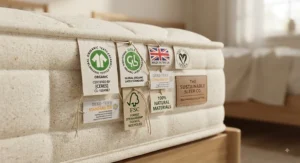
Eco Sleep Certification Guide: GOTS, GOLS, OEKO-TEX and More
If you take one thing from this entire article, make it this: certifications are the difference between an eco friendly mattress claim you can verify and one you’re simply trusting.
GOTS (Global Organic Textile Standard) is the leading certification for organic textiles across the entire supply chain — farming, processing, labour standards — and requires a minimum 70% organic fibre content, rising to 95% for products labelled fully organic, as defined by the official Global Organic Textile Standard. It’s what backs the wool and cotton claims on both the Naturalmat Organic Mattress and Snoozel Green Organic Mattress.
GOLS (Global Organic Latex Standard) is GOTS’s counterpart specifically for natural latex, verifying that the rubber tapped for a mattress’s latex layer meets organic agricultural standards through to the finished product — this is the certification behind Snoozel Green’s latex layer.
OEKO-TEX Standard 100 takes a different angle: rather than certifying organic origin, it tests every component of a textile — threads, dyes, buttons, trims — against more than a thousand regulated and unregulated substances that could be harmful to health. It’s why the Panda Hybrid Bamboo Mattress range and Simba Hybrid Pro can make credible chemical-safety claims even without full organic certification.
CertiPUR applies specifically to foam, verifying it’s made without ozone depleters, PBDE flame retardants, heavy metals or formaldehyde — relevant to any hybrid mattress on this list that still uses a foam comfort layer.
B Corp certification, held by both Naturalmat and Simba, is broader still, auditing a company’s overall social and environmental performance rather than a single material — useful context, but not a substitute for checking material-specific certifications when a claim is about the mattress itself rather than the business behind it.
✨ Don’t Miss These Exclusive Deals!
🔍 Take your search for a genuinely certified eco friendly mattress to the next level — click through on any highlighted pick above to check current pricing and availability before stock or promotions change.
Carbon Neutral Mattress Claims: What They Really Mean
“Carbon neutral” is one of the most misunderstood phrases in sustainable retail, and mattress brands are no exception to the confusion.
In its strictest sense, carbon neutral means a company has measured its greenhouse gas emissions across a defined scope — often just delivery logistics, sometimes the full manufacturing process — and has offset an equivalent amount, typically by funding verified carbon-reduction projects elsewhere. Simba’s claim of carbon-neutral delivery, for instance, applies specifically to the shipping stage rather than the entire lifecycle of manufacturing the mattress itself, which is a meaningfully narrower claim than “this mattress is carbon neutral” might imply at first glance.
The honest caveat here: offsetting is not the same as avoiding emissions in the first place, and the quality of offset schemes varies considerably — some fund genuinely additional, verifiable carbon reduction; others are far more questionable. When a brand makes a carbon neutral claim, the more specific and scoped the language (“carbon neutral delivery,” “carbon neutral manufacturing facility”), the more credible it tends to be, precisely because vague blanket claims are harder to verify and easier to overstate. This is a genuinely fast-moving area of consumer protection too, with UK regulators increasingly scrutinising environmental claims for accuracy — worth bearing in mind as terminology and standards continue to tighten.
Long-Term Cost & Maintenance: Is an Eco Friendly Mattress Worth It?
Sticker price is the least useful number when comparing mattresses, because a £400 mattress replaced every four years costs more over a decade than a £900 mattress that lasts twelve.
Run the maths properly and the picture shifts considerably. The Silentnight Eco Comfort Breathe Pocket 1200, at a typical lifespan of six to eight years for a pocket sprung mattress in this bracket, works out at roughly £50-£65 per year of use — genuinely competitive, even against pricier alternatives. The Naturalmat Organic Mattress, backed by a ten-year guarantee and traditionally longer-lasting natural fibre construction, can work out cheaper per year of ownership than it first appears, despite the much higher upfront cost, because natural fibre mattresses in this quality tier routinely outlast foam hybrids by several years.
Maintenance costs matter too, and they’re not always obvious from a product page. Foam-free mattresses generally need less intervention — no risk of foam degradation or sagging in the way memory foam can develop body impressions over time — but they do benefit from occasional professional cleaning if spills occur, since natural fibres can’t simply be spot-treated with harsh chemical cleaners without undermining their eco credentials in the process. Factor in mattress protector replacement (roughly every two to three years) and the occasional professional clean, and total cost of ownership across most options on this list lands within a fairly narrow band once you account for genuine lifespan differences rather than sticker price alone.
Frequently Asked Questions
❓ Is an eco friendly mattress actually better for you than a regular mattress?
❓ How much more does an eco friendly mattress cost than a standard one?
❓ Are eco friendly mattresses actually biodegradable at the end of their life?
❓ What certification should I actually look for on an eco friendly mattress?
❓ Can I recycle my old mattress when I buy a new eco friendly one?
Conclusion
The honest verdict on eco friendly mattresses in 2026 is this: the market has matured well past greenwashed marketing copy, and there’s now a genuinely defensible option at every price point, from the recycled-bottle pocket springs of the Silentnight Eco Comfort Breathe Pocket 1200 through to the fully certified organic craftsmanship of the Naturalmat Organic Mattress.
What separates a good purchase from a regretted one isn’t the size of your budget — it’s whether you checked for a named, independently audited certification before you clicked buy. GOTS, GOLS, OEKO-TEX and CertiPUR aren’t just acronyms to skim past; they’re the difference between trusting a brand’s word and verifying it. Match that certification check against your actual sleep position and temperature preferences, factor in genuine long-term cost of ownership rather than sticker price, and confirm there’s a real recycling plan for your old mattress before the new one even arrives.
Sleep is not a place to cut corners, and neither, frankly, is the planet you’re sleeping on top of.
✨ Ready to make the switch?
Revisit the comparison table above and pick the eco friendly mattress that matches your budget and sleep style — then check current pricing before it changes.
Recommended for You
- Dunlop vs Talalay Latex Mattress: 7 Honest Picks 2026
- Natural Latex Mattress UK: 7 Genuinely Organic Picks for 2026
- 7 Best Hypoallergenic Mattress Picks UK 2026: Sleep Easier
Disclaimer: This article contains affiliate links. As an Amazon Associate, I earn from qualifying purchases. If you purchase products through these links, we may earn a small commission at no additional cost to you.
✨ Found this helpful? Share it with your friends! 💬🤗
