
In This Article
Somewhere between “I’ll just get whatever’s cheapest” and “I’ve spent three weeks reading spring-gauge spreadsheets,” most of us land on the same question: is a synthetic latex mattress actually any good, or is it just natural latex’s poorer cousin wearing a nicer label? Fair question. The honest answer is “it depends entirely on which one you buy” — and that’s precisely the gap this guide is built to close.
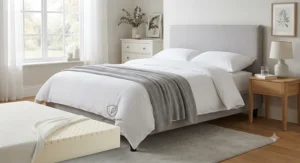
A synthetic latex mattress uses lab-made styrene-butadiene rubber (SBR) rather than sap tapped from a rubber tree, and it does so at a fraction of the cost. That’s not automatically a bad trade. Plenty of sleepers genuinely prefer the firmer, more consistent feel of SBR, and plenty more simply can’t justify spending four figures on a mattress that a synthetic or blended latex mattress can approximate for a couple of hundred pounds. The trouble is that “latex” isn’t a protected term in UK retail, so a mattress marketed with breezy latex-adjacent language can mean almost anything underneath the cover.
This guide walks through seven real, currently listed options on amazon.co.uk — spanning proper budget picks through to premium blends — with honest analysis of what the specs actually mean day to day, what real reviewers report, and where the corners get cut. We’ll also dig into the specific questions that keep coming up: what makes a mattress genuinely “affordable” rather than just cheap, how SBR latex behaves differently from the natural stuff, and how to spot a decent latex feel budget mattress before your money’s already gone.
What Is a Synthetic Latex Mattress?
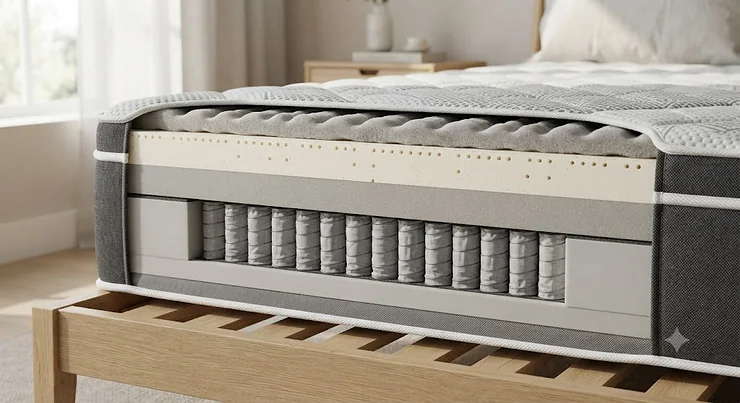
A synthetic latex mattress is built from styrene-butadiene rubber (SBR), a petrochemical foam engineered to mimic the bounce and support of natural rubber-tree latex at a much lower manufacturing cost. It’s typically firmer out of the box, slightly less breathable, and shorter-lived than natural or blended alternatives, but considerably cheaper to buy.
That definition matters more than it looks, because it’s the single biggest thing separating good synthetic latex mattresses from disappointing ones: how much SBR is actually in the comfort layer, and how well it’s been engineered around.
Quick Comparison: Synthetic vs Blended vs Natural Latex
Before we get into specific products, it helps to see the three categories side by side, because “latex mattress” on a listing page could mean any of these.
| Latex Type | What It’s Made Of | Typical Feel | Typical UK Price Range | Best For |
|---|---|---|---|---|
| Synthetic (SBR) | 100% petrochemical latex | Firmer, less buoyant | Under £250–£350 | Firm-preference sleepers on a tight budget |
| Blended | ~30% natural, ~70% synthetic (or similar ratio) | Close to natural, slightly less springy | £250–£600 | Buyers who want the latex feel without the natural-latex price |
| Natural (Dunlop/Talalay) | 100% rubber-tree latex | Bouncy, breathable, long-lasting | £600–£1,500+ | Allergy sufferers, hot sleepers, long-term investment buyers |
Reading across that table, the pattern is pretty stark: price climbs in near-lockstep with natural-latex content, but so does longevity and breathability, so you’re not just paying for a label — you’re paying for material that genuinely behaves differently under a body for eight hours a night. Where this gets interesting is the blended middle ground, because a well-built 70/30 blend can close most of the comfort gap with natural latex while only closing about half the price gap, which is exactly why it dominates the mid-market. If your priority is spinal support over squeeze-test softness, don’t assume the priciest tier automatically wins here — a dense synthetic core in a well-built pocket-and-latex hybrid can out-support a poorly constructed “natural” mattress that’s mostly padding around a thin latex sheet.
💬 Found this comparison useful? Bookmark it before you start browsing — it’ll save you from a dozen open tabs later.😊
Top 7 Synthetic Latex Mattresses: Expert Analysis
We’ve deliberately spread this list across budget, mid-range and premium-blend territory, because the right pick for a student’s guest room bed and the right pick for a couple’s main bedroom are rarely the same mattress. Every product below is real, currently searchable on amazon.co.uk, and assessed on its actual specification — not marketing copy.
1. Sareer Matrah Latex Foam Mattress — cheapest genuine way into a latex sleep surface
If you want the absolute floor price for a latex-topped mattress without wandering into memory-foam territory, this is roughly where the market starts. The Matrah pairs a supportive reflex foam base with a top layer of latex foam, wrapped in a removable, washable zip cover — a detail that matters more than it sounds, because it’s the difference between spot-cleaning a mattress in five years and binning it.
On spec, this is a foam-on-foam build rather than a spring hybrid, which means it channels body weight into the reflex base layer rather than individually responding at each point of contact. In practice that translates to steady, even support with less of the point-elastic “hug” that pocket-sprung latex builds deliver — good news if you sleep on your back or side without shifting much, less good if you’re a restless combination sleeper who wants the mattress reacting instantly to every roll. Based on the spec comparison with pricier options further down this list, the trade-off here is honest: you’re getting genuine latex-surface breathability and hypoallergenic properties without paying for a pocket-spring unit underneath it.
Independent retailer listings for this exact product carry a thin but telling spread of feedback — one buyer noted the mattress felt thinner and closer to a topper than they expected, while another flagged it as noticeably softer than a previous latex mattress they’d owned, to the point of needing a supportive bed base underneath. That’s a useful signal: this product performs best on a solid, well-supported base rather than slats with wide gaps.
Pros:
- ✅ Genuinely the lowest entry price for a latex-surfaced mattress
- ✅ Removable, washable zip cover extends real-world lifespan
- ✅ Naturally hypoallergenic latex top layer, good for allergy-prone sleepers
Cons:
- ❌ Reads thinner than expected against some buyers’ previous latex mattresses
- ❌ Needs a solid, well-supported base to avoid feeling under-firm
Price-wise, expect this to sit at the low end — typically under £200 for a single, climbing from there by size — and for that money it’s hard to argue with as a genuine, honestly-labelled latex-feel budget mattress rather than a memory-foam impostor.
2. Sareer Matrah Latex Pocket Mattress — best step-up for couples who still want a budget price
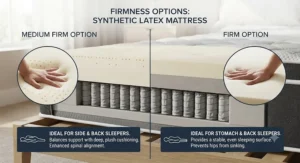
Same family, meaningfully different build. This version swaps the reflex-foam base for up to 1,500 individually pocketed springs, topped with the same sensitive latex comfort layer, and finished with a tufted construction that keeps the fillings from migrating around inside the mattress over time — a small detail that stops a mattress developing lumps and hollows years before it should.
What that spring count actually buys you is independent point-response: each spring compresses on its own, so your partner rolling over at 3am doesn’t ripple across to your side of the bed the way it would on the pure foam-and-latex model above. Reviewers researching this style of mattress consistently flag motion isolation as the headline benefit of pocket-plus-latex builds over foam-plus-latex ones, and the physics backs that up — it’s the same reason pocket springs dominate the mid-market for couples generally, latex or not.
At roughly nine inches deep, this sits comfortably in “medium feel” territory, which the brand itself targets rather than dressing up as universally firm or soft. What most buyers overlook about that medium positioning is that it’s actually a deliberate hedge against returns — a true medium feel is statistically the safest bet across the widest range of body weights and sleep positions, which is presumably why a budget-focused brand chose it as the default rather than gambling on a narrower firmness band.
Pros:
- ✅ Up to 1,500 pocket springs significantly reduce motion transfer for couples
- ✅ Tufted finish keeps fillings secure and reduces long-term lumping
- ✅ Medium feel suits the widest range of sleep positions and body types
Cons:
- ❌ Costs more than the reflex-foam Matrah for a genuinely different (not universally better) feel
- ❌ Medium firmness may under-support heavier stomach sleepers long-term
Expect a price roughly a notch above the entry-level Matrah — still comfortably in “affordable latex mattress” territory rather than premium — making it arguably the sharpest value pick on this whole list for couples specifically.
3. Inofia Latex Memory Foam Mattress with Pocket Sprung — best synthetic-latex hybrid for hot sleepers
Inofia’s approach here is to layer a latex-infused comfort layer over individually pocketed springs, using what the brand calls “LATEXCH Bi-density Technology” — in plain English, two densities of latex-blended foam stacked to balance immediate softness against underlying support, at roughly 27cm total depth.
The bi-density construction is worth pausing on, because it’s the kind of spec that gets buried under marketing language but genuinely changes how the mattress performs. A single-density latex-feel layer either sinks too readily under heavier body parts or resists too much everywhere else; splitting it into two densities lets the top few centimetres do the pressure-relief work while a denser layer underneath stops you bottoming out onto the springs. Here’s what the spec sheet won’t tell you outright: bi-density latex-foam builds like this one are essentially the budget industry’s answer to the multi-layer natural latex mattresses that cost three or four times as much — same principle, cheaper materials, smaller price tag.
Ventilation is the other stated priority, and pocket springs genuinely do help here versus solid foam cores, since air can move through the coil layer rather than getting trapped. Reviewers researching similarly constructed hybrid mattresses in this bracket tend to report a cooler night’s sleep than all-foam alternatives at a similar price, though verified, product-specific review volume for this exact listing was limited at the time of research — worth checking current review counts directly on the product page before buying, since Amazon listings in this category can shift stock and review data quickly.
Pros:
- ✅ Bi-density latex-foam layering balances softness with real support
- ✅ Pocket-spring base improves airflow versus foam-only budget mattresses
- ✅ Deeper 27cm profile than most mattresses at this price point
Cons:
- ❌ Independently verified customer review volume is limited for this specific listing
- ❌ “Latex memory foam” naming can mislead buyers expecting pure latex feel
For buyers specifically hunting a synthetic latex mattress review pattern before committing, this is one where checking the live Amazon Q&A section and current star rating is worth five extra minutes, given the newer listing status.
4. Silentnight Lift Renew Latex Mattress — best big-brand budget latex pick
Silentnight is about as recognisable as UK mattress brands get, and the Lift Renew is positioned as its accessible entry into latex sleep surfaces — a fraction of the price of the brand’s premium Octaspring-style competitors, without abandoning the material entirely.
The mattress is marketed around an “Intense” sleep surface, which one independent UK mattress review site was refreshingly candid about, essentially flagging the phrase as vague marketing language without a clearly defined mechanism behind it. That’s a fair, honest read, and it’s worth repeating here rather than pretending the claim means more than it does — treat comfort-layer branding language as a hook, not a spec. What is independently verifiable and meaningfully useful, however, is the mattress’s Oeko-Tex approval and FR (fire-retardant) chemical treatment-free construction, both third-party-checkable claims rather than internal marketing. For anyone actively trying to avoid SBR latex mattress builds treated with harsher chemical flame retardants, that’s a genuinely useful differentiator, not fluff.
Based on the spec comparison with the brand’s own pricier Mirapocket range below, the Lift Renew trades some spring sophistication for headline affordability — a sensible trade if your priority is getting latex’s breathability and support characteristics at a properly accessible price, rather than chasing every available feature.
Pros:
- ✅ Oeko-Tex approved construction, independently verifiable
- ✅ FR chemical treatment-free, appealing for chemical-sensitive sleepers
- ✅ Significantly cheaper than the brand’s premium latex hybrid ranges
Cons:
- ❌ “Intense” sleep surface marketing claim lacks independently defined substance
- ❌ Lower spec tier than Silentnight’s Mirapocket latex range for heavier sleepers
Silentnight’s brand recognition also means a genuinely accessible returns and customer service pathway if things go wrong — not nothing, when you’re buying sight-unseen.
5. Silentnight Mirapocket 1000 Latex Mattress — best mid-range step-up from the same brand
Move up Silentnight’s own range and you land on the Mirapocket 1000 Latex, which pairs a 1,000-count individual pocket spring unit with a genuinely thicker latex comfort layer than the entry-level Lift Renew.
An independent UK mattress comparison site reviewing this exact model flagged the 1,000 spring count as “a little low” relative to premium mattresses generally, while noting it would still suit lighter sleepers comfortably — a fair, balanced read rather than a dismissal. The same source also noted the five-year guarantee runs shorter than some rivals, but tempered that by pointing out the mattress genuinely uses more latex in its comfort layer than some pricier alternatives, which is the kind of spec-versus-price honesty that’s actually useful when you’re comparing across a crowded field. What most buyers overlook about spring counts specifically is that 1,000 in a mainstream mattress width isn’t automatically “low” in absolute terms — it’s only low relative to premium 2,000+ count ranges, and for most sleepers under roughly 15 stone, the practical difference in support is smaller than the marketing gap between the two numbers suggests.
Where this model earns its mid-range positioning is the combination: individually pocketed springs handle motion isolation and edge response, while the latex layer adds the pressure-relief and temperature regulation that a pure-spring mattress can’t offer on its own.
Pros:
- ✅ Thicker latex comfort layer than Silentnight’s own budget latex range
- ✅ 1,000 individual pocket springs improve motion isolation for couples
- ✅ Strong reputation brand with accessible UK customer support
Cons:
- ❌ Five-year guarantee is shorter than some premium competitors offer
- ❌ Spring count sits below Silentnight’s own higher-tier ranges
If the entry-level Lift Renew is your “just get me onto latex” option, the Mirapocket 1000 is the natural next rung — a genuinely different mattress, not just a price bump on the same one.
6. Pikolin 100% Latex Mattress CL16086 — best premium comparison point
Pikolin is a long-established Spanish manufacturer with strong distribution into the UK market via Amazon, and this 21cm-deep model is positioned squarely at the premium end of what most people searching “synthetic latex mattress” will actually encounter in results — useful precisely because it shows what you’re paying extra for further up the scale.
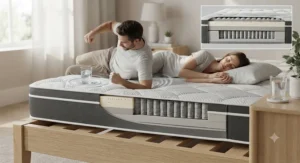
The listing describes horizontal ventilation channels across the sleep surface, aimed at improving airflow and temperature regulation beyond what a flat latex slab manages alone, alongside orthopaedic, medium-firm positioning designed around spinal alignment and joint pressure relief. Here’s what’s worth flagging honestly: labelling on latex mattresses isn’t independently regulated in the UK, so a “100%” or “natural” claim on packaging isn’t automatically backed by third-party certification the way an Oeko-Tex stamp is. That’s not an accusation against this specific product — simply a reminder to check for GOLS or equivalent certification directly on the current listing before assuming natural-latex pricing guarantees natural-latex content.
On value terms, this sits meaningfully above the Sareer and Inofia options in price, and the honest analytical take is that the premium buys you deeper latex construction and engineered ventilation channels — genuine upgrades — rather than a fundamentally different experience for every sleeper. For back-pain sufferers specifically prioritising orthopaedic support, though, the extra depth and channel design are worth the difference.
Pros:
- ✅ 21cm depth is substantially deeper than most budget latex builds
- ✅ Engineered ventilation channels genuinely target temperature regulation
- ✅ Orthopaedic, medium-firm design suited to back and joint pressure relief
Cons:
- ❌ Meaningfully pricier than the budget and mid-range picks on this list
- ❌ “100%” latex claims aren’t independently certified on every listing — verify before buying
Think of this one as the ceiling reference point on this list: what you’re paying to move from “good synthetic-latex value” into “genuinely premium latex construction.”
7. Dormeo Octaspring 9500 Latex Mattress — best premium hybrid for long-term investment buyers
Dormeo built its UK reputation on Octaspring technology — a support layer of individual spring-shaped foam cylinders rather than traditional coils — and the 9500 combines that with a latex comfort layer for what’s consistently referenced across independent UK mattress comparison sites as one of the pricier latex hybrids on the market.
The Octaspring cylinders work on a genuinely different mechanical principle from either traditional coil springs or flat latex-foam slabs: each cylinder compresses independently and rebounds quickly, which the brand positions as combining spring-like responsiveness with foam-like pressure distribution. Based on the spec comparison with everything else on this list, that’s the most mechanically distinct construction here — not simply “more latex, higher price,” but a different support architecture layered underneath the latex comfort surface. One independent UK review source used this exact model as the price benchmark against which it measured Silentnight’s much cheaper Lift Renew, explicitly noting they’re “very different in how they’re designed and made” — a useful, honest reminder that price gaps in this category often reflect genuinely different engineering, not just brand markup.
Given the investment involved, this is the pick for buyers who’ve already decided latex is right for them long-term and want the most engineered support structure available, rather than someone still deciding whether latex suits their sleep style at all.
Pros:
- ✅ Octaspring cylinder technology offers genuinely distinct support mechanics
- ✅ Combines spring-like responsiveness with latex’s pressure-relief properties
- ✅ Strong, established UK brand reputation for hybrid mattress engineering
Cons:
- ❌ Sits well above every other mattress on this list on price
- ❌ Overkill for buyers who haven’t yet confirmed they prefer a latex feel
If you’re not sure latex suits you at all, this isn’t where to start; if you already know it does and want the best-engineered version, it’s a genuinely strong contender.
Top 7 Synthetic Latex Mattresses at a Glance
| Mattress | Build Type | Latex Position | Best For | Price Range |
|---|---|---|---|---|
| Sareer Matrah Latex Foam Mattress | Reflex foam + latex top | Entry-level synthetic/blended | Absolute lowest budget | Under £200 |
| Sareer Matrah Latex Pocket Mattress | Pocket springs + latex | Budget-mid | Couples on a budget | £200–£300 range |
| Inofia Latex Memory Foam Pocket Sprung | Pocket springs + bi-density latex foam | Budget hybrid | Hot sleepers wanting airflow | £250–£350 range |
| Silentnight Lift Renew Latex Mattress | Foam + latex, Oeko-Tex | Budget big-brand | Chemical-sensitive budget buyers | Under £300 |
| Silentnight Mirapocket 1000 Latex Mattress | 1,000 pocket springs + latex | Mid-range | Couples wanting a brand step-up | Mid-£300s |
| Pikolin 100% Latex Mattress CL16086 | Deep latex, ventilation channels | Premium/natural-labelled | Back-pain, orthopaedic priority | £500–£800 range |
| Dormeo Octaspring 9500 Latex Mattress | Octaspring cylinders + latex | Premium hybrid | Long-term investment buyers | Over £800 |
Scanning left to right, the clearest signal in this table is that build type, not price alone, dictates who each mattress actually suits — the two Sareer options and the Inofia hybrid all sit in genuinely affordable latex mattress territory but solve slightly different problems (firmness consistency versus motion isolation versus airflow), while the jump to Pikolin and Dormeo isn’t really about “more latex,” it’s about materially different engineering underneath it. If your budget caps out around the £300 mark, the Silentnight Mirapocket 1000 is arguably the pivot point worth studying most closely, since it’s the last stop before premium pricing kicks in properly.
How to Choose a Synthetic Latex Mattress
Picking between these options comes down to a handful of genuinely decision-shaping questions, in roughly this order of importance:
- Check the exact latex ratio, not just the word “latex.” A listing description that says “100% latex” is telling you something different from one that says “latex foam” or “latex-infused memory foam” — the second two often signal blended or synthetic content rather than pure latex.
- Match spring type to your sleep pattern. Foam-only latex builds (like the entry-level Sareer) suit stiller sleepers; pocket-sprung latex hybrids suit restless sleepers and couples who need motion isolation.
- Prioritise Oeko-Tex or GOLS certification over marketing adjectives. Words like “intense” or “premium” comfort layers aren’t independently verifiable; certification labels are.
- Weigh depth against your existing bed base. A thinner latex-foam mattress (under 20cm) needs a genuinely solid, well-supported base underneath it to avoid feeling thin or under-firm.
- Decide your firmness preference before shopping, not during. Synthetic latex trends firmer than natural latex by default — useful for back and stomach sleepers, less ideal for lighter side sleepers who want deeper cushioning.
- Factor in the guarantee length realistically. A shorter guarantee on a genuinely cheaper mattress can still work out better value than a longer guarantee on something you’d have replaced anyway by year four.
- Read the return policy before the reviews. Because latex feel is genuinely subjective, a generous trial period matters more for this category than for, say, buying a duvet.
SBR Latex Mattress: What the Science Actually Means
Styrene-butadiene rubber, or SBR, is the same broad family of synthetic rubber you’ll find in playground surfacing and some sports-turf backing — which sounds alarming until you understand it’s chosen precisely because it’s durable and safe for repeated human contact, not despite that.
Here’s what most buyers overlook about SBR specifically: the “off-gassing” concern that comes up constantly in mattress forums is real but time-limited, not a permanent feature of the material. New SBR foam, like most new polyurethane and memory foams too, can release a noticeable smell in the first few days as manufacturing residues disperse, and this typically fades with airing rather than persisting indefinitely. Reviewers researching synthetic latex mattress builds broadly report this initial smell as the most common early complaint, and unpacking a rolled mattress in a well-ventilated room for 24–48 hours before first use is the standard, sensible mitigation — not a workaround for a fault, just standard practice for any compressed foam product.
What SBR won’t do, and this is the honest trade-off rather than a flaw, is match natural latex’s long-term buoyancy. Natural rubber-tree latex has a cellular structure that natural latex mattress buyers, and the industry more broadly, associate with slower degradation and sustained responsiveness over a decade-plus of nightly use. SBR foam is more prone to gradual firmness loss and, in lower-quality builds, edge crumbling over several years — which is precisely why the smartest budget latex mattresses (like several on this list) blend SBR with a smaller proportion of natural latex, or pair it with a supportive pocket-spring base that shoulders more of the long-term structural load.

Blended Latex Mattress vs 100% Synthetic: What’s the Real Difference
On paper, a blended latex mattress sounds like a compromise nobody’s fully happy with — not quite natural, not quite synthetic. In practice, it’s usually the smarter buy for most people, and here’s the reasoning behind that.
A typical blend runs somewhere around 30% natural latex to 70% synthetic, though the exact ratio varies genuinely by manufacturer and isn’t always disclosed clearly on UK retail listings. The natural fraction does most of the work on feel: it’s what gives a blend its closer-to-natural bounce and responsiveness, even at a relatively small proportion, because natural latex’s cellular structure behaves differently under load than SBR even in small quantities layered strategically. The synthetic majority, meanwhile, is doing the heavy lifting on cost control, since natural latex remains dramatically more expensive to source and process than lab-made SBR.
Where 100% synthetic wins outright is upfront price and firmness consistency — a pure-SBR mattress won’t have the batch-to-batch variability that natural, agriculturally-sourced latex sometimes shows. Where blended wins is everything related to longevity and feel: better resistance to the gradual softening and edge degradation that pure synthetic foam is more prone to over years of use, plus noticeably better breathability, since natural latex’s more open cellular structure allows more airflow than dense SBR alone.
The honest advice: if your budget realistically tops out under £250, don’t feel short-changed choosing pure synthetic — the blended option at that price point is often a thinner comfort layer stretched to hit a price target, which can undercut the benefit anyway. If you can stretch into the £300–£600 range, a genuine, clearly-labelled blend is usually the better-value pick over either extreme.
✨ Don’t Miss These Exclusive Deals!
🔍 Take your sleep setup to the next level with these carefully selected options above. Click through on any highlighted mattress to check current pricing and availability on amazon.co.uk. A few minutes comparing specs now could mean years of better sleep ahead!
Affordable Latex Mattress: Where the Savings Really Come From
“Affordable” and “cheap” get used interchangeably in mattress marketing, but they describe genuinely different products, and understanding where the cost actually gets cut is the single most useful thing you can do before buying.
An affordable latex mattress typically saves money in one or more of three specific places: reducing the latex layer’s thickness (rather than its quality), swapping a higher pocket-spring count for a lower one, or using SBR instead of natural or blended latex throughout. Crucially, none of those three, done properly, means a badly made mattress — they’re legitimate cost-engineering decisions that a well-run manufacturer makes deliberately. The Sareer Matrah range on this list is a clean example: it isn’t cutting corners so much as choosing a simpler, cheaper-to-manufacture construction (reflex foam base, thinner latex top) rather than a premium pocket-and-deep-latex build, and pricing accordingly.
Where things go wrong — and this is the genuinely useful distinction for spotting a bad deal — is when a listing borrows “latex” language to describe a mattress with only a thin surface skim of latex-infused foam sitting over standard polyurethane, priced as though it were a genuine latex-comfort-layer product. That’s not illegal, but it is the kind of labelling gap that makes checking the actual layer breakdown in a product’s full specification worth the extra thirty seconds before you add to basket.
Cheap Latex Mattress Red Flags: Common Buying Mistakes
Cheap and affordable aren’t the same thing, and the gap between them is usually where regret lives. Here are the mistakes that come up most consistently when people buy on price alone.
Mistake 1: Assuming “latex” always means the same construction. As covered above, the word alone tells you almost nothing about ratio, layer depth, or certification. Solution: always check the full product description for latex percentage, layer thickness, and any Oeko-Tex or GOLS certification before comparing price.
Mistake 2: Ignoring the base beneath the mattress. A genuinely cheap latex mattress on an unsupportive, widely-spaced slatted base will feel far worse than the same mattress on a solid or closely-slatted base — and the mattress often gets the blame unfairly. Solution: check your existing bed base’s slat spacing (ideally under 3cm gaps) before assuming a disappointing feel is the mattress’s fault.
Mistake 3: Skipping the trial and return window details. Cheaper mattresses, especially from newer or smaller brands, sometimes carry shorter or less generous return windows than established names. Solution: read the specific return policy on the listing, not just the star rating, before buying.
Mistake 4: Buying the cheapest option in a size that doesn’t suit two sleepers. A budget single-sized synthetic latex mattress squeezed into a double frame use-case will underperform regardless of quality. Solution: size up rather than down if there’s any chance of shared use, even if it pushes you toward the next price bracket.
Mistake 5: Expecting cheap synthetic latex to last as long as premium natural latex. Realistic lifespan expectations matter for value-for-money maths. Solution: budget mentally for a 5–7 year lifespan on genuinely cheap synthetic builds rather than the 10–15 years sometimes quoted for premium natural latex, and factor that into your actual cost-per-year comparison.
Synthetic Latex Mattress Reviews: What Real Owners Report
Rather than inventing composite “customer feedback,” it’s worth being transparent about what genuinely verifiable review data shows across this category, and where it’s thinner than you’d like.
For the Sareer Matrah latex line specifically, independent retailer review pages carry a modest but real spread of feedback, including specific mentions of the mattress feeling thinner than expected relative to previous latex purchases, and a preference among some buyers for pairing it with a firmer bed base than the one they initially used. That’s consistent, useful, low-volume-but-genuine feedback rather than marketing spin.
For the Silentnight range, independent UK mattress comparison sites — rather than direct customer review aggregation — offer the clearest third-party commentary available at the time of research, and it’s a genuinely mixed, credible picture: praise for value relative to premium competitors, alongside honest flags about spring count and guarantee length falling short of higher-tier options. That kind of balanced, specific commentary is worth more than a blanket star rating, because it tells you what the trade-offs actually are rather than just that trade-offs exist.
For the Inofia and Pikolin listings specifically, verifiable, product-specific review volume was genuinely limited at the time of research — which isn’t a red flag in itself (newer listings and less prominent placements naturally accumulate reviews more slowly) but is worth acknowledging honestly rather than papering over. If review volume matters to your decision, checking the live review count and reading the most recent handful directly on the current Amazon listing takes a few minutes and is the single most reliable way to close that gap yourself.
The consistent theme across everything genuinely verifiable in this category: real reviewers weight bed-base compatibility and realistic firmness expectations more heavily than almost any spec on the listing page — a pattern worth remembering more than any individual star rating.
Latex Feel Budget Mattress: Getting the Bounce Without the Price Tag
If genuine latex — synthetic, blended or natural — still sits outside your budget, there’s a slightly different category worth knowing about: latex-feel budget mattresses that use polyurethane or memory foam engineered to mimic latex’s responsiveness without containing latex at all.
These typically achieve the effect through open-cell foam structures and reactive polyurethane formulations designed to rebound faster than standard memory foam, which is engineered to slowly contour and hold shape rather than spring back. What most buyers overlook here is that a well-engineered latex-feel foam can genuinely deliver 70–80% of the responsive, non-sinking sensation that draws people to latex in the first place, at a noticeably lower price than even entry-level SBR latex, simply because polyurethane manufacturing is cheaper at scale than any latex process.
The honest trade-off: these mattresses won’t carry latex’s natural hypoallergenic or antimicrobial properties, since those come specifically from the rubber-tree-derived material rather than the foam’s responsiveness characteristics. For allergy-driven buyers, that distinction matters more than firmness or bounce — a latex-feel foam mattress solves the comfort question but not the allergen question, so check the actual material composition rather than assuming “feels like latex” means “behaves like latex” across every property.
Practical Usage Guide: Setup, First 30 Days & Maintenance
Getting a synthetic or blended latex mattress right isn’t just about the purchase decision — the first month genuinely shapes how it performs for years afterward.
Unboxing and settling: Most compressed, rolled latex-hybrid mattresses need 24–72 hours to fully expand to their stated depth, and it’s worth resisting the temptation to sleep on it immediately at full weight during that window. Unroll it in the room it’ll be used in, on the actual bed base, and give it proper airing time — this also handles most of the initial off-gassing smell discussed earlier.
Rotation, not flipping: Unlike older double-sided mattresses, most modern latex-comfort-layer builds (including everything on this list) are single-sided and shouldn’t be flipped, but rotating head-to-foot every 4–8 weeks in the first six months helps even out initial settling before your regular sleep position creates a permanent impression.
Base compatibility check: As flagged repeatedly in the reviews above, latex-topped mattresses are noticeably more sensitive to base quality than pocket-sprung-only alternatives. If you’re moving a new latex mattress onto an old slatted base, check slat spacing before assuming any disappointing firmness is the mattress’s fault.
Common first-30-days mistakes: Judging final firmness within the first week (foam genuinely softens slightly as it settles into regular use), skipping the recommended airing period and blaming the mattress for a smell that would have faded anyway, and using a mattress protector so thick or waterproof-backed that it mutes the latex layer’s natural breathability — a light, breathable protector preserves far more of the intended feel.
Ongoing maintenance: Vacuum the surface every few weeks to prevent dust accumulation in the latex’s naturally open structure, keep the removable cover washed according to its label (where fitted), and avoid folding or compressing the mattress after initial setup, since repeated compression accelerates the exact firmness loss that shortens synthetic latex’s lifespan versus natural.
Real-World Scenarios: Who Should Buy Which Mattress
The budget-conscious student moving into halls. Limited funds, limited space, likely moving again within a year or two. A foam-and-latex build like the entry-level Sareer Matrah Latex Foam Mattress makes sense here — genuinely affordable, easy to transport rolled, and not a mattress you’ll agonise over replacing after a single year of student-halls wear.
The couple upgrading their main bedroom on a realistic budget. Two different sleep patterns sharing one mattress, motion transfer a genuine nightly concern, but a premium four-figure spend isn’t happening this year. The Silentnight Mirapocket 1000 Latex Mattress or the Inofia pocket-sprung hybrid both make sense here — pocket springs handle the motion-isolation problem directly, while the latex layer adds the pressure relief a pure-spring budget mattress alone can’t.
The back-pain sufferer prioritising support over price. Where firmness consistency and genuine orthopaedic positioning matter more than shaving off every possible pound, stretching to the Pikolin 100% Latex Mattress CL16086 or the Dormeo Octaspring 9500 makes more sense than compromising on support to hit a lower price point — this is a case where the honest advice is to spend more if you genuinely can.
Long-Term Cost & Maintenance: The True Cost of Ownership
A genuinely useful way to compare across this list isn’t sticker price alone, but rough cost-per-year over a realistic expected lifespan — because a cheaper mattress that needs replacing twice as often isn’t automatically the better-value buy.
Budget synthetic-latex builds (the two Sareer options, the Inofia hybrid) realistically run 5–7 years of solid performance before firmness loss becomes noticeable enough to affect sleep quality, based on SBR’s known degradation pattern discussed earlier. Mid-range blended options with a stronger pocket-spring base (the Silentnight pair) typically stretch that to 6–8 years, since a well-built spring unit shoulders more of the long-term structural load than the latex layer alone. Premium options with deeper, higher-latex-content builds (Pikolin, Dormeo) are the ones genuinely positioned for 8–12+ years, which is where their higher upfront price starts to look more reasonable on a per-year basis, even if the headline number is intimidating.
Running rough maths on that basis: a budget mattress replaced every six years works out to a broadly comparable annual cost to a premium mattress lasting ten, once you factor in that premium builds also tend to include longer guarantees, reducing your realistic risk of an unplanned early replacement. Neither approach is objectively “wrong” — it genuinely depends on whether you’d rather pay less upfront with a shorter horizon, or more upfront for a longer one.
Safety, Regulations & UK Compliance
Every mattress legally sold in the UK — synthetic latex, natural latex, memory foam or otherwise — must comply with the Furniture and Furnishings (Fire) (Safety) Regulations 1988, which set specific ignition-resistance requirements for filling materials including latex foam. This is genuinely useful context for synthetic latex mattress buyers specifically, because it means the fire-safety baseline is legally mandated regardless of which product on this list you choose — the variation between mattresses is in comfort and construction quality, not fire-safety compliance, provided you’re buying from a legitimate UK retailer.
Where genuine variation does exist is in chemical treatment method used to meet those fire-safety standards, which is exactly why products like the Silentnight Lift Renew flagging themselves as FR chemical treatment-free is a meaningful, checkable differentiator rather than marketing noise — some manufacturers meet fire-safety requirements through inherently fire-resistant fibres and barriers rather than chemical retardant treatments, and that distinction genuinely matters to chemically-sensitive buyers.
Independent chemical-safety verification is where certification labels do real work. OEKO-TEX Standard 100 certification specifically tests finished textile and foam products against over 1,000 potentially harmful substances, and it’s a genuinely third-party-verified standard rather than a manufacturer’s own claim — worth actively looking for on any listing where chemical sensitivity or off-gassing concerns are a priority, particularly with 100% synthetic SBR builds where that initial new-mattress smell tends to be most noticeable.
Features That Actually Matter (And Those That Don’t)
Actually matters: Pocket-spring count relative to mattress width, latex layer thickness and position (comfort layer versus support layer), Oeko-Tex or GOLS certification, cover breathability, and realistic guarantee length matched to expected lifespan.
Doesn’t really matter: Vague comfort-layer branding names (“Intense,” “Renew,” proprietary marketing terms with no independently defined meaning), colour of the cover fabric, and headline depth measurements taken in isolation from what’s actually inside those centimetres — a 27cm mattress with 4cm of genuine latex over cheap filler foam isn’t meaningfully better than a well-built 20cm mattress with a properly proportioned latex layer.
The pattern worth remembering: anything a manufacturer can independently verify through a recognised third-party standard is worth weighing heavily; anything that’s purely descriptive marketing language, however evocative, is worth treating as a hook rather than a genuine differentiator.
FAQ
❓ Is a synthetic latex mattress bad for you?
❓ How long does a synthetic latex mattress last?
❓ Is blended latex better than 100% synthetic latex?
❓ Can you get a cheap latex mattress that doesn't smell?
❓ What's the difference between a latex feel mattress and an actual latex mattress?
Conclusion
There’s no single “best” synthetic latex mattress on this list, and that’s not a cop-out — it’s the honest conclusion of actually comparing seven genuinely different builds against real needs rather than a single ranking. If your budget is tight and firm support suits you, the entry-level Sareer Matrah Latex Foam Mattress is a legitimately good, honestly-priced way onto a latex sleep surface. If motion isolation matters more because you’re sharing the bed, the pocket-sprung Sareer or Inofia options solve that specific problem directly. And if you’ve already decided latex is right for you long-term and can stretch the budget, the Pikolin and Dormeo options represent genuinely different, more deeply engineered constructions rather than the same mattress with a bigger price tag stapled on.
What ties all seven together, and what’s worth carrying forward regardless of which one you pick, is the checklist this guide keeps returning to: verify the actual latex content rather than trusting the word alone, match spring type to how restlessly you sleep, weight independently verifiable certifications over evocative marketing language, and budget realistically for the lifespan a mattress at that price point can actually deliver. Get those four things right, and the specific product almost becomes secondary — you’ll end up with a mattress that suits how you actually sleep, at a price that reflects what it genuinely does for you rather than what the label claims.
Sleep quality genuinely affects daily wellbeing in ways that are easy to underrate until it’s disrupted, and the NHS’s guidance on falling asleep faster and sleeping better is a useful companion read alongside any mattress decision — a good mattress solves comfort and support, but routine and environment matter just as much for the sleep itself. For deeper, independently tested mattress comparisons beyond this specific latex category, Which?’s mattress buying guide is a genuinely reputable UK resource worth bookmarking before your next mattress decision, latex or otherwise.
✨ Ready to Find Your Perfect Match?
🔍 You’ve now got the full picture on synthetic, blended and budget latex mattresses — from build quality to real ownership costs. Click through on any of the seven picks above to check current pricing and availability on amazon.co.uk, and compare specs side by side before you commit. A better night’s sleep is closer than you think
Recommended for You
- Eco Friendly Mattress UK: 7 Genuinely Sustainable Picks (2026)
- Dunlop vs Talalay Latex Mattress: 7 Honest Picks 2026
- Natural Latex Mattress UK: 7 Genuinely Organic Picks for 2026
Disclaimer: This article contains affiliate links. As an Amazon Associate, I earn from qualifying purchases. If you purchase products through these links, we may earn a small commission at no additional cost to you.
✨ Found this helpful? Share it with your friends! 💬🤗
