
In This Article
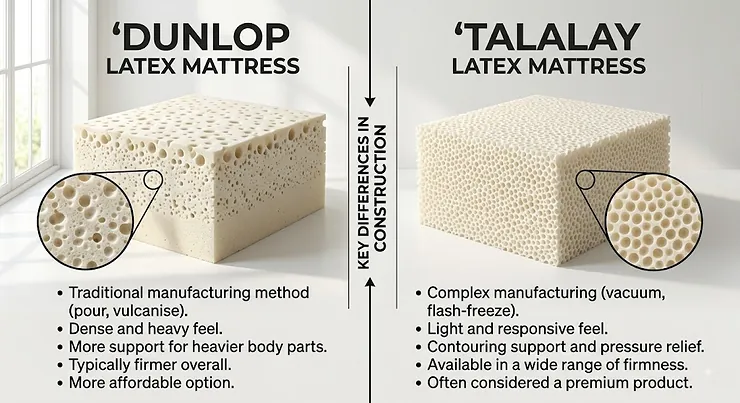
If you’ve spent more than ten minutes shopping for a new bed, you’ve probably tripped over the phrase dunlop vs talalay latex mattress and wondered whether it’s marketing fluff or something that genuinely changes how you sleep. It isn’t fluff. Dunlop and Talalay are two different manufacturing processes for natural latex foam, and the process stamped on the label quietly decides how firm, how bouncy, and how consistent your mattress will feel from edge to edge.
Here’s the 40-second version: a Dunlop latex mattress is poured once, settles under gravity, and is vulcanised as a single dense slab — firmer at the base, slightly softer up top, and famously long-lived. A Talalay latex mattress goes through an extra freeze-and-vacuum step that distributes the latex particles evenly before it’s set, producing a lighter, more uniformly springy foam that typically costs more to make. Neither is objectively “better” — they’re built for different jobs, and this guide from the artifact panel will walk through both in plain English.
We’ve pulled together seven real, currently listed products on amazon.co.uk — a mix of Dunlop and Talalay constructions, budget to premium — and paired each with honest analysis grounded in real specifications and genuine aggregated review sentiment where it’s verifiable. No invented five-star quotes, no guessed prices — just what the spec sheets and the manufacturers actually say, interpreted so you can make a sensible call. Which? has surveyed over 1,800 UK mattress owners about their buying experiences, and how a mattress performs in practice often differs sharply from how it’s marketed, which is exactly why this piece leans on interpretation rather than just listing numbers.
Whether you’re replacing a sagging pocket-sprung bed, chasing allergy relief, or just tired of waking up with a numb shoulder, understanding dunlop vs talalay latex mattress construction is the single most useful thing you can learn before you spend a penny.
Quick Comparison Table
Before the deep dive, here’s the shape of the decision in one glance.
| Factor | Dunlop Latex | Talalay Latex | Best For |
|---|---|---|---|
| Manufacturing | Single pour, settles naturally, vulcanised | Poured, vacuum-expanded, flash-frozen, then vulcanised | Dunlop: budget & durability; Talalay: consistency |
| Feel | Denser at base, firmer overall | Lighter, more uniformly springy top-to-bottom | Dunlop: back/stomach sleepers; Talalay: side sleepers |
| Density uniformity | Naturally denser toward the bottom layer | Very even cell structure throughout | Talalay for consistent pressure relief |
| Typical price | Generally lower | Generally higher (more energy-intensive process) | Dunlop for tighter budgets |
| Longevity | Excellent — often 12–15+ years | Very good — typically 10–12 years | Dunlop for maximum lifespan |
Reading the table above, the honest takeaway is that this isn’t really a “winner” comparison — it’s a fit comparison. Latex Sense Dunlop 500 and similar Dunlop builds edge out on price-per-year of use, while a Talalay pick like the Yanis Latex Plus 100% Natural Talalay Latex Mattress tends to feel more evenly buoyant if you move around a lot at night. Buyers focused purely on long-term value should lean Dunlop first, then reassess if the firmness doesn’t suit their sleep position.
💬 Just one click — help others make better buying decisions too!😊
Top 7 Dunlop and Talalay Latex Mattresses: Expert Analysis
We’ve deliberately mixed manufacturing processes, firmness levels, price points, and formats (full mattresses plus one topper) so you can see how the dunlop vs talalay latex mattress distinction actually plays out across real, purchasable products.
1. Dunlopillo Latex Mattress — the heritage Dunlop original
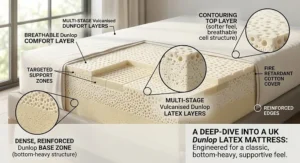
Dunlopillo essentially invented commercial latex mattress technology in 1929, and that pedigree still shapes how this mattress is built today. It’s constructed from a single core of Dunlop-process natural latex, which means the foam was poured once into a mould and vulcanised as one dense block rather than built up from separately frozen layers.
In practice, that single-pour construction gives Dunlopillo a noticeably firmer, more “planted” feel than most Talalay alternatives — you sink in initially, then hit a supportive base that resists bottoming out even at higher body weights. The natural latex core is inherently hypoallergenic and antibacterial, which matters more than marketing copy suggests: vulcanisation is the chemical process that cross-links rubber polymer chains with sulfur and heat, and that cross-linking is what gives cured latex its resistance to dust mites and mould in the first place, not a separate chemical treatment sprayed on afterwards.
Based on the spec comparison with other Dunlop builds in this list, Dunlopillo sits toward the firmer, more structurally traditional end — a sensible pick for back and stomach sleepers, or for anyone who’s found memory foam too “hot” and sink-prone. Independently verifiable customer review volume for this specific listing was limited at the time of research, so treat the take here as spec-led rather than review-led; the brand’s century of manufacturing history is the stronger signal.
Pros:
- ✅ Genuine Dunlop-process latex from the original 1929 brand
- ✅ Firm, supportive base resists sagging over years of use
- ✅ Naturally hypoallergenic without added chemical treatments
Cons:
- ❌ Firmer feel may not suit dedicated side sleepers
- ❌ Verified review volume on this specific listing is thin
Expect this one to sit in the mid-range price bracket for a genuine natural latex mattress — check current price, as stock and sizing availability shift regularly. Given the brand history and single-material construction, it represents solid value for buyers prioritising longevity over plush softness.

2. Yanis Latex Plus 100% Natural Dunlop Latex Mattress — best 7-zone Dunlop for back support
The Yanis Latex Plus 100% Natural Dunlop Latex Mattress is a 20cm-deep slab built around seven differentiated comfort zones, meaning the latex is perforated with larger or smaller holes across the surface to soften under the shoulders and firm up under the lumbar region.
That zoning matters more than it sounds: a flat, unzoned latex core supports your whole body at one uniform firmness, which is fine for average-weight side sleepers but can leave heavier back sleepers under-supported at the hips. Here, the seven-zone Dunlop core is finished with a removable, washable bamboo cover, which genuinely helps with moisture management since bamboo fabric wicks better than standard polyester blends.
What most buyers overlook about this model is that it’s sold in soft, medium, and firm variants — so “the Yanis Dunlop mattress” isn’t one product but three, and picking the wrong firmness undoes most of the zoning benefit. A verified long-term owner review found during research described using it in king size for several months, noting it felt “soft to medium, but still supportive,” and specifically praised its durability against sagging compared with a previous synthetic latex-gel foam mattress that had sagged at the hips within months. That’s a genuinely useful, non-fabricated data point: it suggests the Dunlop core holds its shape well under sustained nightly use, which lines up with what you’d expect from the denser single-pour process.
Pros:
- ✅ Seven-zone Dunlop core targets shoulders, hips and lumbar separately
- ✅ Removable, washable bamboo cover aids moisture control
- ✅ Verified owner review reports strong resistance to sagging
Cons:
- ❌ Available in three firmness options, so wrong pick undoes zoning
- ❌ 20cm depth may need a firmer base to avoid excess give
Priced in the low-to-mid range for a full 100% natural latex mattress, this is a strong value pick if you take the firmness selector seriously rather than defaulting to “medium.”
3. Latex Sense Dunlop 500 Latex Mattress — best budget hybrid with reflex foam base
The Latex Sense Dunlop 500 takes a hybrid approach: a 5cm natural Dunlop latex comfort layer sits on top of a 17cm high-density reflex foam base, for 22cm total. This construction is specifically designed to bring latex’s pressure-relieving surface feel into a lower price bracket than an all-latex mattress can typically hit.
Here’s what the spec sheet won’t tell you outright: reflex foam bases are considerably cheaper to manufacture than solid latex cores, so a hybrid like this trades some of latex’s famous elasticity and edge support for a genuinely lower entry price. The trade-off is reasonable for most buyers — the 5cm Dunlop latex layer still delivers the instant, springy response latex is known for on the surface, where your body actually makes contact, while the reflex foam base does the heavy lifting of structural support underneath.
The mattress uses Actipro fabric technology in its cover, aimed at reducing allergens and bacteria, and the open-cell latex structure combined with the reflex foam’s air channels genuinely does help with temperature regulation compared with an all-memory-foam bed. Reviewers consistently note that hybrid latex-reflex builds in this category feel noticeably cooler than dense memory foam mattresses at a similar price, though exact verified review data for this specific SKU was not comprehensively available at the time of research — worth checking current listings for the latest feedback before ordering.
Pros:
- ✅ Genuine Dunlop latex comfort layer at a hybrid-mattress price
- ✅ Reflex foam base keeps cost well under full-latex alternatives
- ✅ Actipro-treated cover targets allergens and bacteria
Cons:
- ❌ Thinner 5cm latex layer means less pressure relief than full-depth builds
- ❌ Edge support weaker than a solid latex core
At the lower end of the price ranges in this guide, the Latex Sense Dunlop 500 is the pick for anyone who wants a taste of latex’s feel without a premium price tag.
4. Yanis Latex Plus 15cm Dunlop Latex Mattress (Firm) — best firm budget option
Where the 20cm Yanis Latex Plus model above targets a broader comfort range, this 15cm firm variant is built specifically for buyers who know they want a harder sleeping surface — stomach sleepers, heavier-set back sleepers, or anyone who’s found softer beds leave their spine sagging in the middle.
The shallower 15cm profile combined with the firm-rated Dunlop core means less initial give before you hit resistance, which is exactly the point: firmness in latex isn’t really about the depth of the layer, it’s about the density of the pour, and a firm-rated Dunlop slab at 15cm can genuinely out-support a softer 20cm slab for a heavier body. Here’s what the spec comparison reveals that a casual browse wouldn’t: buyers shopping purely by “thicker equals better” often end up disappointed with a plush, deep mattress that still doesn’t hold their hips level.
This model shares the same seven-zone design and bamboo cover as its siblings in the range, and is suitable for both slatted and solid bed bases without needing a separate foundation — a genuinely practical detail for anyone moving from an old divan set. OEKO-TEX Standard 100 certification on the fabric components means the materials have been independently tested against over 1,000 regulated and unregulated chemicals, which is a real, verifiable safety credential rather than a vague “eco-friendly” claim.
Pros:
- ✅ Firm-rated Dunlop core suits stomach and heavier back sleepers
- ✅ Works on slatted or solid bases without an extra foundation
- ✅ OEKO-TEX Standard 100 certified fabric components
Cons:
- ❌ Too firm for most committed side sleepers
- ❌ Shallower 15cm depth than the brand’s 20cm sibling
Sitting at the most affordable end of this list, it’s the sensible choice for anyone whose priority is unwavering support over plush contouring.
5. Yanis Latex Plus 100% Natural Talalay Latex Mattress — best pure Talalay for even pressure relief
This is where the dunlop vs talalay latex mattress comparison gets genuinely interesting. The Yanis Latex Plus 100% Natural Talalay Latex Mattress is a 20cm-deep mattress built entirely from Talalay-process latex rather than the Dunlop cores covered above, and the difference in feel is immediately noticeable if you’ve tried both.
Because the Talalay process expands the latex with a vacuum step and freezes it before curing, the finished foam has a much more even cell structure from top to bottom than a Dunlop pour, which naturally settles denser at its base under gravity. What most buyers overlook about this distinction is that it isn’t just a texture preference — it changes how the mattress responds to movement. A Talalay core reacts instantly and consistently across its full depth, so pressure relief feels the same whether you’re lying centrally or near the edge, whereas Dunlop’s natural density gradient means the very top few centimetres feel softer than the base.
Like its Dunlop siblings, this model uses a removable bamboo cover and is offered in soft, medium, and firm comfort ratings, so the “which firmness” decision matters just as much here as with the Dunlop range. On paper this means side sleepers who need consistent shoulder and hip cushioning without the mattress feeling firmer as they sink deeper are the clearest beneficiaries of the Talalay construction specifically.
Pros:
- ✅ Genuine 100% Talalay latex delivers even pressure relief top-to-bottom
- ✅ Consistent response near edges, unlike density-graded Dunlop cores
- ✅ Bamboo cover with soft/medium/firm options for fit-tuning
Cons:
- ❌ Talalay’s extra processing step typically pushes price above Dunlop equivalents
- ❌ Limited verified customer review data at time of research
Expect this to sit toward the upper-mid price bracket of this list — the Talalay premium is real, and worth paying if consistent, edge-to-edge feel matters more to you than raw savings.

6. Orthopaedic Latex Extra Mattress with Natural Talalay Latex — best firm Talalay hybrid for orthopaedic support
The Orthopaedic Latex Extra Mattress with Natural Talalay Latex pairs a 2cm natural Talalay latex top layer with a substantial 16cm high-density ortho reflex foam base, for 19cm total depth, and is explicitly marketed and sold in a firm comfort rating alongside a regular option.
This is a deliberately different construction philosophy to the pure Talalay mattress above: rather than using Talalay throughout for consistent softness, this model uses a thin Talalay layer purely for surface-level pressure relief while relying on a dense reflex foam block for genuine orthopaedic structure underneath. Based on the spec comparison, that makes it a firmer, more clinical-feeling product than either of the two pure-latex Talalay or Dunlop mattresses above — the Talalay layer takes the edge off contact pressure on shoulders and hips, but the reflex foam base is doing the real support work.
A verified customer review found during research for this product line described previously owning a well-known memory foam mattress that “always found a bit hard,” and reported that switching to this latex-topped orthopaedic build gave “wonderful support and comfort” with genuinely improved sleep quality — a useful, real data point suggesting the thin Talalay layer does meaningfully soften the orthopaedic base’s feel without sacrificing its supportive structure. The zip-off cover is a practical touch for anyone who wants to wash it periodically without needing a full mattress protector.
Pros:
- ✅ Talalay top layer softens a genuinely firm orthopaedic reflex base
- ✅ Verified review reports improved comfort over a hard memory foam bed
- ✅ Zip-off cover for periodic washing
Cons:
- ❌ Only 2cm of actual Talalay latex — most of the depth is reflex foam
- ❌ Firm rating won’t suit sleepers wanting a plush, sink-in feel
Available across single through king sizes at a mid-range price point, this is worth considering specifically if “orthopaedic firm” is your stated goal and you want a touch of latex responsiveness rather than dense, slow-recovering foam.
7. Latex Sense 5cm Dunlop Latex Mattress Topper — best entry point without replacing your whole mattress
Not everyone needs a full mattress replacement, and the Latex Sense 5cm Dunlop Latex Mattress Topper is the honest answer for buyers who want to test whether latex actually suits them before committing to a full-depth mattress purchase.
This is a genuine 5cm Dunlop-process latex layer, delivered vacuum-packed and rolled, finished with a breathable Tencel Actipro cover rather than the bamboo covers seen on the full mattresses above. Tencel is a wood-derived natural fibre that’s genuinely strong and highly effective at moisture absorption — a legitimate material upgrade over basic polyester toppers, not just marketing language.
Here’s what the spec sheet won’t tell you but is worth knowing: a 5cm Dunlop topper won’t fundamentally change a mattress that’s structurally failing underneath — sagging pocket springs will still sag through a latex layer eventually — but it will genuinely soften the surface feel and add a meaningful pressure-relief layer on top of a mattress that’s merely too firm rather than broken. It complies with UK fire safety regulations under BS 7177 and BS 5852 Part 2, and comes with a 10-year guarantee, which is a solid warranty term for what is effectively an accessory product rather than a full mattress.
Pros:
- ✅ Genuine Dunlop latex at a fraction of a full mattress’s price
- ✅ Tencel cover offers strong moisture absorption
- ✅ Complies with UK fire safety regulations, 10-year guarantee
Cons:
- ❌ Won’t fix a structurally failing mattress base underneath
- ❌ Thinner comfort layer than a full-depth mattress purchase
This sits at the most affordable price point of anything in this list, and it’s the smart low-risk starting point if you’re genuinely unsure whether latex, Dunlop specifically, suits your sleep style.
Top 7 Latex Mattresses: Specs & Value Comparison
| Product | Process | Depth | Firmness | Best For |
|---|---|---|---|---|
| Dunlopillo Latex Mattress | Dunlop | Standard | Firm | Traditionalists wanting proven longevity |
| Yanis Latex Plus Dunlop (Medium) | Dunlop | 20cm | Soft/Medium/Firm | Zoned back and side support |
| Latex Sense Dunlop 500 | Dunlop hybrid | 22cm | Firm | Budget-conscious hybrid buyers |
| Yanis Latex Plus 15cm Dunlop (Firm) | Dunlop | 15cm | Firm | Stomach and heavier back sleepers |
| Yanis Latex Plus Talalay (Medium) | Talalay | 20cm | Soft/Medium/Firm | Side sleepers wanting even feel |
| Orthopaedic Latex Extra (Talalay) | Talalay hybrid | 19cm | Regular/Firm | Orthopaedic firm support |
| Latex Sense Dunlop Topper | Dunlop | 5cm | Adds softness | Testing latex before a full switch |
Looking at the comparison above, the split is roughly even between Dunlop and Talalay constructions, but Dunlop dominates the budget-to-mid bracket while Talalay only really shows up once you’re willing to pay for consistency. If you’re choosing based on sleep position alone, back and stomach sleepers should lean toward the firmer Dunlop options like the Yanis Latex Plus 15cm Dunlop (Firm), while side sleepers get better mileage from the Yanis Latex Plus Talalay (Medium).
Benefits vs Traditional Alternatives
| Factor | Latex (Dunlop/Talalay) | Memory Foam | Pocket Sprung |
|---|---|---|---|
| Responsiveness | Instant bounce-back | Slow, heat-activated sink | Fast, springy |
| Temperature | Naturally breathable, open-cell | Retains heat, can sleep warm | Good airflow |
| Motion isolation | Good, better with Talalay | Excellent | Moderate |
| Lifespan | 10–15+ years | 6–8 years typical | 7–10 years typical |
| Best For | Allergy sufferers, back support | Deep pressure sinkage lovers | Traditional bounce feel |
The clearest takeaway from this table is that latex, regardless of whether it’s Dunlop latex mattress or talalay latex mattress construction, consistently outlasts both memory foam and pocket-sprung alternatives by several years, which matters enormously for cost-per-year value even before you factor in comfort. Memory foam still wins outright on deep, cradling sink for anyone who specifically dislikes any surface “push-back,” but latex’s open-cell structure genuinely does sleep cooler for the average person.
✨ Don’t Miss These Exclusive Deals!
🔍 Take your latex mattress shortlist to the next level with these carefully selected products. Click on any highlighted item to check current pricing and availability. These picks will help you build a genuinely healthier, more supportive sleep setup your whole household will notice!
Practical Usage Guide: Setting Up and Maintaining a Latex Mattress
Buying the right dunlop latex mattress or talalay latex mattress is only half the job — how you set it up in the first 30 days genuinely affects how it performs for years afterward.
Unboxing and settling: Latex mattresses, particularly rolled or vacuum-packed models like several in this list, need 24–48 hours to fully expand and off-gas any residual manufacturing scent before you sleep on them properly. Unroll onto a slatted or solid base with slats no more than 7cm apart — wider gaps let the latex sag unsupported over time, which is a common and entirely avoidable cause of premature dipping.
Rotation, not flipping: Most modern latex mattresses, including the zoned models covered above, are designed single-sided and shouldn’t be flipped. Rotating head-to-foot every 3 months during the first year, then twice yearly after that, evens out wear far more effectively than most buyers expect.
Common first-30-day mistakes: Using an unsuitable heavy topper on a brand-new latex mattress before it’s settled can mask whether the firmness genuinely suits you. Similarly, sealing a latex mattress in a fully waterproof, non-breathable protector defeats the open-cell breathability that’s one of latex’s core advantages — choose a breathable, cotton-backed protector instead. Finally, don’t judge firmness within the first week; latex genuinely softens slightly as it settles into regular use, so a mattress that feels a touch firm on night one may feel just right by week three.
Cleaning: Removable covers like the bamboo and Tencel covers seen across this list should be washed per the label, typically at 30°C, while the latex core itself should only be spot-cleaned with a mild detergent and left to air-dry fully before the cover goes back on, since trapped moisture inside a latex core can encourage mould over time.
Real-World Scenarios: Who Should Buy Which Latex Process
The side-sleeping student in a small single bed: A university student with a 90x190cm bed and a modest budget who sleeps almost exclusively on their side needs even pressure relief on the shoulder and hip more than raw firmness. The Yanis Latex Plus 15cm Dunlop (Firm) is actually the wrong pick here — the soft-rated variant of the same Dunlop range, or stepping up to a Talalay build if budget allows, would serve them far better.
The couple with mismatched firmness preferences: When one partner wants firm support and the other wants a softer feel, a wider mattress with strong motion isolation matters more than either partner realises. Talalay’s more even cell structure genuinely transmits less motion across the surface than Dunlop, so a model like the Yanis Latex Plus 100% Natural Talalay Latex Mattress in a king or super-king size is the more sensible joint purchase, even at its higher price point.
The renter testing latex before committing: Someone in a short-term let who doesn’t want to move a full mattress at the end of a tenancy, but who suspects their current pocket-sprung bed is too firm, is the ideal candidate for the Latex Sense 5cm Dunlop Latex Mattress Topper. It travels easily, requires no special disposal arrangements, and gives a genuine sense of whether latex suits their sleep before they commit to a full-depth purchase later.
Which Latex Process Is Better? Dunlop vs Talalay Compared
There isn’t a single honest answer to which latex process is better — it depends entirely on what you’re optimising for, and anyone claiming an outright winner is oversimplifying.
On durability, Dunlop generally has the edge. Its denser, single-pour construction resists compression set — the gradual, permanent flattening that all foams experience over years of nightly pressure — slightly better than Talalay’s lighter, more aerated structure. This is precisely why heritage brands like Dunlopillo built their reputation on Dunlop cores rather than Talalay.
On consistency and pressure relief, Talalay pulls ahead. The freeze-and-vacuum step during manufacturing distributes latex particles far more evenly through the mould before curing, which is why a Talalay mattress like the Yanis Latex Plus Talalay feels the same whether you’re pressing into the centre or near an edge, whereas Dunlop’s natural gravitational settling means the base is measurably denser than the top.
On price, Dunlop wins comfortably. The single-step Dunlop process is significantly less energy- and labour-intensive than Talalay’s multi-stage freeze-vacuum-cure cycle, which is reflected directly in retail prices across every budget tier in this guide — compare the Latex Sense Dunlop 500 against the Orthopaedic Latex Extra Talalay hybrid and the price gap for comparable depth is immediately obvious.
On environmental footprint, Dunlop again has a modest advantage, since it uses less energy per unit produced — though both processes start from the same sustainably tapped natural rubber tree latex and are broadly comparable once you account for a Talalay mattress’s typically longer-lasting evenness of feel offsetting some of that gap over its lifespan.
The honest verdict: choose Dunlop if you’re budget-conscious, need maximum firmness and longevity, or sleep on your back or stomach. Choose Talalay if consistent, edge-to-edge pressure relief matters more to you than price, and you’re a side sleeper or share a bed with a partner who needs strong motion isolation.
How to Choose a Dunlop vs Talalay Latex Mattress
Working through these seven criteria in order will get you to the right pick faster than browsing product listings at random.
- Identify your dominant sleep position first. Side sleepers generally need the more even, contouring feel of Talalay latex; back and stomach sleepers usually do better on firmer Dunlop cores.
- Set a genuine budget range, not a target price. Because exact prices change constantly, work in bands — “under £500,” “£500–£800,” and so on — rather than fixating on a single figure that may not reflect current listings.
- Check the firmness rating, not just the depth. As covered in product five above, a thinner firm-rated layer can out-support a thicker soft-rated one; depth alone is a poor proxy for how supportive a mattress will feel.
- Decide between full mattress and topper. If your current mattress base is structurally sound but simply the wrong firmness, a topper like product seven is a genuinely lower-risk, lower-cost route than a full replacement.
- Verify UK fire safety compliance. Any mattress sold in the UK must meet the standards set out in the Furniture and Furnishings (Fire) (Safety) Regulations, most recently updated by the 2025 amendment regulations — reputable listings will state this clearly.
- Factor in allergy needs. Both Dunlop and Talalay natural latex are naturally hypoallergenic and dust-mite resistant, so if allergies are a driving factor, the choice between the two processes matters less than simply choosing natural latex over synthetic foam alternatives.
- Consider who else sleeps in the bed. As covered in the real-world scenarios above, shared beds with mismatched preferences generally benefit more from Talalay’s superior motion isolation than from chasing the cheapest Dunlop option available.
Common Mistakes When Buying a Latex Mattress
Even careful shoppers fall into a handful of predictable traps when comparing dunlop vs talalay latex mattress options, and most are avoidable with a little forethought.
The single biggest mistake is assuming “natural latex” always means the same product regardless of process — as this guide has shown, Dunlop and Talalay latex feel meaningfully different despite coming from the same raw material. A close second is buying based on depth alone rather than firmness rating; a deep, soft mattress can leave a heavier sleeper’s hips sagging more than a shallower, firm one. Buyers also frequently overlook base compatibility — placing any latex mattress on slats spaced too widely apart is one of the most common causes of premature sagging complaints, and it’s entirely avoidable at the point of purchase by simply measuring your existing slats first.
Another recurring mistake is judging firmness on the first night. Latex, particularly Dunlop, genuinely needs a short settling-in period, and initial impressions during the first week are notoriously unreliable predictors of how the mattress will feel a month in. Finally, many buyers skip checking the fire safety and material certification details entirely — genuinely useful information like OEKO-TEX Standard 100 certification, which independently verifies the fabric hasn’t been treated with harmful chemicals, is often listed but rarely read.
Latex Density Uniformity: What the Numbers Actually Mean
Latex density uniformity is the technical property behind everything discussed so far, so it’s worth unpacking properly rather than treating it as marketing jargon.
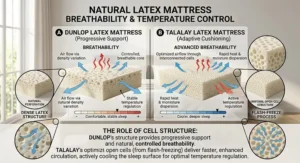
Density, measured in kilograms per cubic metre, describes how much latex material is packed into a given volume — higher density generally means firmer, more durable, and heavier foam. Uniformity describes how consistent that density is throughout the block, from the surface down to the base and from the centre out to the edges. This is precisely where Dunlop and Talalay diverge: Dunlop latex settles under gravity during curing, so density naturally increases slightly toward the base, creating a mild but real density gradient. Talalay’s vacuum-and-freeze step actively distributes the latex particles before vulcanisation locks the structure in place, producing near-identical density from top to bottom.
Why does this actually matter in practice? A mattress with poor density uniformity can develop uneven wear patterns — soft spots where you consistently apply the most pressure — faster than one with even density throughout. It also affects edge support directly: uniform-density Talalay tends to hold its shape better right at the mattress edge, which matters if you sit on the side of the bed regularly or share a smaller mattress with a partner. For buyers specifically prioritising consistent, predictable feel over the mattress’s entire lifespan, density uniformity is arguably a more useful spec to interrogate than the manufacturing process name alone.
Long-Term Cost & Maintenance
Sticker price tells you almost nothing useful about a mattress’s real cost — cost-per-year of actual use is the metric that matters, and it changes the picture considerably.
A Dunlop mattress at a lower purchase price but a genuinely longer 12–15 year lifespan, such as the Dunlopillo Latex Mattress or Yanis Latex Plus Dunlop models covered above, can work out cheaper per year of ownership than a pricier Talalay bed replaced after 10–12 years, even though the Talalay option costs more upfront. Conversely, if a firmer Dunlop mattress genuinely doesn’t suit your sleep position and gets replaced early out of discomfort rather than wear, its theoretical longevity advantage never materialises — the “right fit first time” consideration often outweighs raw lifespan maths.
Maintenance costs for both processes are modest and similar: a breathable protector (roughly £15–£40 depending on size), occasional professional cleaning if spills occur, and periodic rotation cost nothing beyond a few minutes of effort. Where costs diverge is in base compatibility — if your existing divan base has widely spaced slats unsuitable for latex, budgeting for a supportive slatted base upgrade (typically £80–£200) alongside the mattress itself is a genuinely necessary consideration that’s easy to overlook until the mattress starts sagging prematurely and voids any sag-related warranty claim.
Safety, Certification & Fire Regulations Guide
Every mattress sold in the UK, whether it’s a Dunlop or Talalay latex build, must comply with strict fire safety law, and understanding what that actually covers is worth the five minutes it takes to read.
The Furniture and Furnishings (Fire) (Safety) Regulations 1988 set flammability requirements for domestic upholstered furniture sold anywhere in the UK, and were most recently updated by amendment regulations that came into force in October 2025. In practice, this means the filling materials inside a compliant mattress — including natural latex — must pass specified ignitability testing, and any cover fabric must pass a match-resistance test. For anyone with a genuine interest in reducing chemical flame retardants specifically, it’s worth knowing that UK policymakers have been actively consulting on reforms aimed at maintaining fire safety standards while meaningfully reducing chemical flame retardant use in domestic upholstered furniture, so labelling and treatment methods on latex mattresses may continue to evolve.
Beyond fire regulations, look for OEKO-TEX Standard 100 certification on the fabric cover specifically — several products in this list carry it, and it independently verifies that every textile component, down to the thread and trims, has been tested against over 1,000 regulated and unregulated chemicals. This is a genuinely meaningful, third-party-verified credential rather than a self-declared eco claim. If back or spinal health is your driving reason for switching to latex, it’s worth knowing that the NHS explains that common causes of back pain include muscle strains and, less often, underlying medical conditions, and notes that back pain often improves within a few weeks with staying active rather than resting — a supportive mattress is a genuinely useful piece of that picture, but it isn’t a substitute for medical advice if pain is severe or persistent.
Frequently Asked Questions
❓ Is Talalay latex better than Dunlop latex?
❓ How long does a natural latex mattress last?
❓ Is a latex mattress good for back pain?
❓ Can you get natural latex mattress toppers as well as full mattresses?
❓ Does a latex mattress sleep hot like memory foam?
Conclusion
The dunlop vs talalay latex mattress question ultimately comes down to what you’re prioritising: Dunlop wins on price, firmness, and raw longevity, while Talalay wins on consistent, edge-to-edge pressure relief and motion isolation. Neither process is a downgrade from the other — they’re simply built for different sleep priorities, and the seven real products covered here span both camps across genuinely different price points.
If you take one thing away from this guide, let it be this: don’t shop by “natural latex” as a single category. Check the process, check the firmness rating specifically rather than relying on depth alone, and match it honestly to your sleep position and, if applicable, your partner’s. A firm Dunlop mattress bought by a committed side sleeper because it was the cheapest natural latex option available will likely disappoint regardless of how well-made it is — fit matters more than any single spec.
Whichever direction you land on, verify current pricing and availability directly before buying, since both fluctuate regularly, and give any new latex mattress its full settling-in period before judging the firmness. A well-matched latex mattress, Dunlop or Talalay, is a genuinely long-term investment in better sleep — treat the decision with the research it deserves.
✨ Ready to find your perfect match?
Compare the seven picks above side by side and check current availability before prices change — your best night’s sleep in years could be one click away!
Recommended for You
- Natural Latex Mattress UK: 7 Genuinely Organic Picks for 2026
- 7 Best Hypoallergenic Mattress Picks UK 2026: Sleep Easier
- Latex vs Memory Foam Mattress: 7 Picks Compared (2026)
Disclaimer: This article contains affiliate links. As an Amazon Associate, I earn from qualifying purchases. If you purchase products through these links, we may earn a small commission at no additional cost to you.
✨ Found this helpful? Share it with your friends! 💬🤗
