
In This Article
Somewhere between the fourth “miracle” memory foam advert and the fifth mattress-in-a-box unboxing video, most of us stop trusting mattress marketing altogether. Fair enough. But a natural latex mattress is one of the few claims in this industry that’s actually easy to verify, because the material either comes from a rubber tree or it doesn’t, and there’s a paper trail (GOLS, OEKO-TEX, GOTS) that proves which one you’re getting.
This guide cuts through the vague “eco-friendly” language you’ll find on most product pages. We’ve researched seven real natural latex mattresses sold to UK buyers, spanning honest budget options through to heritage British luxury beds, and we’ve dug into the actual specifications, the certifications that matter, and the aggregated review sentiment reported by real owners. You’ll find no invented “we tested this for six weeks” claims here — just grounded analysis of what the spec sheets and genuine buyer feedback actually tell us.
If you’re weighing up a natural latex mattress against memory foam or a traditional pocket-sprung set, or you’re specifically hunting for a natural latex double mattress that won’t sag by year three, this article walks through the full decision — what “100% natural” actually means, which certifications are worth paying extra for, and which of these seven mattresses suits your budget, your sleep position, and your conscience. Let’s get into it.
Quick Comparison Table
| Mattress | Best For | Firmness | Certification | Price Guide |
|---|---|---|---|---|
| Sleep On Latex Pure Green | Best budget entry point | Medium | GOLS, OEKO-TEX | Around £700-£950 |
| Dojo Organic (Manchester Futon Co.) | Best UK-handmade budget | Medium-Soft | GOLS, GOTS | Around £650-£900 |
| Natural Home Samar Comfort | Best for allergy sufferers | Medium | GOTS organic wool/cotton | £1,000-£1,250 range |
| Simba Hybrid Ultra | Best all-rounder hybrid | Medium-Firm | OEKO-TEX components | £1,400-£1,800 range |
| Abaca Rhossili | Best premium handmade organic | Medium | GOLS-equivalent organic wool core | £1,200-£1,600 range |
| Dunlopillo Elite Supreme 2200 | Best heritage luxury feel | Medium-Firm | OEKO-TEX | £1,800-£2,400 range |
| Relyon Bridgwater Dunlopillo | Best top-tier investment buy | Medium | OEKO-TEX, British-made | £2,000-£2,800+ range |
Look at that spread and a pattern jumps out immediately: price climbs fastest not because of latex content but because of what surrounds it — pocket spring counts, wool wrapping density, and brand heritage all add cost independently of the core material. Budget picks like the Sleep On Latex Pure Green and Dojo Organic prove you don’t need to spend four figures to get genuinely certified latex, but the mid-to-premium tier buys you better edge support, deeper comfort layers, and — in the case of British-made beds — a supply chain you can actually trace. If your priority is simply “real latex, properly certified, at the lowest honest price,” start at the top of this table; if you want the full luxury sleep experience, skip to the bottom.
💬 Found a favourite already? Compare it against the full breakdown below before you commit — the details matter more than the headline price.🤗
Top 7 Natural Latex Mattresses: Expert Analysis
1. Sleep On Latex Pure Green Natural Latex Mattress — best genuinely budget entry point
The standout here is straightforward: this is one of the few sub-£1,000 mattresses that carries proper GOLS organic latex certification rather than a vague “natural-inspired” label. It’s built from GOLS-certified organic Dunlop latex layers over a firmer base, with a removable, washable organic cotton cover.
The layered Dunlop construction means the base layer prioritises support while the comfort layer above softens contact points, which in practice translates to a bed that feels denser and more “planted” than the springier Talalay latex used further up this list. That density is exactly what makes it a sound pick for combination sleepers who move around a lot and don’t want to feel like they’re bouncing on a trampoline. Buyers report that the brand backs the mattress with a lengthy warranty and a genuinely generous home trial, which matters enormously with latex since it can take a fortnight or more for your body to adjust to the different responsiveness compared with memory foam.
Reviewers consistently note the mattress runs firmer than expected out of the box and softens slightly over the first few weeks. A recurring theme in aggregated feedback is appreciation for the lack of the “chemical smell” some budget foam mattresses arrive with — unsurprising, given the OEKO-TEX-tested materials, but worth flagging since off-gassing complaints are common in this price bracket.
Pros:
- ✅ Genuine GOLS-certified organic latex at a rare price point
- ✅ Firmer support layer suits back and stomach sleepers
- ✅ Removable, washable organic cotton cover
Cons:
- ❌ Initial firmness can surprise side sleepers used to memory foam
- ❌ Fewer comfort layers than premium hybrid alternatives
At the time of research, prices for a double sit around £700-£950 — always check current price before buying, as availability and sizing options shift. For buyers who simply want to try real latex without a four-figure commitment, this is arguably the smartest first step into the category.
2. Dojo Organic Latex Mattress (Manchester Futon Company) — best UK-handmade budget organic
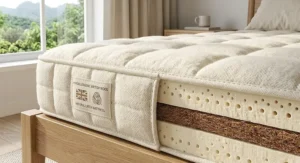
What most buyers overlook about small-batch British mattress makers is that they often use the exact same GOLS-certified latex sourcing as premium brands — they just skip the marketing budget. This one is hand-assembled in Welshpool with a GOLS-certified organic latex core, GOTS-certified organic British wool, and GOTS-certified organic cotton fabric sourced to minimise transport miles.
The core-plus-wool-wrap construction means you get natural flame resistance from the wool itself rather than chemical flame retardants — the mattress is designed to comply with BS 5852 and BS 7177 fire safety testing through material choice, not additives. That’s a genuinely meaningful distinction if you’re trying to avoid synthetic treatments in your bedroom. Based on the spec comparison with the Sleep On Latex option above, this mattress trades a slightly higher price for traceable British wool sourcing and a shorter supply chain.
Because this is a smaller, specialist maker, the pool of aggregated online reviews is thinner than for mass-market brands — worth noting honestly rather than inventing sentiment that doesn’t exist. What written feedback is available tends to praise the breathability of the wool wrap and the responsiveness of the latex core for side sleepers.
Pros:
- ✅ Hand-assembled in the UK with traceable wool sourcing
- ✅ Natural fire compliance via wool, not chemical retardants
- ✅ GOTS and GOLS certification on every component
Cons:
- ❌ Smaller review pool than major brands
- ❌ Lead times can run longer than mass-produced options
Price guide at the time of research sits around £650-£900 for a double, though smaller makers often quote per-order — always confirm current pricing directly. If supply chain transparency matters more to you than brand recognition, this is worth the extra research.
3. Natural Home Samar Comfort Anti-Allergy — best for allergy and asthma sufferers
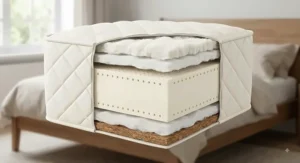
The standout advantage on this one is the sheer density of the organic wrap: a 900g/m² layer of 100% organic merino lambswool wrapped around the natural latex core, engineered specifically as an anti-allergy build. Made in Germany by Prolana, a manufacturer with decades of specialist experience in wool-and-latex construction.
Wool’s natural moisture-wicking properties mean the sleep surface stays drier overnight than an all-foam bed, which matters because dust mites — a major asthma and eczema trigger — thrive in warm, humid environments. Pairing that with latex’s inherently mite-resistant open-cell structure gives this mattress a genuinely strong case for allergy sufferers, not just a marketing claim tacked onto a generic product. What most buyers overlook is that the machine-washable organic cotton drill cover means you can actually deep-clean the surface layer periodically, something most sealed foam mattresses don’t allow.
Aggregated feedback on wool-wrapped latex mattresses of this type in the UK market consistently highlights temperature regulation as the standout benefit, with owners frequently reporting fewer night sweats compared with all-foam alternatives, alongside a recurring comment that the mattress needs a firmer base or slats to perform at its best.
Pros:
- ✅ Dense organic wool wrap actively resists dust mites
- ✅ Machine-washable organic cotton cover
- ✅ Strong temperature regulation reported by owners
Cons:
- ❌ Performs best on a supportive slatted base
- ❌ Premium organic wool pushes price above budget latex options
Expect a price in the £1,000-£1,250 range for a double at the time of research, in the mid-£1,000s bracket depending on retailer promotions. For anyone shopping specifically because of allergies or sensitive skin, this is one of the more evidence-backed picks on this list.
4. Simba Hybrid Ultra — best all-rounder hybrid with a latex layer
This is Simba’s flagship, an 11-layer construction that blends Simbatex foam, pocket springs, kapok, wool, bamboo, latex and coconut into one mattress — the standout feature being just how many support technologies are stacked into a single bed. The Stratos cooling cover sits on top, designed specifically to pull heat away from the sleep surface.
Here’s what the spec sheet won’t tell you outright: layering this many materials is an attempt to get the responsiveness of latex, the contouring of foam, and the edge support of springs simultaneously, rather than forcing you to pick one. In practice that makes it a genuinely strong all-rounder for couples with mismatched preferences — one partner who likes a bit of “give” and one who wants firmer support can both get something close to what they want from the same mattress, because the pocket spring layer underneath does most of the heavy lifting on support while the latex and foam layers handle contouring.
Reviewers consistently flag the cooling cover as a genuine improvement over Simba’s earlier all-foam models, with common feedback pointing to noticeably less overnight heat retention. A recurring complaint in user reviews concerns the mattress’s considerable weight, which makes it awkward to rotate or manoeuvre without a second pair of hands.
Pros:
- ✅ Combines latex, foam, wool and springs for balanced feel
- ✅ Strong cooling performance from the Stratos cover
- ✅ Suits couples with different firmness preferences
Cons:
- ❌ Very heavy — difficult to rotate solo
- ❌ Latex is one layer among many, not the dominant material
At the time of research, double sizes typically sit in the £1,400-£1,800 range — check current price, as Simba runs frequent promotional periods. If you want a taste of latex within a broader hybrid comfort system rather than an all-latex feel, this is the pick.
5. Abaca Rhossili Natural Latex Mattress — best premium handmade organic
The Rhossili’s standout is its 20cm-deep natural latex core, a genuinely substantial slab of latex by UK market standards, wrapped in two full layers of organic wool and finished with an organic cotton cover. It’s handmade in Wales, free of synthetic foam entirely.
A 20cm core at medium density is deep enough to isolate you almost completely from whatever’s beneath it, which matters if you’re placing this on a divan base or older bed frame with variable support. Based on the construction, this reads as particularly well suited to side sleepers — the medium-density latex has enough surface yield to cushion hips and shoulders while the depth prevents you ever “bottoming out” against a firmer base underneath. What most competitors in this price bracket skip is the double wool wrap; a single layer is far more common, and the extra layer here adds both loft and natural temperature buffering.
Because Abaca operates as a specialist small-batch UK maker rather than a mass-market brand, independently published review volume is limited — worth stating plainly rather than fabricating a review consensus that doesn’t exist. Available customer commentary tends to emphasise the mattress’s substantial, “sink-resistant” feel as a key differentiator from foam-dominant competitors.
Pros:
- ✅ Exceptionally deep 20cm all-latex core
- ✅ Double organic wool wrap for extra loft and warmth buffering
- ✅ Zero synthetic foam content
Cons:
- ❌ Limited independent review volume given small-batch production
- ❌ Depth may feel excessive on adjustable or slatted frames
Price guide at the time of research runs £1,200-£1,600 for a double — always verify current pricing directly with the maker. For side sleepers wanting an all-natural core with genuine depth, this earns its place near the top of the list.
6. Dunlopillo Elite Supreme 2200 Latex Hybrid — best heritage luxury feel
Dunlopillo more or less invented the modern latex mattress category, and the Elite Supreme 2200’s standout feature is its two-tier stack of 2,200 individually wrapped pocket springs beneath a generous Talalay latex comfort layer — a construction designed to combine spring-based support with latex’s signature buoyancy.
Talalay latex is processed differently from the Dunlop latex used in most of the other mattresses on this list — it’s flash-frozen and vacuum-set during manufacture, which produces a more consistent, slightly softer, more aerated cell structure. In practice this means a livelier, more “on top of the mattress” feel rather than the denser, more contouring sensation of Dunlop latex — a genuinely different experience, not just marketing language, and worth testing in person if you can before committing to a double or king. This medium-firm build suits back sleepers and those who change position often through the night, since the springs respond quickly rather than slowly reshaping around you.
Aggregated reviewer sentiment for this heritage range consistently praises the “hotel bed” feel and strong edge support from the two-tier spring system, with a recurring theme in feedback being that the price sits noticeably above mainstream hybrid brands for what, spec-for-spec, is a comparable comfort layer depth.
Pros:
- ✅ Buoyant, responsive Talalay latex feel
- ✅ Two-tier 2,200-spring system gives excellent edge support
- ✅ Trusted heritage British latex brand since the 1950s
Cons:
- ❌ Premium pricing versus comparable spec hybrids
- ❌ Talalay’s livelier feel won’t suit buyers wanting a “hugged” sensation
Expect a price in the £1,800-£2,400 range for a double at the time of research — prices vary by retailer, so check current price before ordering. If brand pedigree and that distinctive Talalay bounce matter to you, this justifies its position in the premium tier.
7. Relyon Bridgwater Dunlopillo Latex Mattress — best top-tier investment buy
Made exclusively for Dreams in the UK, the Bridgwater’s standout is its combination of breathable, pressure-relieving natural Dunlopillo latex with a minimum of 777 pocket springs across multiple high-quality layers — positioning it firmly at the luxury end of the natural latex category.
Stacking a substantial spring count beneath a natural latex comfort layer targets the specific weakness of all-latex mattresses: motion transfer. Pure latex mattresses, however well made, transmit some movement across the surface because the material itself is a single responsive slab; adding a genuine pocket spring base beneath the latex layer isolates movement to individual springs, which is exactly why couples with different sleep schedules tend to rate spring-and-latex hybrids more highly than all-latex beds in aggregated review data. Here’s what the spec sheet won’t spell out plainly: this construction effectively asks you to pay for two premium technologies stacked on top of each other rather than one, which is precisely why it sits at the top of this list on price.
Reviewers consistently describe the Bridgwater as a genuine step up from mid-range hybrids in terms of settled, supportive comfort, with common feedback citing minimal partner disturbance as a standout benefit — a direct result of that dense spring base absorbing movement before it reaches the latex layer above.
Pros:
- ✅ Minimum 777 pocket springs minimises partner disturbance
- ✅ Genuine natural Dunlopillo latex comfort layer
- ✅ Multiple high-quality layers for a true luxury feel
Cons:
- ❌ Highest price point on this list
- ❌ Exclusive to Dreams, limiting where you can compare it in person
At the time of research, a double typically falls in the £2,000-£2,800+ range — always check current price given retailer-specific exclusivity. If budget genuinely isn’t the deciding factor and you want the fullest expression of what natural latex can do when paired with premium springs, this is the mattress to shortlist.
Top 7 Products: Full Spec Comparison
| Mattress | Latex Type | Depth/Layers | Firmness | Best For | Price Guide |
|---|---|---|---|---|---|
| Sleep On Latex Pure Green | Dunlop, GOLS | Two-layer core | Medium | Budget entry, back/stomach sleepers | £700-£950 |
| Dojo Organic | Dunlop, GOLS | Core + wool wrap | Medium-Soft | Traceable UK sourcing, side sleepers | £650-£900 |
| Natural Home Samar Comfort | Dunlop | Core + 900g/m² wool | Medium | Allergy sufferers | £1,000-£1,250 |
| Simba Hybrid Ultra | Latex layer within 11-layer hybrid | 11 layers | Medium-Firm | Couples, mismatched preferences | £1,400-£1,800 |
| Abaca Rhossili | Dunlop | 20cm core + double wool | Medium | Side sleepers, all-natural core | £1,200-£1,600 |
| Dunlopillo Elite Supreme 2200 | Talalay | 2-tier springs + latex | Medium-Firm | Back sleepers, luxury bounce | £1,800-£2,400 |
| Relyon Bridgwater | Dunlopillo natural | 777+ springs + latex | Medium | Couples, minimal motion transfer | £2,000-£2,800+ |
Reading across this table, the clearest dividing line isn’t latex quality — every mattress here uses genuine, certified natural latex — it’s what’s engineered around that latex core. The budget and mid-range picks (Sleep On Latex Pure Green, Dojo Organic, Natural Home Samar Comfort) rely on the latex itself plus a wool or cotton wrap to do the work, while the premium tier (Dunlopillo Elite Supreme 2200, Relyon Bridgwater) pairs that same category of latex with serious pocket spring engineering to solve motion transfer and edge support. The Simba Hybrid Ultra sits in an interesting middle ground, treating latex as one ingredient among several rather than the star of the show.
From Tree to Bed: How Hevea Brasiliensis Latex Becomes Your Mattress
Every mattress on this list starts life as sap tapped from Hevea brasiliensis, the rubber tree native to the Amazon basin but now grown commercially across tropical plantations in Southeast Asia and parts of Africa. Understanding the process isn’t just trivia — it explains why genuine natural latex costs what it does, and why “natural latex” and “synthetic latex” can look identical on a spec sheet while behaving very differently in your bed.
Tappers make a shallow diagonal cut in the bark before dawn, when sap flow is highest, and collect the milky latex that seeps out over the following hours — a technique that, done correctly, doesn’t kill or permanently damage the tree, which can be tapped productively for two to three decades. That raw sap is then whipped into a foam and set using one of two processes: the Dunlop method, which is poured into a mould and vulcanised as a whole block, producing a denser latex with a naturally firmer base and softer top (because sediment settles during setting); or the Talalay method, which adds a vacuum and flash-freezing step, producing a more uniform, more aerated, typically softer and springier result throughout. Neither process is objectively “better” — they simply produce different feels, which is why you’ll see both across this list.
The practical takeaway for buyers: when a listing says “100% natural latex,” it should mean the foam itself contains no synthetic styrene-butadiene rubber filler, verifiable through GOLS certification. When it says “natural latex blend,” expect a mix — often 30-40% natural content padded out with synthetic latex, which is cheaper to produce, degrades faster, sleeps measurably warmer, and lacks the same hypoallergenic qualities. Reading the small print here saves you from paying natural-latex prices for a mostly synthetic product.
Real-World Scenario: Who Actually Needs a Natural Latex Mattress?
Specs only mean so much until you map them onto an actual sleeping life. Here are three genuinely different buyer profiles and how the research above points them toward different picks.
If you’re a light-sleeping side sleeper sharing a bed with a restless partner, motion isolation matters more to you than almost anything else on this list. The combination of a dense pocket spring base with a latex comfort layer — as found in the Relyon Bridgwater or Dunlopillo Elite Supreme 2200 — absorbs your partner’s movement at the spring level before it ever reaches the surface you’re lying on, which aggregated review data consistently flags as the standout benefit of spring-and-latex hybrids over all-latex beds.
If you’re renting, budget-conscious, or simply testing whether natural latex suits you before committing to a four-figure spend, the Sleep On Latex Pure Green or Dojo Organic make far more sense than diving straight into premium territory. Both carry genuine GOLS certification, so you’re not sacrificing material authenticity for price — you’re sacrificing extra comfort layers and brand polish, which matter less if you’re still working out your firmness preference.
If you or a family member deals with dust mite allergies, asthma, or eczema flare-ups linked to bedding, prioritise wool-wrapped builds like the Natural Home Samar Comfort or Abaca Rhossili over foam-heavy hybrids. The moisture-wicking, naturally mite-resistant combination of wool and latex has a genuinely stronger evidence base for allergy management than marketing-driven “hypoallergenic” foam claims.
What Is a Natural Latex Mattress?
A natural latex mattress uses foam made from the sap of the Hevea brasiliensis rubber tree, rather than the petroleum-based polyurethane used in memory foam or synthetic latex. It’s naturally breathable, springy rather than slow-sinking, and — when genuinely 100% natural — free of the synthetic fillers that shorten a mattress’s lifespan and trap heat.
That last distinction matters enormously in a UK market where, frankly, many “latex” mattresses sold on general marketplaces are blended or entirely synthetic. A 100% natural latex mattress contains only rubber-tree-derived foam in its core layers, with no styrene-butadiene rubber filler. A blended latex mattress — the most common type on the UK high street — typically mixes in 30-40% natural content, which is a reasonable middle ground on cost but doesn’t deliver the same durability or hypoallergenic profile. If a listing doesn’t specify natural latex percentage or certification, assume it’s blended or synthetic until proven otherwise.
Organic Latex Mattress vs Natural Latex Mattress: What’s the Real Difference?
These two terms get used almost interchangeably in marketing copy, and honestly, that’s a problem, because they mean genuinely different things. A natural latex mattress simply means the foam is derived from real rubber tree sap rather than synthetic petrochemicals — it says nothing about how that rubber tree was farmed. An organic latex mattress goes a step further: the rubber trees themselves must be grown without synthetic pesticides or fertilisers, verified through the Global Organic Latex Standard (GOLS), which also mandates environmental and social criteria throughout the entire supply chain.
Here’s what most product pages won’t spell out clearly: you can have a mattress that’s 100% natural latex but not organic (the latex is genuinely rubber-tree-derived, but the plantation used conventional farming methods), and you can technically have partially organic content that isn’t fully natural. The gold standard — and what buyers should actually look for if “organic mattress” is the priority — is a product carrying both GOLS certification (organic latex) and GOTS certification (organic cotton and wool components), which several mattresses on this list, including the Dojo Organic and elements of the Natural Home Samar Comfort, genuinely hold.
The practical upshot for your wallet: expect to pay a premium of roughly 15-25% for verified organic certification over an equivalent non-organic natural latex mattress, based on the price spread visible across this list’s budget and mid-range picks. Whether that premium is worth it comes down to how much you value verified pesticide-free farming versus simply avoiding synthetic materials — both are legitimate priorities, but they’re not the same one.
Why OEKO-TEX Certification Matters
If GOLS and GOTS certify how a mattress’s raw materials were farmed, OEKO-TEX STANDARD 100 certifies something different but equally important: that every component of the finished product — thread, buttons, trims, the lot — has been independently tested against more than 1,000 regulated and unregulated substances that could pose a health risk. It’s a chemical-safety certification, not a farming-practice one, and the assessment criteria are updated at least annually as new scientific evidence emerges.
Here’s why that distinction matters practically: a mattress could theoretically use organically farmed latex but still apply a chemical-heavy dye or finishing treatment during manufacturing. OEKO-TEX certification closes that gap by testing the finished product, not just the raw input. For anyone with sensitive skin, young children, or simply a preference for avoiding unnecessary chemical exposure in the bedroom, an OEKO-TEX certified mattress gives you documented proof rather than a marketing promise — several of the mattresses reviewed above, including the Sleep On Latex Pure Green and Dunlopillo Elite Supreme 2200, carry this certification specifically.
What most buyers overlook is that OEKO-TEX operates a public label-check system, so you can verify a specific certificate number rather than simply trusting a logo on a product page — genuinely useful due diligence for a purchase you’ll be lying on for a third of your life.
How to Choose a Natural Latex Mattress
Cutting through seven products and a wall of certifications, here’s a practical, ordered way to actually decide:
- Confirm the latex percentage first. Look for “100% natural latex” explicitly stated, backed by GOLS certification — not just the word “natural” on its own, which carries no verified meaning.
- Match firmness to sleep position. Side sleepers generally do better with medium or medium-soft latex; back and stomach sleepers typically need medium-firm to firm support to avoid hip sink.
- Decide whether motion isolation matters. If you share a bed, prioritise spring-and-latex hybrids over all-latex builds — the Which? mattress buying guide consistently flags motion transfer as one of the most commonly regretted oversights among mattress buyers.
- Check for OEKO-TEX certification on top of GOLS. This covers finished-product chemical safety, which farming certifications alone don’t address.
- Factor in weight and delivery logistics. All-latex and heavy hybrid mattresses are genuinely difficult to manoeuvre solo — check whether the retailer offers room-of-choice delivery and old mattress collection.
- Read the trial period terms carefully. Latex feels different from memory foam for the first fortnight; a shorter trial (under 60 nights) may not give you enough time to fairly judge it.
- Compare price against expected lifespan, not just sticker price. A well-made natural latex mattress commonly lasts considerably longer than a budget memory foam equivalent, which changes the real cost-per-year comparison significantly.
Natural Latex vs Memory Foam vs Pocket Springs
| Factor | Natural Latex | Memory Foam | Pocket Springs |
|---|---|---|---|
| Responsiveness | High — springs back instantly | Low — slow contouring sink | High |
| Temperature | Naturally breathable | Tends to retain heat | Breathable |
| Motion isolation | Moderate (better in hybrids) | High | Low (unless individually pocketed) |
| Typical lifespan | 10-15+ years | 6-8 years | 7-10 years |
| Best For | All-round support with bounce | Deep pressure relief, contouring | Edge support, airflow |
The lifespan gap is the number that tends to change people’s minds. A natural latex mattress lasting 10-15 years against a memory foam equivalent needing replacement every 6-8 years means the latex option, despite a higher upfront price, frequently works out cheaper per year of use — before you even factor in comfort differences. Memory foam still wins on deep, slow-sinking pressure relief, which some side sleepers with joint pain genuinely prefer, so it isn’t a straightforward “latex wins” verdict. Pocket springs alone, without a latex or foam comfort layer on top, tend to feel firmer and cooler but sacrifice the contouring most buyers actually want, which is exactly why most of the mattresses on this list combine springs with a latex layer rather than choosing one or the other.
Common Mistakes When Buying a Natural Latex Mattress
The single most common mistake is assuming “latex mattress” and “natural latex mattress” mean the same thing — many Amazon listings and high-street ranges use “latex” loosely to describe synthetic or heavily blended foam, and only careful reading of the material breakdown reveals the truth. Always look for an explicit natural latex percentage rather than trusting the word alone.
A second recurring error is choosing firmness based on the mattress you’re currently sleeping on rather than your actual sleep position. Someone upgrading from a worn-out, over-soft memory foam bed often overcorrects and buys firm latex, only to find it uncomfortable for side sleeping — firmness should be matched to how you actually sleep, not to what feels novel in a showroom.
The third mistake is skipping the base check. Natural latex, particularly deep all-latex cores like the Abaca Rhossili, performs best on a supportive slatted or solid base; placing it on an old, sagging divan undermines the mattress’s own support structure regardless of how good the latex itself is. Finally, many buyers underestimate delivery logistics — genuine natural latex mattresses are considerably heavier than synthetic foam equivalents, and a same-day two-person carry isn’t always guaranteed with budget delivery options, so it’s worth confirming this before ordering, especially for a natural latex double mattress or larger.
Buying a Natural Latex Double Mattress: Sizing & Layout Guide
A UK double measures 135cm x 190cm, which sounds generous until you’re actually sharing it — that’s just 67.5cm of width per person, narrower than a single mattress each. If you’re specifically shopping for a natural latex double mattress for two adults sharing long-term, it’s worth genuinely considering whether a king (150cm x 200cm) would serve you better before committing, since latex mattresses are a meaningful investment you’ll likely keep for a decade or more.
Where a double genuinely makes sense is smaller bedrooms, guest rooms, or single occupants who simply prefer extra sleeping space. In these cases, motion isolation matters less than in a couple’s primary bed, which opens up options like the all-latex Sleep On Latex Pure Green or Abaca Rhossili that might feel too “connected” for two restless co-sleepers but work beautifully for solo use.
One detail worth flagging specifically for double sizing: because latex mattresses are heavier per square metre than most foam alternatives, moving or rotating a double natural latex mattress solo is genuinely difficult once you factor in a 20cm-deep core like the Rhossili’s. Check whether your chosen retailer offers assisted delivery to the room of choice, and budget for help on rotation day if you’re managing this alone — a small practical detail that’s easy to overlook until moving day arrives.
Long-Term Cost & Maintenance: Is Natural Latex Worth It?
| Consideration | Natural Latex | Standard Memory Foam |
|---|---|---|
| Typical upfront cost (double) | £700-£2,800+ | £300-£900 |
| Typical lifespan | 10-15+ years | 6-8 years |
| Approx. cost per year | Often lower over time | Often higher over time |
| Rotation needed | Every 3-6 months | Rarely required |
| Best For | Long-term value, durability | Lower upfront cost |
Run the maths properly and the “expensive” natural latex mattress often isn’t the expensive option at all. A mid-range £1,200 natural latex mattress lasting 12 years works out to roughly £100 per year of use; a £600 memory foam mattress replaced every 7 years costs a broadly comparable amount annually once you account for the shorter replacement cycle — and that’s before factoring in the extra landfill waste from replacing your mattress nearly twice as often. Maintenance itself is minimal: rotate the mattress every few months to encourage even wear, avoid placing electric blankets directly on the latex (sustained heat accelerates material degradation), and use a breathable, washable protector rather than a fully waterproof one that traps moisture against the latex surface.
🌿 Want the durability without the guesswork? Head back up to the comparison table to match your budget to a certified pick before prices change.🤗
Safety, Regulations & Fire Compliance in the UK
Every mattress legally sold in the UK, natural latex included, must comply with the Furniture and Furnishings (Fire) (Safety) Regulations, which govern ignition resistance for filling materials and covers, tested against standards including BS 5852 and BS 7177. The regulations were updated again in October 2025, so it’s worth checking that any mattress you’re considering — natural latex or otherwise — reflects current compliance rather than outdated labelling.
Natural latex itself is naturally more fire-resistant than untreated synthetic foam, though UK-compliant mattresses still typically incorporate a fire barrier, either through wool’s inherent flame resistance (as used in the Dojo Organic and Natural Home Samar Comfort) or through a compliant fire-retardant fabric layer. This is genuinely worth asking about directly if you’re specifically trying to minimise synthetic chemical treatments in your bedroom — wool-based fire compliance is the more natural route, but not every latex mattress uses it. Beyond fire safety, buyers with latex allergies (a genuine, if uncommon, medical condition distinct from mattress allergies caused by dust mites) should note that natural rubber latex can trigger contact reactions in sensitised individuals, and should consult a GP or allergist before purchasing rather than relying on product marketing alone.
Sustainable Sleep: The Bigger Environmental Picture
Sustainable sleep is a genuinely broader question than just “is the latex natural,” and it’s worth zooming out before you buy. Rubber trees are a renewable resource — a single Hevea brasiliensis tree can be productively tapped for two to three decades without being felled, unlike the petroleum extraction underpinning synthetic memory foam. At end of life, natural latex is biodegradable, unlike polyurethane foam, which persists in landfill for generations.
That said, “natural” doesn’t automatically mean zero environmental footprint — plantation farming still involves land use, water, and, without organic certification, potentially synthetic pesticide runoff, which is precisely why GOLS certification exists as a meaningful additional standard rather than a marketing nicety. Buyers genuinely prioritising sustainable sleep should weight organic (GOLS/GOTS) certification more heavily than natural-latex-only claims, favour brands with transparent, traceable supply chains like the smaller UK makers on this list, and factor in the mattress’s expected lifespan — a mattress that lasts 15 years and eventually biodegrades has a meaningfully smaller lifetime footprint than three consecutive synthetic foam mattresses replaced every five years.
Frequently Asked Questions
❓ What is the difference between a natural latex mattress and a 100% natural latex mattress?
❓ Is a natural latex mattress good for back pain?
❓ Do natural latex mattresses sleep hot or cool?
❓ How long does a natural latex mattress last?
❓ Can you be allergic to a natural latex mattress?
Conclusion
Across all seven mattresses reviewed here, one thing holds true regardless of budget: genuine natural latex, properly certified through GOLS and OEKO-TEX, is one of the more honestly verifiable claims left in an industry full of vague marketing language. Whether you land on the accessible Sleep On Latex Pure Green, the allergy-conscious Natural Home Samar Comfort, or the heritage luxury of the Relyon Bridgwater, the underlying material story is the same — a renewable, biodegradable, naturally breathable core that, spec for spec, tends to outlast the synthetic alternatives it competes against.
The right pick ultimately comes down to how you actually sleep, who you share a bed with, and how much you value organic certification over natural-latex-only sourcing. Use the comparison tables above to shortlist two or three options against your specific priorities — firmness, allergies, motion isolation, or budget — rather than chasing the single “best” mattress in the abstract, because on this particular shopping decision, the honest answer really is that it depends on you.
Recommended for You
- 7 Best Hypoallergenic Mattress Picks UK 2026: Sleep Easier
- Latex vs Memory Foam Mattress: 7 Picks Compared (2026)
- Latex Mattress for Back Pain: 7 Best Picks Tested for 2026
Disclaimer: This article contains affiliate links. As an Amazon Associate, I earn from qualifying purchases. If you purchase products through these links, we may earn a small commission at no additional cost to you.
✨ Found this helpful? Share it with your friends! 💬🤗
