
In This Article
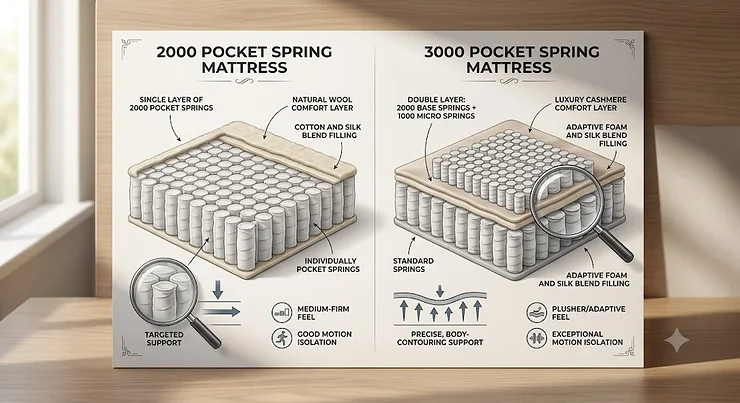
Somewhere in a mattress showroom in Leeds or a product listing on amazon.co.uk, a shopper is squinting at two near-identical beds and wondering why one costs £150 more purely because of a bigger number stitched onto the label. That number is the spring count, and the 2000 vs 3000 pocket spring mattress question is one of the most googled — and most misunderstood — decisions in UK bed buying. Here’s a snappy answer before we go further: a pocket spring mattress uses individually wrapped coils, each sewn into its own fabric pocket, so they compress independently rather than dragging their neighbours down with them; a 2000-spring version typically has larger, more traditional coils, while a 3000-spring version usually swaps in smaller “mini” coils layered for extra contouring. More springs is not automatically a better mattress — it depends on coil gauge, the comfort layers on top, and your own body weight. Over the next several thousand words we’ll dig into seven real, currently available mattresses spanning budget to premium, work out exactly where the extra springs earn their keep and where they’re mostly a marketing flourish, and give you a framework for deciding which one actually deserves a spot in your bedroom.
Quick Comparison Table
| Mattress | Spring Count | Comfort Layer | Feel | Price Range | Best For |
|---|---|---|---|---|---|
| Silentnight Pocket Memory 2000 | 2000 Mirapocket | Memory foam pillowtop | Soft-medium | Under £500 | Pressure relief on a budget |
| Amazon Basics Hybrid Mattress | Pocket spring hybrid | Pressure-relief foam | Medium-plush | Under £300 | First-time buyers, spare rooms |
| Vesgantti 10 Inch Hybrid | Individual pocket spring (7-zone) | Breathable foam layers | Medium-firm | Under £350 | Couples wanting motion isolation cheaply |
| Bed Nation 3000 Organic | 3000 pockets + 2000-count base | Wool and cotton | Medium-firm | £350-£550 range | Natural-fibre fans on a mid budget |
| Silentnight Lift Replenish Hybrid 2000 | 2000 zoned pocket | Latex + carbon cover | Firm | £700-£900 range | Front sleepers, heavier builds |
| Giltedge Beds Geneva 3000 | 3000 pocket | Memory foam + Flotech gel | Medium | £650-£850 range | Side sleepers who overheat |
| Kensington 3000 (Magnabeds) | 3000 pocket | Egyptian cotton, tufted | Extra firm | £850+ range | Back-pain sufferers wanting a UK-made bed |
Looking at the spread above, the jump from Silentnight Pocket Memory 2000 to Bed Nation 3000 Organic costs roughly the same as trading up a hatchback for a slightly bigger hatchback — noticeable, but not transformative. The real differentiator across this table isn’t the spring number at all; it’s what sits above the springs, whether that’s a slab of memory foam, a wool topper, or a latex layer, because that’s what your shoulder actually touches at 2am. Buyers on a tight budget shouldn’t feel short-changed by Amazon Basics Hybrid Mattress or Vesgantti 10 Inch Hybrid, since both use pocket spring technology at a fraction of the outlay of the 3000-count options.
💬 Found a favourite already? Save this comparison and share it with whoever’s arguing with you about which mattress to buy!
Top 7 2000 vs 3000 Pocket Spring Mattress Options: Expert Analysis
1. Silentnight Pocket Memory 2000 — best budget pick for pressure relief
Silentnight has sold this configuration for years, and the reason it persists is simple: 2000 individually wrapped Mirapocket springs paired with a memory foam pillowtop is a formula that works. The zoned spring layout is firmer through the centre third to stop the hips sinking, while softer zones cradle the shoulders — a detail that matters more for side sleepers than raw spring count ever will. Reviewers consistently note that this model needs no flipping, only an occasional head-to-toe rotation, and that the memory foam layer sinks in without the “stuck in concrete” feel some cheaper foam mattresses produce. Based on the spec comparison with pricier 3000-count rivals, this is the mattress to recommend for anyone who wants noticeably reduced roll-together and pressure relief without paying premium prices. A recurring theme in aggregated feedback is that the mattress runs slightly deeper than expected, so fitted sheets can feel snug at first.
Pros:
- ✅ Zoned 2000 spring layout targets hips and shoulders
- ✅ No-turn design with simple head-to-toe rotation
- ✅ Strong value against pricier 3000-spring rivals
Cons:
- ❌ Runs deep, so existing fitted sheets may not fit
- ❌ Memory foam retains more heat than latex alternatives
At around £350-£500 depending on size and retailer, this remains one of the most consistently recommended entry points into pocket sprung mattresses, and represents genuinely solid value for the spec.
2. Amazon Basics Hybrid Mattress — best rock-bottom budget hybrid
There’s no glamour here, and that’s rather the point. This is a straightforward pocket spring hybrid sold directly through Amazon, built with a pressure-relief foam layer over an individually wrapped coil unit. What most buyers overlook about entry-level hybrids like this is that even a “basic” pocket spring unit still delivers the core benefit of the technology — independent coil movement — even if the coil count and comfort layer thickness are modest compared with branded competitors. This is a practical choice for guest rooms, teenage bedrooms, rental properties, or anyone testing whether they even prefer a hybrid feel before committing serious money. On paper, the lower spring density and thinner foam mean less contouring for heavier sleepers or side sleepers with pronounced hip and shoulder pressure points, so honest expectations matter here.
Pros:
- ✅ Genuinely low price point for pocket spring construction
- ✅ Straightforward Prime delivery and returns via Amazon
- ✅ Reasonable option for guest rooms and rentals
Cons:
- ❌ Thinner comfort layer than mid-range competitors
- ❌ Less suited to heavier or side sleepers needing contouring
Priced typically under £300 for a double, it’s hard to find genuine pocket spring construction cheaper, though buyers should check current pricing and size-specific listings before ordering.
3. Vesgantti 10 Inch Hybrid Mattress — best value motion isolation for couples
Vesgantti’s hybrid range pairs individually wrapped pocket springs with a 7-zone layout and breathable foam, and it has become one of the most reviewed mattress brands on amazon.co.uk for good reason. The spec sheet won’t tell you this, but user reports suggest the CertiPUR-US-certified foam and OEKO-TEX-tested fabric genuinely reduce the “off-gassing” smell that cheaper vacuum-packed mattresses are notorious for in the first 48 hours. For couples on a budget, the individually wrapped coil design is the headline benefit: one partner turning over shouldn’t wake the other, and reviewers frequently cite this specifically. It’s worth noting the mattress needs 24-72 hours to fully expand after unboxing, which surprises first-time bed-in-a-box buyers.
Pros:
- ✅ CertiPUR-US and OEKO-TEX certified materials
- ✅ Reliable motion isolation for couples
- ✅ Comes with a 100-night trial and 10-year warranty
Cons:
- ❌ Takes up to 72 hours to fully expand
- ❌ Firmness options limited to medium/medium-firm
Expect to pay somewhere in the low-to-mid £300s range, which places it firmly among the best-value pocket spring hybrids currently sold in the UK.
4. Bed Nation 3000 Organic Mattress — best natural-fillings 3000-count option
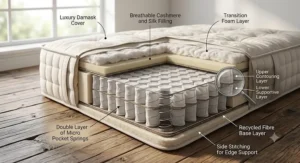
This is where the “3000” marketing starts getting genuinely interesting, because Bed Nation’s construction actually layers a 3000-pocket unit over a 2000-count pocketed spring foundation, hand tufted and hand side-stitched for edge strength, then dresses it in cotton with a generous wool filling. Here’s what the spec sheet won’t tell you, but honest aggregated review reading reveals: feedback on this exact model is genuinely mixed. Several reviewers describe excellent value and good firmness retention after months of use, while others report the mattress softening or losing shape within weeks, and at least one buyer received an instant refund after finding the springs noisy. That split is worth taking seriously rather than glossing over — it suggests batch consistency may vary, which is common in mid-market UK-manufactured beds sold primarily through marketplace listings rather than showrooms.
Pros:
- ✅ Natural wool and cotton fillings, not synthetic foam
- ✅ Hand tufted and hand side-stitched for edge support
- ✅ Genuine 3000-plus-2000 dual pocket spring construction
Cons:
- ❌ Reviewer feedback on longevity is inconsistent
- ❌ Some buyers report springs feeling noisy over time
Priced in the £350-£550 range, this suits shoppers who specifically want natural fillings at 3000-spring level, provided they go in with realistic expectations about variability.
5. Silentnight Lift Replenish Hybrid 2000 — best for front sleepers and heavier builds
This is a genuinely instructive case for the 2000 vs 3000 pocket spring mattress debate, because independent testing from TechRadar found this 2000-spring hybrid to be a firm, well-supported bed that outperforms plenty of higher-spring-count competitors for a specific group: front sleepers and those of an average-to-heavier build. The zoned pocket springs are firmer through the centre third, and the latex comfort layer — a 50/50 natural-synthetic blend — adds responsive bounce without the heat retention memory foam is known for. Reviewers and testers alike found the mattress excellent at absorbing motion transfer, with one tester’s restless movements barely registering to their partner. Based on the spec comparison, the carbon-infused cover and graphite-sprayed latex genuinely do sleep cooler than a straightforward memory foam equivalent, which matters for hot sleepers regardless of spring count.
Pros:
- ✅ Firm, zoned support ideal for front and heavier sleepers
- ✅ Latex comfort layer sleeps cooler than memory foam
- ✅ Independently tested with strong motion isolation results
Cons:
- ❌ Too firm for lighter-weight side sleepers
- ❌ Limited bounce noted with the medium-firm option
Expect a price range around £700-£900 for a double, positioning it as a mid-to-premium hybrid that proves 2000 well-engineered springs can comfortably outperform a poorly built 3000-spring rival.
6. Giltedge Beds Geneva 3000 — best for side sleepers who run hot
The Geneva 3000 pairs 3000 pocket springs with 7.5cm of memory foam, including Flotech memory gel designed to dissipate heat, inside a genuinely substantial 30cm-deep build. What most buyers overlook about gel-infused foam is that it doesn’t eliminate heat retention entirely — it slows the rate at which body heat accumulates, which is a meaningfully different claim from “sleeps cold.” The medium feel and zoned support right up to the mattress edge make this a strong option for side and occasional back sleepers who need pressure relief at the hips and shoulders without excessive sink. Reviewers of similarly specified Giltedge models consistently report accurate firmness labelling and good value against big-brand equivalents, though independent air circulation vents help offset some of the heat the gel layer generates.
Pros:
- ✅ 3000 springs with zoned edge-to-edge support
- ✅ Flotech memory gel aids heat dissipation
- ✅ Substantial 30cm build for a premium feel
Cons:
- ❌ Memory foam layer still retains some warmth
- ❌ Deep profile may need deeper-fitted bedding
At the time of research this model sat in the £650-£850 range for a king, so always check current pricing before buying, as retailers rotate promotions regularly.
7. Kensington 3000 (Magnabeds) — best premium UK-handmade option
If you want the full 3000-spring experience without any hybrid compromises, the Kensington 3000 is a traditional, handmade-in-Britain mattress built specifically around its spring count as the headline feature. The individually nested pocket springs move independently to support pressure points along the spine, wrapped in a Damask stretch-knit cover that wicks moisture, with a tufted 100% Egyptian cotton border said to help guard against allergens. This is an extra-firm mattress, and reviewers consistently describe it as excellent for posture alignment and easing back discomfort — but that firmness will be too much for lighter-weight side sleepers who need more give at the hips. Being double-sided, it can be flipped as well as rotated, which meaningfully extends its working life compared with the single-sided budget options earlier in this list.
Pros:
- ✅ Genuine 3000 individual pocket springs, no shortcuts
- ✅ Double-sided design extends usable lifespan
- ✅ Handmade in Great Britain to order
Cons:
- ❌ Extra-firm feel unsuitable for lighter side sleepers
- ❌ Made-to-order lead times are longer than stock items
Pricing sits in the £850-plus range depending on size, reflecting its handmade, made-to-order positioning at the top of this comparison.
Practical Usage Guide: Getting the Most From Your New Mattress
Whichever spring count you land on, the first 30 days genuinely shape how the mattress performs for the next decade. Unbox a rolled mattress in the room it will actually live in, not the hallway, since manoeuvring a fully expanded double up a staircase is unnecessarily hard work. Allow 24-72 hours for full expansion before judging the feel — vacuum-packed foam and hybrid mattresses in particular need this settling time, and lying on one within the first hour will give a misleading first impression. For the first month, rotate the mattress head-to-toe every one to two weeks if it’s single-sided (most 2000 and 3000-spring hybrids are), or fully flip it fortnightly if it’s a traditional double-sided design like the Kensington 3000. Avoid sitting repeatedly on the same edge spot, since this is where premature sagging typically begins, and use a breathable, close-fitting protector rather than a thick waterproof one that traps heat against a memory foam layer. Common first-30-days mistakes include judging firmness before the foam has warmed to room temperature, skipping the base-slat spacing check (most manufacturers specify slats no more than 7cm apart), and assuming any initial “new mattress smell” from off-gassing indicates a fault rather than normal, temporary VOC release that clears within days with ventilation.
Buyer’s Decision Framework
If you’re sharing a bed with a partner who moves a lot at night, choose a 2000 or 3000-spring hybrid with a strong motion-isolation reputation, like Silentnight Lift Replenish Hybrid 2000 or Vesgantti 10 Inch Hybrid, because independently pocketed coils are engineered specifically to stop movement travelling across the mattress. If you’re a side sleeper under roughly 12 stone, prioritise softer zoned support and generous foam depth over raw spring count — Silentnight Pocket Memory 2000 or Giltedge Beds Geneva 3000 both suit this profile. If you’re a heavier or front-sleeping build, firmer 2000-spring hybrids with denser coil gauge, such as the Lift Replenish, will outperform a softer 3000-spring bed every time, because gauge and zoning matter more than count for this group. If back pain is your primary concern, look for a medium-firm feel with even weight distribution rather than reaching automatically for “extra firm,” and consider the Kensington 3000 only if a firmer feel genuinely suits your body weight. And if budget is the deciding factor above all else, the Amazon Basics Hybrid Mattress delivers authentic pocket spring technology without the premium price tag attached to higher spring counts.
Is 3000 Springs Better Than 2000? The Diminishing Returns Explained
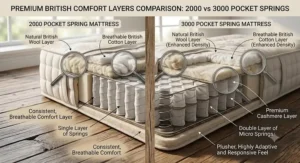
This is the crux of the whole 2000 vs 3000 pocket spring mattress question, and the honest answer is: not automatically, and often not by much. Spring count is standardised around a UK king-size mattress, so a 3000-spring king genuinely does pack in about 50% more coils than a 2000-spring equivalent — but manufacturers achieve that higher number largely by shrinking the coils themselves into “mini” or “micro” pocket springs, not by cramming in more full-sized units. Reviewers and industry guides consistently flag that once you move beyond roughly 1,500-2,000 springs in a king-size mattress, the incremental improvement in contouring and support starts to flatten out noticeably, because the surrounding fillings and fabric pockets begin interfering with how freely each individual spring can move. In practical terms, a well-built 1000 or 2000-spring mattress with generous, high-quality upholstery layers can comfortably outperform a poorly upholstered 3000-spring mattress that’s cut corners on fillings to hit its headline number. That’s precisely the pattern visible in this comparison: the Silentnight Lift Replenish Hybrid 2000 genuinely rivals or beats several 3000-spring competitors in independent testing, purely because its spring gauge and comfort layer were engineered together rather than the spring count being treated as the whole story.
| Factor | 2000 Springs | 3000 Springs |
|---|---|---|
| Typical coil size | Standard to medium | Smaller “mini” coils common |
| Contouring precision | Good | Marginally finer, diminishing returns apply |
| Typical price premium | Baseline | Often £100-£250 more |
| Best suited to | Most sleepers, most budgets | Side sleepers wanting maximum zoning, deep pockets |
The table above illustrates why this isn’t a simple “more is better” equation: the marginal gain in contouring from 2000 to 3000 springs is real but small, while the price gap is often disproportionately large. Buyers should weigh that premium against upgrading the comfort layer instead — a better foam or latex topper on a 2000-spring base frequently delivers more noticeable comfort than paying extra purely for a higher spring number.
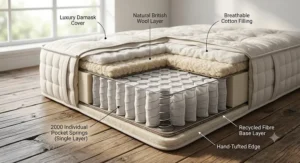
Spring Density Per Square Inch: What the Number Really Means
Spring count on its own is a headline figure, but spring density — how tightly those coils are packed per square inch of the mattress surface — is the more meaningful engineering detail, and it’s rarely advertised clearly. A king-size UK mattress measures roughly 150cm by 200cm, giving a surface area of around 4,650 square inches once converted; a 2000-spring king therefore averages a little under half a spring per square inch, while a 3000-spring king pushes that closer to two-thirds of a spring per square inch. What most buyers overlook is that this density figure interacts directly with coil gauge (wire thickness): a denser pack of thin-gauge mini springs contours more finely to small body curves like the lower back, but provides less resistance under concentrated weight, such as a heavier sleeper’s hips. A sparser pack of thicker-gauge springs, as used in several 2000-spring hybrids on this list, resists deeper sinking and suits heavier or front-sleeping bodies better. Reviewers consistently note that mattresses marketed purely on spring count rarely disclose gauge, so it’s worth checking product specifications or contacting the retailer directly if you have a specific body weight or condition to accommodate.
Common Mistakes When Buying a 2000 vs 3000 Pocket Spring Mattress
The single most common mistake is assuming spring count functions like a star rating — that 3000 is simply “better” than 2000 in the way five stars beats four. As covered above, that’s not how coil engineering works. A second frequent error is ignoring mattress depth and comfort layer thickness entirely, focusing purely on the spring number while overlooking that a shallow foam layer on top of an otherwise excellent spring unit can undermine the whole mattress’s comfort. A third mistake is buying based on a partner’s or friend’s recommendation without matching firmness to your own body weight and sleeping position — a firm 2000-spring mattress that suits a 16-stone back sleeper may feel punishing to a 9-stone side sleeper. Fourth, many buyers skip checking the base compatibility, particularly slat spacing, which can void warranties or cause premature sagging if slats sit further apart than the manufacturer specifies. Finally, shoppers frequently overlook return and trial periods; with mattresses like the Vesgantti 10 Inch Hybrid offering 100-night trials, there’s rarely a good reason to commit to a mattress you haven’t properly slept-tested for several weeks.
What to Expect: Real-World Performance
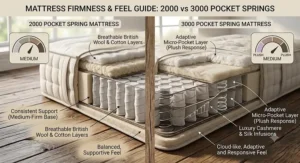
On paper, spring count differences look dramatic — a 50% increase from 2000 to 3000 sounds like a significant upgrade. In practice, most sleepers describe the difference as subtle rather than transformative, particularly in the first few nights before any comfort layer has fully “broken in.” Where the difference becomes more noticeable is in motion isolation for couples: a well-constructed 3000-spring or zoned 2000-spring hybrid genuinely reduces the chance of one partner’s movement disturbing the other, and this is consistently one of the most-cited positive experiences in aggregated reviews across all seven products here. Temperature regulation tends to depend far more on the comfort layer — memory foam, gel-infused foam, or latex — than on the spring count itself. Edge support, meanwhile, correlates more with tufting, border reinforcement, and whether a mattress is single or double-sided than with the number of coils beneath the surface. In short: expect meaningful gains in motion isolation and zoned pressure relief as you move up this list, but don’t expect the spring number alone to predict comfort.
2000 vs 3000 Pocket Spring Mattress for Different Sleepers
For side sleepers, prioritise a softer zoned mattress with generous cushioning at the hips and shoulders — the Silentnight Pocket Memory 2000 and Giltedge Beds Geneva 3000 both suit this profile well, regardless of their differing spring counts. For back sleepers, a medium-firm feel that supports the lumbar curve without letting the hips sink too far works best; several UK sleep guides echo NHS-aligned advice that medium-firm support, rather than maximum firmness, tends to reduce lower back discomfort more effectively (see the further reading below). For front sleepers and heavier-build sleepers, firmer options with reinforced edge support — such as the Silentnight Lift Replenish Hybrid 2000 or Kensington 3000 — provide the resistance needed to stop the hips sinking excessively. Couples with significantly different body weights should look specifically for split-tension or zoned options, since a single uniform spring tension rarely suits two very different sleepers equally well. And for younger or lighter sleepers furnishing a first flat or spare room, budget-conscious hybrids like the Amazon Basics Hybrid Mattress or Vesgantti 10 Inch Hybrid deliver genuine pocket spring benefits without over-specifying for needs that don’t yet exist.
Long-Term Cost & Maintenance
Judging a mattress purely on its up-front price misses the real financial picture, which is cost per year of use. A £300 mattress that needs replacing after four years works out more expensive annually than a £700 mattress that comfortably lasts ten, so total cost of ownership matters more than sticker price alone. Higher spring counts don’t automatically extend lifespan — that depends far more on build quality, whether the mattress is single or double-sided, and how well it’s maintained through regular rotation. Natural fillings, as used in the Bed Nation 3000 Organic, often compress and settle faster than higher-density foam, meaning the “3000 springs” headline doesn’t guarantee a longer working life if the upholstery above it is thin. Most manufacturers offer 5-to-10-year guarantees on the spring unit itself, since springs rarely fail outright; it’s the comfort layers that wear first and dictate when a mattress genuinely needs replacing.
| Mattress | Typical Guarantee | Turn/Rotate Schedule | Estimated Lifespan |
|---|---|---|---|
| Silentnight Pocket Memory 2000 | 5 years | Rotate only, no turning | 6-8 years |
| Bed Nation 3000 Organic | Varies by retailer | Turn and rotate | 5-7 years |
| Kensington 3000 | Long-term (check retailer) | Turn and rotate (double-sided) | 8-12 years |
As the table shows, the double-sided Kensington 3000 has the potential to outlast several single-sided competitors simply because it can be flipped as well as rotated, spreading wear across two full sleep surfaces rather than one. When comparing value for money, factor in delivery and old-mattress-removal costs too, since several retailers charge separately for these, which can meaningfully shift the total cost of a “cheaper” mattress once delivery fees are added.
✨ Ready to stop guessing and start sleeping better? Compare today’s prices on these seven mattresses before you decide.
Safety, Regulations & UK Compliance
Every mattress legally sold in the UK, regardless of spring count, must comply with the Furniture and Furnishings (Fire) (Safety) Regulations, which set ignition-resistance requirements for filling materials used in mattresses, divans, and bed bases sold anywhere in the UK. These regulations were updated in 2025, and while display labelling requirements have been relaxed for some product categories, filling materials still must meet specified fire-resistance testing. Separately, mattress-specific fire testing in the UK is generally referenced against British Standard BS 7177, which many retailers cite directly in product specifications — it’s worth checking that any mattress you’re considering states compliance clearly. Beyond fire safety, look for CertiPUR-US or OEKO-TEX certification on foam and fabric components, as seen on the Vesgantti 10 Inch Hybrid, since these confirm the materials have been independently tested against a list of regulated and unregulated chemicals that could otherwise affect indoor air quality.
Mattress Upgrade Guide: Is a 2000 vs 3000 Spring Mattress Worth It?
If you’re currently sleeping on an old open-coil or budget mattress under five years old, upgrading to any properly built pocket spring mattress — 2000 or 3000 count — will likely deliver a noticeable improvement in motion isolation and pressure relief, simply because independent coil movement is such a leap over connected coil systems. If you already own a well-built 2000-spring mattress from the last three to five years and are wondering whether to upgrade specifically to a 3000-spring model, the honest answer from the diminishing-returns pattern discussed earlier is: probably not, unless your current mattress has genuinely sagging support or unsuitable firmness for your current body weight or sleeping position. The exception is if you’re upgrading the comfort layer at the same time — moving from a thin foam topper to a proper latex or gel-infused layer alongside the spring change, as with the Giltedge Beds Geneva 3000, since that combination delivers a more meaningful comfort jump than the spring count change alone. A sensible upgrade checklist: check your current mattress’s age and sag, assess whether your body weight or sleeping position has changed since you bought it, test a few options during their trial periods before committing, and remember that mattress protectors and correct base slat spacing matter just as much as the spring count you eventually choose.

FAQ
❓ What's the difference between a 2000 and 3000 pocket spring mattress?
❓ Is 3000 springs better than 2000 for back pain?
❓ Is a 2000 vs 3000 spring mattress worth the price difference?
❓ How long does a pocket spring mattress last?
❓ Does a higher spring count mean a firmer mattress?
Conclusion
The 2000 vs 3000 pocket spring mattress debate ultimately comes down to a simple truth: spring count is one input among several, not the whole verdict. Across the seven mattresses compared here, from the budget-friendly Amazon Basics Hybrid Mattress to the handmade Kensington 3000, the clearest pattern is that comfort layer quality, coil gauge, and zoning consistently mattered as much as — or more than — the headline spring number. If your budget stretches to it and you’re specifically a side sleeper wanting maximum zoned contouring, a well-built 3000-spring option like the Giltedge Beds Geneva 3000 is a genuinely good pick. If you’re after the best all-round value, a thoughtfully engineered 2000-spring hybrid such as the Silentnight Lift Replenish Hybrid 2000 or Silentnight Pocket Memory 2000 will very often outperform a cheaper 3000-spring rival that cut corners elsewhere. Whichever you choose, prioritise checking current pricing, trial periods, and your own body weight and sleep position over the number printed on the label.
✨ Don’t Miss These Exclusive Deals!
🔍 Take your sleep setup to the next level with these carefully selected mattresses. Click on any highlighted item to check current pricing and availability. These picks will help you create the restful, pain-free nights your whole household will thank you for!
Recommended for You
- 2000 Pocket Spring Mattress: 7 Honest UK Picks for 2026
- 1000 vs 2000 Pocket Spring Mattress: 7 Real Picks for 2026
- 1000 Pocket Spring Mattress UK: 7 Best Value Picks for 2026
Disclaimer: This article contains affiliate links. As an Amazon Associate, I earn from qualifying purchases. If you purchase products through these links, we may earn a small commission at no additional cost to you.
✨ Found this helpful? Share it with your friends! 💬🤗
