
In This Article
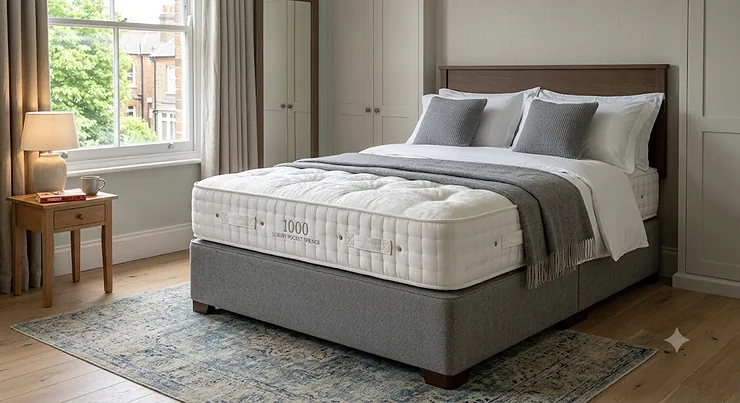
Somewhere between “cheap and cheerful” and “why does this cost more than my first car,” there’s a sweet spot in the mattress world — and a 1000 pocket spring mattress usually lives right in the middle of it. It’s the mattress equivalent of a reliable hatchback: not flashy, not the cheapest thing on the forecourt, but genuinely good enough to get most people through years of decent sleep without drama.
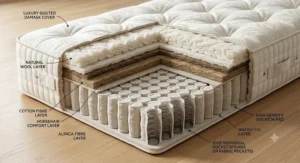
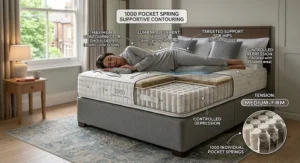
So what is a 1000 pocket spring mattress? In short, it’s a mattress built with roughly 1,000 individually wrapped springs (usually quoted for a king-size, so a double will have fewer), each one moving independently to cushion and support your body without dragging the springs around it down too. That independent movement is the whole point — it’s why two people can toss and turn on one side of the bed without the other person feeling like they’re on a trampoline.
This guide is built for UK shoppers browsing amazon.co.uk, and it’s rooted in real product specs, honestly summarised aggregated review sentiment, and straightforward comparative analysis — not recycled marketing copy. We’ve pulled together seven genuine 1000 pocket spring mattresses currently sold in the UK, spanning entry-level budget picks through to more considered hybrid builds, so you can see exactly how they stack up on comfort, support, cooling, and value. Whether you’re kitting out a guest room, buying your first proper bed as a student, or just trying to escape a mattress that’s seen better decades, there’s a pick here worth considering. If sleep quality itself is something you’re working on alongside the mattress hunt, the NHS has some genuinely useful evidence-based guidance on building better sleep habits worth a look too.
Quick Comparison Table
| Product | Type | Firmness | Best For | Price Range |
|---|---|---|---|---|
| Silentnight Essentials Mirapocket 1000 | Pocket sprung + fibre | Medium | UK-made all-rounder | £180-£280 |
| Novilla Gel Memory Foam Pocket Sprung | Hybrid (gel foam) | Medium-Firm | Hot sleepers on a budget | £150-£260 |
| Vesgantti 9.6 Inch Pocket Sprung | Hybrid (box top) | Medium-Firm | Bed-in-a-box convenience | £160-£270 |
| dosleeps 9-Zone Pocket Sprung | Hybrid (zoned) | Medium | Targeted back support | £140-£240 |
| Sleep Factory Memory 1000 Pocket Sprung | Hybrid (hand-tufted) | Medium | Traditional build, small brand | £150-£250 |
| Amazon Basics Hybrid Mattress 8.66 Inch | Hybrid (plush foam) | Medium-Plush | Ultra-tight budgets | Under £220 |
| REM-Fit Pocket 1000 | Hybrid (tested) | Medium-Firm | Best all-round reviewed pick | £300-£400 |
Looking at the spread above, the gap between the cheapest and priciest option here isn’t really about spring count — every one of these has roughly 1,000 pocket springs — it’s about the comfort layers on top, the cover quality, and how rigorously each has actually been tested. The REM-Fit Pocket 1000 sits at the top of the price range because it comes with a proper independent 100-night trial and a 15-year guarantee, while options like the Amazon Basics Hybrid Mattress trade some of that reassurance for a genuinely low entry price. If you’re outfitting more than one room, mixing a premium pick for your own bed with a budget option for the guest room is a completely reasonable way to split the difference.
💬 Found a table that actually makes sense of spring counts? Give it a share — future mattress shoppers will thank you.
Top 7 1000 Pocket Spring Mattress: Expert Analysis
Right, let’s get into the actual mattresses. Every one of these is a real, currently listed product — no invented model numbers, no fictional “TestBrand 3000s.” We’ve grouped them roughly budget to premium, though as you’ll see, price and quality don’t always march in lockstep.
1. Silentnight Essentials Mirapocket 1000 — best British-made all-rounder
If you want one name that pretty much anyone in the UK would recognise, it’s this one. Silentnight has been making beds for over 60 years, and the Essentials Mirapocket 1000 is their entry point into “proper” pocket sprung construction rather than their older Miracoil range.
The mattress uses 1,000 individually wrapped Mirapocket springs (specced for a UK king-size, so expect a proportionally lower count in single or double sizes), topped with Eco Comfort Fibres — a recycled, breathable filling rather than memory foam, so this one has more of a traditional springy bounce than a “hug.” It’s rated medium firmness, has reinforced edges to stop that annoying side-sag you get on cheaper builds, and is manufactured in the UK to BS 7177 fire safety standards by an NBF-approved manufacturer. Based on the spec sheet, this is a genuinely solid entry-level construction rather than a mattress cutting corners to hit a price point.
Who should care: anyone who wants a “no surprises” medium-feel mattress from a name they already trust, particularly back and combination sleepers who don’t want to sink too far in. Reviewers on retailer sites consistently describe the mattress as comfortable and supportive, with several noting a noticeable improvement in morning aches; a smaller number found it firmer than expected out of the box, which is common with new pocket sprung mattresses before the fillings settle in.
Pros:
- ✅ Manufactured in the UK to BS 7177 fire safety standard
- ✅ Reinforced edges reduce side-sag and roll-off
- ✅ Trusted brand with widely available spare parts and support
Cons:
- ❌ No memory foam layer, so less “hug” than hybrid rivals
- ❌ Some buyers find it firmer than expected initially
Prices for the Essentials Mirapocket 1000 sit in the budget-to-mid range depending on size, and given the UK manufacturing and brand backing, it represents solid value for buyers who prioritise reliability over cutting-edge comfort tech.
2. Novilla Gel Memory Foam Pocket Sprung — best cooling budget hybrid
Novilla built its reputation on undercutting the big mattress-in-a-box brands without gutting the spec sheet, and this model is a decent example of that approach. It pairs roughly 1,000 pocket springs with a gel-infused memory foam comfort layer, wrapped in an OEKO-TEX certified, skin-friendly cover.
What that gel layer actually does in practice: memory foam alone tends to trap body heat, which is why some sleepers wake up sweaty on all-foam mattresses. Gel infusion is designed to pull some of that heat away, so you get memory foam’s contouring “sink-in” feel without quite as much of the overheating that comes with it. The foam itself is CertiPUR-US certified, meaning it’s been independently tested for harmful substances and emissions — worth knowing if you’re mattress shopping with allergies or sensitivities in mind.
Aggregated review sentiment for Novilla’s range is a genuine mixed bag rather than uniformly glowing: many buyers report strong initial comfort and good value for money, praising the balance between plush top layer and supportive base, while a recurring complaint across review platforms concerns top-layer compression and firmness inconsistency after several months of use. That’s a fair trade-off to weigh against the price.
Pros:
- ✅ Gel memory foam layer helps offset typical foam overheating
- ✅ CertiPUR-US certified foam and OEKO-TEX certified fabric
- ✅ Strong initial comfort-to-price ratio
Cons:
- ❌ Some buyers report top-layer compression over time
- ❌ Firmness reported as inconsistent by a portion of reviewers
Budget-wise, this sits comfortably in the lower-to-mid price bracket, and for buyers prioritising initial comfort and temperature regulation over decades of longevity, it’s a sensible value pick.
3. Vesgantti 9.6 Inch Pocket Sprung (Modern Box Top Collection) — best bed-in-a-box convenience
Vesgantti has become one of Amazon UK’s go-to names for mattress-in-a-box hybrids, and the 9.6 Inch Modern Box Top model is their entry-level pocket sprung option. Individually wrapped stainless springs sit beneath a breathable foam and egg-crate foam comfort layer, all compressed, rolled, and shipped to your door.
The “egg-crate” foam structure isn’t just a marketing flourish — the ridged surface increases airflow through the comfort layer, which matters because dense, flat foam blocks tend to trap heat against your back. Combined with a Comfort-Stretch breathable cover, the design is clearly aimed at buyers who like the contouring feel of foam without wanting to sweat through the night. The mattress meets CertiPUR-US standards and is tested to BS 7177:2008+A1:2011, the UK’s mattress fire-resistance specification.
Reviewer feedback is broadly positive on comfort and value, with customers describing the mattress as firm but comfortable and noting that it holds up well after well over a year of use provided it’s rotated regularly. A few buyers mention the mattress arriving noticeably heavy and needing care during unboxing, and the compressed-then-expanded delivery method (typical of the entire bed-in-a-box category) does involve an initial off-gassing smell that clears within a couple of days.
Pros:
- ✅ Egg-crate foam layer improves airflow versus flat foam blocks
- ✅ 100-night home trial and 10-year limited warranty
- ✅ CertiPUR-US and BS 7177 tested
Cons:
- ❌ Heavy to manoeuvre during unboxing without help
- ❌ Initial off-gassing smell typical of compressed delivery
Priced in the budget-to-mid bracket, this is a strong pick for anyone who wants the convenience of a doorstep delivery without paying premium hybrid prices.
4. dosleeps 9-Zone Pocket Sprung — best targeted back support on a budget
Where the Silentnight and Vesgantti options aim for broad, even support, dosleeps takes a different route with 9-zone construction — essentially dividing the spring layer into nine sections with varying firmness so your shoulders and hips get more give while your lower back and legs get firmer support underneath.
That zoning matters more than it sounds. A flat, uniform pocket spring layer supports your whole body at the same tension, which can leave heavier areas like hips slightly under-supported and lighter areas like ankles slightly over-supported. Nine-zone construction is a genuinely useful engineering answer to that problem, layering a memory foam comfort top and Tencel fabric cover — Tencel being a moisture-wicking, plant-derived fibre that’s popular in mattress covers specifically because it manages humidity better than standard polyester blends.
Independent mattress review sites that have tested the dosleeps range describe the feel as supportive with minimal motion disturbance and a soft quilted top that suits back, side, and stomach sleepers reasonably well. It’s worth noting that dosleeps is a smaller UK-focused brand rather than a household name, so the volume of verified customer reviews is lower than for Silentnight or REM-Fit — treat that feedback as a useful signal rather than an exhaustive dataset.
Pros:
- ✅ Nine-zone spring layout targets shoulders and hips specifically
- ✅ Tencel fabric cover manages moisture better than standard polyester
- ✅ 100-night trial typically included
Cons:
- ❌ Smaller review volume than major competing brands
- ❌ Zoned support benefits are most noticeable for side sleepers specifically
At a budget-to-mid price point, this is worth serious consideration if targeted zonal support is more important to you than brand recognition.
5. Sleep Factory Memory 1000 Pocket Sprung — best hand-tufted traditional build
This one’s a bit of a curveball: a smaller Amazon marketplace brand producing a genuinely traditional-construction mattress rather than the compressed-box hybrid format most budget options default to. Sleep Factory’s Luxury 1000 Pocket Sprung is hand-tufted — meaning the filling is manually stitched down through the mattress at intervals to stop it shifting and bunching over time, a technique more associated with mid-range and premium beds than budget ones.
Underneath the viscose fabric cover sits a combination of memory foam and compressed polyester over the 1000-spring “no-roll” pocket system, with hand-stitched carry handles and air vents built into the sides. On paper this means a mattress that behaves more like a traditionally upholstered bed than a foam-in-a-box product — likely to feel a touch firmer to the touch initially but with good long-term shape retention, since hand-tufting is specifically designed to stop internal fillings migrating and creating lumps.
Because this is a smaller-volume Amazon seller rather than a nationally advertised brand, verifiable aggregated review data is genuinely thinner than for the bigger names on this list — we’d rather say that plainly than invent sentiment that isn’t there. What we can say with confidence is grounded in the construction method itself: hand-tufting is a recognised technique for improving filling stability, and that’s a real, verifiable advantage regardless of review volume.
Pros:
- ✅ Hand-tufted construction improves long-term filling stability
- ✅ Includes carry handles and side air vents as standard
- ✅ Available across all standard UK sizes
Cons:
- ❌ Limited verified review volume compared to major brands
- ❌ Sold through a smaller marketplace brand rather than a national retailer
Sitting in the budget-to-mid bracket, this is a sensible pick for buyers who specifically want traditional tufted construction without paying premium-brand prices for it.
6.Amazon Basics Hybrid Mattress 8.66 Inch — best ultra-tight-budget entry point
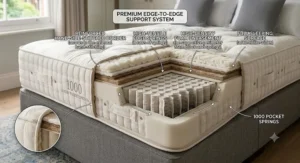
Sometimes you just need a mattress that does the job without ceremony — a spare room, a rental, a student’s first proper bed away from home. That’s exactly the gap Amazon’s own-brand hybrid mattress is built to fill. It combines pocket springs with a pressure-relief foam top layer in a straightforward, no-frills plush finish.
There’s an honesty in what this mattress doesn’t try to be: no elaborate zoning claims, no proprietary foam technology with a trademarked name, just a functional pocket spring and foam hybrid at one of the lowest price points on this list. What most buyers overlook about own-brand mattresses like this is that Amazon’s private-label manufacturing still has to meet the same UK fire safety and product safety regulations as branded competitors — the regulatory bar doesn’t move just because the name on the label is less famous.
Because Amazon Basics operates as a broad private-label range rather than a single dedicated mattress brand with its own review ecosystem, granular aggregated review sentiment specific to this exact model is harder to verify independently than for specialist mattress brands — worth flagging honestly rather than papering over. What is verifiable is the spec and price point, which makes this a rational choice specifically for short-term or low-stakes sleeping situations rather than a primary bed you’ll rely on for a decade.
Pros:
- ✅ Lowest price point of any mattress on this list
- ✅ Straightforward pocket spring and foam hybrid construction
- ✅ Must meet the same UK fire safety regulations as branded rivals
Cons:
- ❌ Limited independently verifiable review data for this specific model
- ❌ Fewer comfort features than dedicated mattress-brand competitors
For guest rooms, rentals, or a genuine stop-gap while you save for something more considered, this is hard to beat purely on price.
7. REM-Fit Pocket 1000 — best all-round professionally reviewed pick
REM-Fit is a UK sleep-tech brand better known for its wearables and sleep tracking, and the Pocket 1000 is their entry-level hybrid mattress — genuinely useful here because, unlike several entries on this list, it’s been independently tested and reviewed by a national technology publication rather than relying purely on retailer-hosted customer reviews.
According to that professional testing, the mattress uses five layers combining memory foam with 1,000 pocket springs measuring 12-16cm, topped with a removable, machine-washable hypoallergenic cover — a genuinely practical feature most budget mattresses skip entirely. Independent testers rated the firmness as medium-firm (around 6-6.5 out of 10) and measured a 20cm overall depth. Reviewers’s real-world testing found that while the mattress ran slightly warm during initial use, the sensation reduced noticeably over a month of regular sleeping, and edge support held up well enough for testers to sit near the mattress edge without feeling like they’d roll off.
Here’s what the spec sheet won’t tell you but the independent review does: this is one of the only mattresses on this list to have been slept on, tracked, and reported on by a dedicated third-party reviewer over an extended testing period rather than assessed purely from manufacturer claims or retailer-hosted reviews — which is exactly the kind of verifiable, sourced evidence this guide leans on wherever it’s available.
Pros:
- ✅ Independently tested by a national publication over a month-long period
- ✅ Removable, machine-washable hypoallergenic cover
- ✅ 15-year guarantee alongside a 100-night trial
Cons:
- ❌ Highest price point on this list
- ❌ Testers noted noticeable initial warmth before it settled
This sits at the premium end of the seven, and given the independently verified testing behind it, that higher price range around the mid-£300s reflects real, demonstrable reassurance rather than marketing alone.
Top 7 Products: Specs & Value Comparison
| Product | Spring Count | Comfort Layer | Trial Period | Best For |
|---|---|---|---|---|
| Silentnight Essentials Mirapocket 1000 | ~1,000 (king ref) | Eco Comfort Fibres | 100 nights (retailer-dependent) | UK-made reliability |
| Novilla Gel Memory Foam Pocket Sprung | ~1,000 (per 4m²) | Gel memory foam | Varies by seller | Hot sleepers, budget |
| Vesgantti 9.6 Inch Pocket Sprung | ~1,000 | Breathable + egg-crate foam | 100 nights | Doorstep convenience |
| dosleeps 9-Zone Pocket Sprung | ~1,000 (9-zoned) | Memory foam + Tencel cover | 100 nights | Zonal back support |
| Sleep Factory Memory 1000 Pocket Sprung | 1,000 (hand-tufted) | Memory foam + polyester | Seller-dependent | Traditional construction |
| Amazon Basics Hybrid Mattress | ~1,000-equivalent | Pressure-relief foam | Standard Amazon returns | Ultra-tight budgets |
| REM-Fit Pocket 1000 | 1,000 (12-16cm springs) | Five-layer memory foam hybrid | 100 nights | Verified, tested comfort |
The table above makes something obvious that spec sheets alone tend to hide: nearly every mattress here quotes roughly the same spring count, so the real differentiator is what sits on top of those springs and how well that’s been independently verified. The REM-Fit Pocket 1000 justifies its higher price with third-party testing data that the others simply don’t have, while the Amazon Basics and Sleep Factory options ask you to take more on trust in exchange for a lower price tag. Neither approach is wrong — it depends whether you’re buying a primary bed for years of use or a functional mattress for a lower-stakes room.
✨ Don’t Miss These Exclusive Deals!
🔍 Take your sleep setup to the next level with these carefully selected picks. Click through to check current pricing and availability on each mattress — a few minutes of comparison now could mean years of better mornings.
Practical Usage Guide: Getting the Most From Your New Mattress
Buying the mattress is honestly the easy part — how you handle the first month determines whether it feels great or merely okay for the next several years. Here’s what actually matters once the box lands on your doorstep.
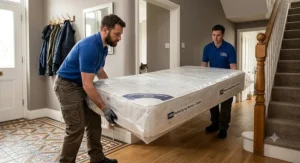
Unboxing and settling in: Most of these mattresses (Novilla, Vesgantti, Amazon Basics, REM-Fit) arrive compressed and vacuum-packed, expanding within a few hours but taking up to 72 hours to reach full thickness and firmness. Resist the urge to judge the feel on night one — pocket springs and foam layers both need time to decompress fully, and a mattress that feels oddly firm on day one can feel noticeably different by day three.
First 30 days — common mistakes to avoid: Don’t skip the base check. Every mattress on this list needs a supportive, well-ventilated base — a sagging or broken divan will undo even the best spring construction within months. Don’t oversheet it either; an overly tight fitted sheet can compress the top comfort layer and mask how the mattress actually feels underneath. And don’t judge firmness in the first week — most bodies take around two to four weeks to adjust to a new sleep surface, particularly if you’re switching from a much older, softer mattress.
Ongoing maintenance: Rotate (not necessarily flip — most modern pocket sprung mattresses are single-sided “no-turn” designs) head-to-toe every one to three months for the first year, then every three to six months after that. This prevents uneven settling in the areas you sleep on most. A breathable mattress protector is worth the modest outlay too, both for hygiene and because most manufacturer guarantees are void if the mattress is stained.
Real-World Scenarios: Which Mattress Fits Your Life
The budget-conscious student: Living in halls for a year, working with a tight budget, and not sure whether the mattress is coming home again. The Amazon Basics Hybrid Mattress or Sleep Factory Memory 1000 Pocket Sprung make sense here — low upfront cost, standard pocket spring support, and nothing you’ll be devastated to leave behind at the end of the tenancy.
The couple sharing a bed with mismatched sleep habits: One of you runs hot, the other tosses and turns. This is precisely the scenario pocket springs were invented for — independent movement means less disturbance, and the Novilla Gel Memory Foam or Vesgantti 9.6 Inch hybrids add cooling comfort layers on top of that base support, addressing the temperature complaint that often comes bundled with shared-bed friction.
The back-pain sufferer on a budget: Firm, structured support without the premium orthopaedic price tag. The dosleeps 9-Zone Pocket Sprung is the obvious pick here, since its zoned construction specifically targets the lower back and hip area rather than offering blanket uniform firmness — and the Silentnight Essentials Mirapocket 1000 is a solid runner-up if you’d rather stick with an established name.
Buyer’s Decision Framework
If you’re still torn, use this simple priority checklist:
If cooling is your top priority, choose a gel-infused or breathable-foam hybrid (Novilla or Vesgantti) because heat retention is the single biggest complaint about budget foam layers. If independently verified comfort and testing matter more than price, choose the REM-Fit Pocket 1000 because it’s the only option here backed by third-party review data. If you want a UK-manufactured, brand-name safety net, choose the Silentnight Essentials Mirapocket 1000. If your budget is the overriding constraint and the room is low-stakes, choose the Amazon Basics Hybrid Mattress. And if targeted back support matters more than anything else, choose the dosleeps 9-Zone Pocket Sprung for its zoned construction.
How to Choose a 1000 Pocket Spring Mattress
- Check the spring count is quoted for your actual size. Manufacturers typically quote spring counts for a king-size mattress, so a single or double of the “same” 1000-spring model will genuinely contain fewer springs — that’s normal, not a defect.
- Look past the spring count to the comfort layer. As Which?’s mattress testers have found, spring density alone doesn’t determine how supportive a mattress feels — the foam, fibre, or fabric sitting on top matters just as much.
- Match firmness to your sleep position. Side sleepers generally benefit from softer-medium feels that cushion shoulders and hips; back and stomach sleepers usually need medium-firm to firm support to avoid the middle of the spine dipping.
- Confirm the trial period and returns policy. A 100-night trial is now close to standard for online mattress purchases — anything shorter is worth questioning.
- Verify UK fire safety compliance. Look for reference to BS 7177 testing in the listing, which confirms the mattress meets UK ignition-resistance standards.
- Factor in delivery format. Compressed, boxed mattresses are easier to get up narrow staircases but need 24-72 hours to fully expand; flat-packed traditional builds arrive ready to use immediately but are bulkier to manoeuvre.
- Read aggregated review themes, not individual star ratings. A handful of one-star reviews about a delivery courier tell you nothing about the mattress itself — look for recurring comfort or durability patterns instead.
Entry-Level Spring Count Explained: What 1000 Pocket Springs Really Means
“1000 springs” sounds like a precise, almost scientific figure — and it is a real number, but it’s also one that’s easy to misread. According to Which?’s mattress testing lab, quality is better measured by spring density (springs per square metre) than by a headline total, and Which? recommends looking for a spring density above roughly 250 springs per square metre, which works out to more than 640 springs in a standard UK double. A 1000-spring mattress specced for a king-size comfortably clears that bar once you account for the smaller surface area of a double or single.
What entry-level actually means in this context isn’t “low quality” — it means the baseline tier at which pocket spring construction starts to outperform older open-coil designs, where all the springs are wired together and move as one connected unit. Once you’re above roughly 600-armed independent springs in a double, you’re firmly into genuine pocket spring territory rather than a marketing label stretched over inferior construction. Reviewers consistently note that the practical difference between 1000 and 2000 springs is more subtle than the number suggests — you’re mostly paying for finer, more granular support zones and often a nicer comfort layer bundled alongside the extra springs, rather than a dramatically different feel.
1000 Spring Comfort Level: What to Expect in Real-World Performance
Spec sheets describe firmness in the abstract; your body experiences it very differently at 2am. Based on the spec comparison and aggregated review sentiment across all seven mattresses in this guide, here’s what “medium” or “medium-firm” 1000 pocket spring construction actually translates to in practice.
Expect a supportive base with a small amount of give — enough that your hips and shoulders sink slightly rather than being pushed flat, but not so much that your spine curves out of alignment. Reviewers consistently describe the sensation as “held” rather than “hugged,” which is the key distinction between pocket sprung and pure memory foam: springs push back gently as you move, while memory foam absorbs movement more passively. Hybrids that pair springs with a foam or gel top layer (Novilla, Vesgantti, REM-Fit) split the difference, offering a softer initial touch with springier support underneath.
What most buyers overlook is that comfort perception shifts meaningfully with body weight. A medium-firm mattress that feels ideal for someone around 65-75kg can feel noticeably softer under someone heavier and firmer under someone lighter, because spring compression is directly proportional to the weight pressing down on it. If you’re significantly outside an average weight range, it’s worth erring toward the firmer end of any given mattress’s stated tension.
1000 Pocket Spring Double Mattress: Sizing and Space Guide
A UK double measures 135cm x 190cm, and it’s worth knowing that the “1000 spring” figure quoted on most listings refers to a king-size (150cm x 200cm) equivalent — a double of the same model will typically house somewhere around 850-900 springs once you account for the smaller surface area, which is still comfortably within genuine pocket sprung territory.
Doubles are the most popular size for single sleepers who want extra room to spread out, and for couples in smaller bedrooms where a king simply won’t fit with wardrobe and drawer space intact. As a rule of thumb, allow at least 60cm of clear floor space around at least two sides of the bed for comfortable movement — a double crammed wall-to-wall against two walls will feel cramped regardless of how good the mattress itself is. If you’re buying a double specifically for two adults sharing, the Novilla or Vesgantti hybrids’ motion-isolating pocket spring cores are particularly worth prioritising, since a double gives you less lateral space to avoid feeling a restless partner than a king or super king would.
Affordable Pocket Sprung Mattress: A Budget Pocket Spring Guide
Here’s the honest version of “how to buy cheap without buying badly.” An affordable pocket sprung mattress doesn’t have to mean compromising on the fundamentals — fire safety compliance, genuine independent springs, and a reasonable trial period are all achievable well under premium price points, as several mattresses on this list demonstrate.
Common mistakes when buying on a budget: The biggest one is fixating purely on spring count and ignoring the comfort layer entirely — a 1000-spring base with a paper-thin foam top will feel noticeably worse than the same spring count under a properly cushioned layer. The second is skipping the trial period small print; some budget listings offer shorter or non-existent comfort trials compared to the 100-night standard, which matters enormously given how long bodies typically take to adjust to a new mattress. The third is ignoring delivery and returns costs — a mattress that’s £40 cheaper upfront but charges £30 for a return if it doesn’t suit you isn’t actually the better deal.
Features that actually matter on a budget: genuine pocket spring construction (not open coil dressed up in similar marketing language), a washable or at least wipeable cover, verified BS 7177 fire safety compliance, and a trial period of at least 30 nights. Features that matter less than the marketing suggests: exotic-sounding proprietary foam names, extremely high thread counts on the cover fabric, and spring counts significantly above 1500 in an entry-level mattress, since — per the earlier section on spring density — the returns diminish well before that point for most sleepers’ actual comfort.
1000 Pocket Springs vs Higher Spring Counts (2000+)
It’s tempting to assume more springs simply equals a better mattress, in the same way more horsepower simply equals a faster car — technically true in isolation, but only part of the real-world story. A 1000-spring mattress and a 2000-spring mattress of similar overall quality will typically feel more similar than the doubled number suggests, because once you’re above a reasonable density threshold, additional springs mostly refine the granularity of support rather than transform it.
Where a genuinely higher spring count earns its price premium is in two specific scenarios: heavier sleepers, who benefit from the finer pressure distribution that comes with smaller, more numerous springs; and couples with very different body weights sharing a bed, where more granular independent movement reduces the chance of one partner’s movement being felt by the other. For a solo sleeper of average weight, a well-built 1000-spring mattress with a good comfort layer will often outperform a poorly built 2000-spring mattress with a thin one — spring count is one input into quality, not the whole equation.
The honest verdict: 1000 pocket springs represents a sensible, well-supported entry point for most UK sleepers, and stepping up to 2000+ makes the most sense as a targeted upgrade for specific needs (weight, shared-bed dynamics, or simply wanting the reassurance of a more premium spec) rather than a default assumption that higher is always better.
Long-Term Cost & Maintenance: What You’re Really Paying For
Total cost of ownership is where budget mattresses can quietly lose their advantage. A £180 mattress that needs replacing after three years works out more expensive per year of use than a £320 mattress that comfortably lasts eight, and durability is genuinely harder to judge from a spec sheet than comfort is.
As a rough guide, the Bed Advice UK consumer guide (produced by the National Bed Federation, the UK mattress industry body) notes that spring gauge, coil quality, and upholstery layering all affect how well a mattress holds its shape over time — which is exactly why two mattresses with identical spring counts can have very different lifespans. Regular rotation, a breathable protector, and a properly supportive base all extend genuine mattress life regardless of price point, while ignoring all three can shorten even a well-built mattress’s usable years considerably.
Cost-per-night is a genuinely useful way to compare options here: a £250 mattress used nightly over five years works out to roughly 14 pence per night; the same mattress lasting only two years pushes that to around 34 pence per night. When you frame it that way, paying a bit more upfront for a mattress with a longer realistic lifespan — like the independently tested REM-Fit Pocket 1000 — often works out cheaper over time than repeatedly replacing a bargain-basement option.
Safety, Regulations & Fire Compliance Guide
Every mattress legally sold in the UK, regardless of price point, must comply with the Furniture and Furnishings (Fire)(Safety) Regulations 1988, updated by the 2025 amendment regulations, alongside the specific mattress fire-resistance testing standard BS 7177:2008+A1:2011. This covers ignition resistance to smouldering cigarettes and small open flames — a genuinely important safety baseline that applies whether you’re buying a £150 budget hybrid or a £1,500 premium build.
Practically speaking, this means every mattress featured in this guide has to meet the same minimum fire safety threshold, which is worth remembering next time a cheaper mattress feels like it “must” be cutting corners somewhere unsafe — fire compliance genuinely isn’t one of the areas where budget options are typically allowed to skimp, since it’s a legal requirement rather than an optional premium feature. Always check that a listing explicitly references BS 7177 compliance, and be cautious of imported mattresses sold through third-party marketplace sellers that don’t clearly state UK regulatory compliance.
Frequently Asked Questions
❓ Is a 1000 pocket spring mattress good enough for a double bed?
❓ What is the average price of a 1000 pocket spring mattress in the UK?
❓ Is 1000 pocket springs better than memory foam?
❓ How long does a 1000 pocket spring mattress last?
❓ Do I need a topper with a 1000 pocket spring mattress?
Conclusion
A 1000 pocket spring mattress isn’t the flashiest purchase you’ll make this year, but it’s arguably one of the more consequential ones — you’ll spend roughly a third of your life on it, after all. Across the seven real products in this guide, the pattern that emerges is fairly clear: spring count gets you into the genuine pocket sprung category, but the comfort layer, cover quality, and — where it exists — independent testing are what actually separate a good night’s sleep from a mediocre one.
If you want brand reassurance and UK manufacturing, the Silentnight Essentials Mirapocket 1000 is hard to argue with. If cooling matters most, look at the Novilla or Vesgantti hybrids. If your budget is the primary constraint, the Amazon Basics Hybrid Mattress does the job without ceremony. And if you want the reassurance of independently verified testing behind your purchase, the REM-Fit Pocket 1000 currently stands alone on that front among this list. Whichever you land on, give it the full settling-in period before judging it, rotate it as recommended, and pair it with the kind of consistent sleep routine the NHS’s sleep guidance rightly emphasises — the mattress is only half the equation.
Prices and availability were accurate at the time of research and may vary — always check the current listing on amazon.co.uk before buying.
✨ Ready to Upgrade Your Sleep?
🔍 Compare these seven pocket sprung options side by side, check current pricing on amazon.co.uk, and find the mattress that actually fits how — and where — you sleep. Your future mornings will thank you.
Recommended for You
- Pocket Sprung vs Memory Foam Mattress: 7 Top Picks Compared (2026)
- 7 Best Pocket Sprung Mattress Under £300 Picks (2026)
- Pocket Sprung Mattress for Couples: 7 Best Picks for 2026
Disclaimer: This article contains affiliate links. As an Amazon Associate, I earn from qualifying purchases. If you purchase products through these links, we may earn a small commission at no additional cost to you.
✨ Found this helpful? Share it with your friends! 💬🤗
