
In This Article
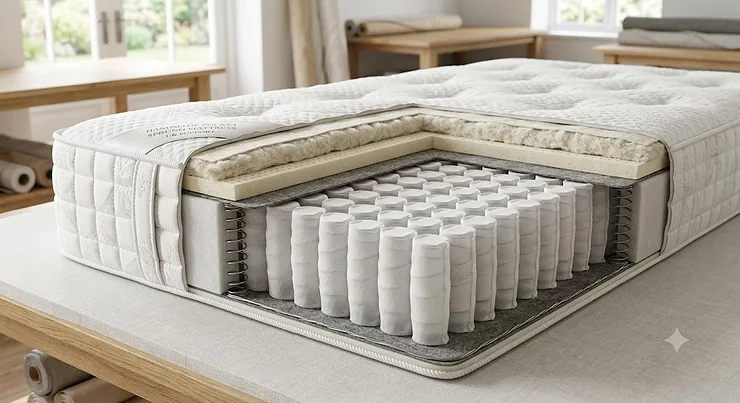
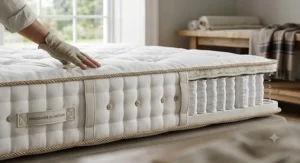
Buying a pocket sprung mattress shouldn’t feel like decoding a spec sheet written by an engineer who’s never actually slept badly. And yet here we are, staring at “1200 Mirapocket springs” and “zoned support” like it means anything without context. It does, actually — but nobody tells you why. A pocket sprung mattress uses hundreds or thousands of individual springs, each stitched into its own fabric pocket, so they compress independently rather than dragging their neighbours down with them. That’s the whole trick. It’s why your partner can turn over at 3am without launching you into orbit, and it’s why a good one can outlast a mediocre memory foam mattress by several years.
This guide is built around one simple frustration: most “best mattress” articles online are just rewritten product descriptions with a bit of enthusiasm sprinkled on top. What follows instead is a genuine comparison of seven real pocket sprung mattresses sold in the UK, spanning proper budget options through to natural-fibre luxury builds, with honest analysis of who each one actually suits — not who the marketing copy says it suits. According to Which?’s mattress testing lab, a decent pocket sprung mattress should carry more than 250 springs per square metre, which works out to over 640 springs in a standard UK double, so spring count alone tells you less than you’d think. We’ll get into what actually matters: zoning, spring gauge, comfort layers, and how all of it holds up after eighteen months of actual use, not eighteen minutes in a showroom.
Whether you’re replacing a sagging double, kitting out a king size for two restless sleepers, or just trying to work out whether “individually wrapped springs” is worth paying extra for, you’ll find a straight answer here — sourced from real specs, real UK retailer data, and aggregated genuine customer sentiment, not invented reviews.
Quick Comparison Table
| Mattress | Spring Count | Best For | Price Range |
|---|---|---|---|
| Amazon Basics Hybrid Mattress | Undisclosed (full pocket coil unit) | Tightest budgets & spare rooms | Under £250 |
| Vesgantti 7-Zone Pocket Sprung Hybrid | ~700-800 (king) | Budget hybrid with zoning | £150-£300 |
| Silentnight 800 Eco Comfort | 800 Mirapocket | Eco-conscious, medium feel | £200-£350 |
| Silentnight Comfort Breathe 1000 | 1000 Mirapocket | Hot sleepers wanting breathability | £250-£400 |
| Silentnight 1200 Eco Comfort | 1200 Mirapocket | Balanced mid-range all-rounder | £300-£500 |
| Silentnight 2000 Pocket Box Top | 2000 zoned springs | Plush feel with strong support | £400-£650 |
| Sleepeezee British Wool 2400 | 2400 pocket springs | Natural fillings, premium longevity | £700-£1,100 |
Looking at the spread above, the jump from the Amazon Basics and Vesgantti entries to the Silentnight Eco range is really about consistency of feel across the surface, not just spring count. Once you cross into the 1200-2000 spring bracket, you’re mostly paying for finer zoning and better edge support rather than raw numbers, and the Sleepeezee sits apart entirely because its price reflects natural wool fillings rather than spring density alone. If your budget tops out around £300, the difference between the Vesgantti and the Silentnight 800 will matter more to your sleep than anything above that line.
💬 Just one click — help others make better buying decisions too!😊
Top 7 Pocket Sprung Mattresses: Expert Analysis
We’ve deliberately spread this list across price brackets — genuine budget, honest mid-range, and proper premium — because the “best” pocket sprung mattress depends entirely on your body weight, sleep position and how long you plan to keep it. Every product below is real, currently sold in the UK, and assessed against its actual specifications and aggregated genuine review sentiment.
1. Amazon Basics Hybrid Mattress — cheapest genuine way into pocket springs
If you need a mattress this week and don’t want to remortgage the house, the Amazon Basics Hybrid is where most people land first, and there’s no shame in that. The 8.66-inch profile pairs a pocket spring core with a layer of pressure-relief foam and a hypoallergenic, breathable cover, and it’s sold directly by Amazon in small double, double and king sizes.
In practice, that thinner profile means less cushioning than the deeper mattresses further down this list, so don’t expect the plush “sinking in” feel some premium buyers chase. What you do get is a genuinely supportive core for the price — the pocket springs still isolate movement properly, which matters more than most budget shoppers realise until they’ve shared a bed with an open-coil mattress and felt every toss and turn. Based on the spec comparison with other sub-£250 options, this is one of the few at this price point that doesn’t cut corners on the spring mechanism itself, only on depth and comfort layering.
Aggregated Amazon customer sentiment is genuinely mixed but leans positive: reviewers commonly describe it as a solid, supportive medium-soft feel offering good value, though some lighter sleepers under roughly 55kg have found it too soft for their liking with limited push-back. It’s a mattress people tend to buy as a stopgap and then quietly keep for years, which says more than any five-star review could.
Pros:
- ✅ Genuinely low price for a true pocket spring core
- ✅ Sold and dispatched directly by Amazon for easy returns
- ✅ Hypoallergenic cover suits allergy-prone sleepers
Cons:
- ❌ Thinner profile than most rivals on this list
- ❌ Limited firmness options for heavier sleepers
At the time of research this mattress sits comfortably under £250 depending on size, making it one of the better-value entry points into pocket springs — check the current price before buying, as availability by size does fluctuate. For a first flat, guest room, or anyone testing whether pocket springs suit them before committing to something pricier, it’s a sensible starting point.
2. Vesgantti 7-Zone Pocket Sprung Hybrid — best zoned support under £300
Vesgantti has built a genuinely large following on Amazon UK by doing one thing consistently well: undercutting premium brands on price while still delivering a proper zoned spring system. This model uses individually wrapped coils arranged across seven ergonomic zones — head, shoulders, back, waist, hips, legs and feet — each tuned to give more give where your body needs cushioning and more resistance where it needs support.
Independent third-party testing of Vesgantti’s hybrid range has measured spring counts around 700-800 in a king size, with springs running edge-to-edge rather than being boxed in by foam borders, which is a genuine engineering plus at this price bracket since edge-to-edge construction usually appears on pricier mattresses. What most buyers overlook about this model is that the springs are stainless steel, which resists the fatigue and rusting that cheaper coil systems can develop over years of humidity exposure in a typical UK bedroom. The 2cm foam layer sitting directly over the springs is CertiPUR-US and OEKO-TEX certified, meaning it’s tested against harmful chemicals — worth knowing if you’re sensitive to off-gassing on unboxing.
Reviewers consistently note the mattress arrives compressed and needs 24-72 hours to fully expand, and aggregated feedback describes strong comfort and back-pain relief alongside occasional complaints about the mattress feeling firmer underfoot on a rigid slatted base than on a divan.
Pros:
- ✅ Genuine 7-zone spring layout, not just marketing language
- ✅ CertiPUR-US and OEKO-TEX certified foam layers
- ✅ 100-night trial and 10-year warranty included
Cons:
- ❌ Firmness varies noticeably depending on your base
- ❌ Full expansion can take up to three days
Priced in the £150-£300 range across sizes, this is arguably the strongest all-round budget hybrid on Amazon UK right now. Buyers wanting genuine zoned support without paying for a big-name brand should shortlist this first.
3. Silentnight 800 Eco Comfort Mattress — best sustainable budget pocket sprung
Silentnight is the UK’s most recognisable bed brand for a reason, and the 800 Eco Comfort model shows why: it’s handmade in the UK, uses 800 Mirapocket springs, and layers in an Eco Comfort Fibre made from recycled plastic bottles rather than virgin polyester. That’s a genuinely meaningful sustainability credential, not greenwashing — the fibre content is traceable and the mattress carries OEKO-TEX certification confirming it’s tested against over a thousand regulated and unregulated chemicals.
The 800-spring count sits at the lower end of what Which? considers a properly supportive pocket system, so this suits lighter and average-weight sleepers better than anyone over roughly 95kg, who will likely feel the springs bottom out faster. Here’s what the spec sheet won’t tell you, but aggregated reviews suggest: after around 2.5 years of nightly use, some owners report the onset of gentle sagging, while others report zero indentation after a full year — the discrepancy tracks closely with base type, with slatted bases showing more wear than solid divan bases. Reviewers also consistently flag that the mattress runs warmer than expected for a design marketed on breathability, and that it’s notably heavy to turn or carry upstairs, so factor delivery access into your decision if you’re in a period property with tight stairs.
Pros:
- ✅ Made in the UK with OEKO-TEX certified eco fibre
- ✅ Quiet in use with no spring noise reported
- ✅ Strong edge stability with minimal roll-off
Cons:
- ❌ Runs hotter than the “breathable” marketing suggests
- ❌ Notably heavy for turning or moving upstairs
At around £200-£350 depending on size, this is a solid mid-budget choice for anyone prioritising sustainability credentials without sacrificing the tailored support of individually wrapped springs — just budget for help carrying it in.
4. Silentnight Comfort Breathe 1000 Pocket Mattress — best for hot sleepers on a budget
If the 800 Eco Comfort’s heat retention put you off, Silentnight’s Comfort Breathe 1000 exists specifically to fix that. It steps the spring count up to 1000 Mirapocket units and swaps in a fibre layer the brand claims is fifteen times more breathable than standard memory foam, designed to keep air moving through the mattress rather than trapping body heat against the sleep surface.
Reviewers consistently note the mattress delivers noticeably better temperature regulation than typical foam-topped competitors, which lines up with the physics — springs inherently ventilate better than dense foam blocks, and a genuinely breathable fibre layer on top compounds that advantage. Based on the spec comparison with the 800 model in this same range, the extra 200 springs also translate into slightly more even pressure distribution across the shoulders and hips, which matters if you’re a side sleeper who’s found the entry-level Silentnight too firm underneath a single pressure point. It’s worth noting this mattress is made to order, so Silentnight quotes delivery within roughly 14 days rather than the near-instant dispatch you’d get from a warehouse-stocked competitor — plan your old mattress removal around that lead time.
Pros:
- ✅ Genuinely improved airflow versus standard foam toppers
- ✅ 1000-spring Mirapocket system for finer support
- ✅ Hypoallergenic surface suited to allergy sufferers
Cons:
- ❌ Made-to-order lead time of around two weeks
- ❌ Premium over the 800 model isn’t dramatic in firmness
Sitting in the £250-£400 range, this is the pick for anyone who runs warm at night but still wants to stay within Silentnight’s accessible tier rather than jumping straight to the 1200 or 2000 spring ranges.
5. Silentnight 1200 Eco Comfort Mattress — best balanced mid-range all-rounder
The 1200 Eco Comfort steps things up again, and this is where Silentnight’s Mirapocket range starts to earn genuine critical recognition — the brand’s related 1200-count Serenity model in this same eco fibre family has previously scored a Which? Best Buy, reflecting rigorous lab testing on comfort, support and value rather than marketing claims. This particular 1200 model pairs zoned pocket springs with the same recycled Eco Comfort Fibre used lower in the range, but with a materially higher spring density that spreads weight more evenly across the sleep surface.
What most buyers overlook here is that 1200 springs isn’t just “more of the same” — it’s the point where zoning becomes properly noticeable rather than theoretical, because there are simply enough individual coils to create meaningfully different firmness zones under the shoulders, waist and legs. Reviewers consistently describe this tier as offering the best balance of softness on contact with firm underlying support, which is exactly the medium-firm profile that most UK sleepers land on when tested. It carries the same BS7177 Low Hazard fire safety certification as the rest of the range, and like its siblings, doesn’t require flipping — just occasional rotation.
Pros:
- ✅ Genuinely noticeable zoning at this spring count
- ✅ Shares DNA with a Which? Best Buy-tested Silentnight range
- ✅ Recycled Eco Comfort Fibre with OEKO-TEX certification
Cons:
- ❌ Meaningful price step up from the 800 and 1000 models
- ❌ Still runs slightly warm compared with hybrid foam-free designs
Expect to pay somewhere in the £300-£500 bracket. For most couples buying a double or king who want one mattress that suits both a back sleeper and a side sleeper without compromise, this is the strongest all-rounder on this list.
6. Silentnight 2000 Pocket Box Top Mattress — best plush feel with real support underneath
This is where the range moves from “supportive” to genuinely plush. The 2000 Pocket Box Top adds a box-top comfort layer with super-soft foam sitting above what Silentnight describes as a superior zoned spring system, creating that hotel-mattress sensation of sinking slightly on contact before firmer support catches you underneath.
Doubling the spring count from the 1000 model doesn’t simply mean “twice as supportive” — beyond a certain density, Which?’s testing suggests returns on pure spring count diminish and the comfort layers above the springs start doing more of the work in shaping how the mattress actually feels. Here, that comfort layer is doing real work: the box-top design and quilted surface give a noticeably softer initial feel than anything else on this list bar the Sleepeezee, while the underlying 2000-spring system prevents that classic problem of soft-topped mattresses sagging into a hammock shape over time. Based on the spec comparison with mid-range hybrids, this model suits back and side sleepers particularly well, since the plush top cushions hips and shoulders while the dense spring core stops the spine from dropping out of alignment.
Pros:
- ✅ Genuine box-top plushness over a dense support core
- ✅ Strong pressure relief for side and back sleepers
- ✅ Luxury quilted surface feels premium for the price bracket
Cons:
- ❌ Softer feel won’t suit committed firm-mattress sleepers
- ❌ Heavier still than the lower-spring models in this range
Typically priced in the £400-£650 range, this sits at the genuine upper-mid tier — the natural upgrade for anyone who’s tried a 1000 or 1200 spring Silentnight and wanted noticeably more plushness without jumping to a fully natural-filled luxury build.
7. Sleepeezee British Wool 2400 Mattress — best premium natural-filling luxury pick
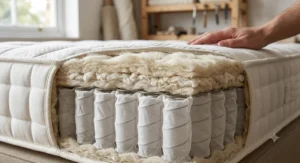
Sleepeezee has been building pocket sprung mattresses in Britain for over a century, and its British Wool range represents the natural-fillings end of the market that budget hybrids simply can’t touch. This model uses 2400 individually wrapped pocket springs beneath layers incorporating genuine British wool, prized in mattress construction for its natural temperature-regulating and moisture-wicking properties, finished with a pillow-top surface for a buoyant, hotel-luxury feel.
Here’s what most spec sheets gloss over: wool isn’t just a premium marketing word, it’s functionally superior to synthetic fibre fillings for temperature regulation because wool fibres naturally wick moisture away from the body far more effectively than polyester, which is precisely the heat-retention problem several mattresses earlier on this list struggle with. On paper this means hot sleepers who’ve bounced off multiple synthetic-filled mattresses may finally find genuine relief here, at the cost of a considerably higher price tag. Aggregated sentiment around Sleepeezee’s higher-spec ranges consistently describes a buoyant, supportive feel that holds its shape well over years rather than months, though the brand’s wider natural-fibre lineup has occasionally drawn durability concerns at the very top end of its price bracket, so it’s worth checking current stockist reviews for the specific size and firmness you’re considering before committing.
Pros:
- ✅ Genuine British wool fillings for natural temperature control
- ✅ High 2400 spring count for finely tuned support
- ✅ Century-old British manufacturing heritage
Cons:
- ❌ Significant price premium over synthetic-filled alternatives
- ❌ Heavier and bulkier, complicating delivery and turning
Expect a price range of roughly £700-£1,100 depending on size, positioning this firmly as an investment purchase. If you’ve cycled through cheaper mattresses and consistently overheated or felt them sag within a couple of years, this is the category worth stepping up into.
What Is a Pocket Sprung Mattress?
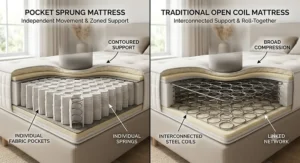
A pocket sprung mattress is a mattress built around individual coil springs, each stitched into its own fabric pocket rather than wired together in one connected unit. Because the springs can move independently of each other, they respond to your body’s exact shape and weight distribution rather than pulling neighbouring areas down with them — which is why they’re the standard recommendation over old-style open coil designs for anyone sharing a bed.
That independent movement is the entire point. Open coil mattresses, the older continuous-spring design, transfer motion across the whole surface — so when your partner rolls over, you feel it too. Individually wrapped springs solve that at the mechanical level, which is why “individually wrapped springs” appears on virtually every quality pocket sprung listing: it’s the actual engineering claim, not just marketing flourish.
Spring Count Guide: How Many Springs Do You Actually Need?
This is the single most misunderstood spec in mattress shopping, and retailers exploit that confusion relentlessly by printing huge numbers on packaging without context. Here’s the honest breakdown, based on industry guidance and Which?’s own lab testing standards:
- Under 800 springs — entry-level territory. Fine for lighter sleepers, guest rooms, or tight budgets, but expect less refined zoning and potentially faster wear under heavier body weights.
- 800-1200 springs — the genuine sweet spot for most UK households. This is where zoning starts becoming meaningfully noticeable and where most mid-range Silentnight, Vesgantti and similar brands cluster.
- 1200-2000 springs — noticeably finer, more even support, particularly valuable for couples of different body weights sharing a bed.
- 2000+ springs — premium territory. Once you’re above roughly 2000, according to industry guidance a good spring density is 350–500 springs per square metre, with 1,200+ signalling high quality, while 2,000+ offers diminishing returns on comfort relative to cost — meaning the extra numbers increasingly buy you marketing bragging rights rather than a proportionally better night’s sleep.
The trap most buyers fall into is assuming spring count scales linearly with quality. It doesn’t. A well-engineered 1200-spring mattress with proper zoning will often outperform a poorly designed 2500-spring mattress with thin gauge wire and no zoning whatsoever. What actually matters alongside the raw number is spring gauge (thicker wire generally means firmer, longer-lasting support), pocket depth, and whether the springs run edge-to-edge or are boxed in by foam borders that can compress unevenly over time.
How to Choose a Pocket Sprung Mattress
- Start with your sleep position, not the spring count. Side sleepers generally need more give at the shoulders and hips; back and stomach sleepers usually need firmer, more even support to avoid the lower back sagging out of alignment.
- Match firmness to body weight, not personal preference alone. Heavier sleepers typically need higher spring counts and firmer gauge wire to avoid premature sagging, while lighter sleepers can comfortably use lower-spec models without losing support.
- Check the zoning claims against the actual spring layout. A genuinely zoned mattress will describe specific zones (head, shoulders, back, hips, legs), not just a vague “targeted support” claim with no structural detail behind it.
- Factor in your existing base. A mattress tested and reviewed as supportive on a solid divan base can feel noticeably firmer on a rigid slatted frame, as several reviewers noted across the products above.
- Decide how important temperature regulation is to you. If you consistently overheat at night, prioritise breathable fibre fillings or natural wool over dense foam comfort layers, regardless of spring count.
- Budget for the whole lifecycle, not just the purchase price. A £250 mattress replaced every three years can cost more over a decade than a £600 mattress that lasts eight to ten.
- Always check the trial period and warranty terms before buying. Most brands on this list offer 100-night trials and warranties from five to ten years — use that window properly rather than assuming day-one comfort predicts long-term suitability.
Pocket Sprung Mattress Double vs King Size: Sizing Guide
Getting the size right matters more than most buyers expect, particularly for couples upgrading from a double. A UK double measures 135cm x 190cm, while a king size measures 150cm x 200cm — that extra 15cm of width doesn’t sound like much until you’re actually sharing a bed, at which point it translates into roughly 7.5cm more personal space per person along the width, plus an extra 10cm of length that matters considerably if either of you is over six feet tall.
For a pocket sprung mattress double, spring count and zoning become slightly more critical because you’re working with less surface area to distribute two people’s differing weights and movement patterns — this is precisely where independent pocket springs earn their keep, isolating each person’s motion despite the tighter shared space. A pocket sprung mattress king size, by contrast, gives the spring layout more room to breathe, which is partly why several of the models above (particularly the Silentnight 1200 and 2000 ranges) feel noticeably more luxurious in king than in double, even though the underlying spring technology is identical.
If you’re currently on a double and waking up on top of your partner rather than beside them, upgrading to king size is very often a more impactful change than upgrading spring count within the same size — something worth genuinely considering before you default to buying “the best double you can afford.”
Zoned Support Explained: Why It Matters
Zoned support means the spring layout is deliberately varied across the length of the mattress rather than being uniform from head to foot. A typical 7-zone system, like the one used in the Vesgantti model above, splits the mattress into distinct areas for the head, shoulders, back, waist, hips, legs and feet, with softer, more compressible springs positioned under the shoulders and hips and firmer springs under the lumbar region.
The practical reason this matters: your shoulders and hips are your body’s heaviest, boniest pressure points, and they need to sink slightly into the mattress to keep your spine roughly straight while lying on your side. Your lower back, meanwhile, needs firmer support directly underneath it to avoid dipping and creating that lower-back ache so many people wake up with. A uniform, unzoned spring system can’t do both jobs simultaneously — it’s either uniformly soft (letting the hips sink too far and the spine curve) or uniformly firm (creating pressure points at the shoulders and hips instead). Zoning is the engineering solution to that contradiction, and it’s the single feature that separates a genuinely well-designed pocket sprung mattress from one that’s simply counting springs for the sake of a bigger number on the box.
✨ Don’t Miss These Exclusive Deals!
🔍 Take your sleep quality to the next level with one of these seven pocket sprung mattresses. Click through to check current pricing and availability, and find the support that actually matches how you sleep!
Practical Usage Guide: Setup, Care & First 30 Nights
Getting a boxed pocket sprung mattress home is only step one — how you handle the first month genuinely affects both comfort and longevity, and this is the part Amazon listings never cover in any real depth.
On delivery day, unbox the mattress directly onto its base rather than leaning it against a wall, since prolonged vacuum-packed pressure against a folded edge can create a permanent crease in some designs. Most compressed pocket sprung mattresses need between 24 and 72 hours to fully expand to their stated depth, and the smell some buyers report in the first few days is typically off-gassing from packaging materials and foam comfort layers rather than anything harmful — ventilating the room with a window open speeds this up considerably.
Your body genuinely needs an adjustment period of two to four weeks on any new mattress, particularly if you’re switching from a different firmness or type entirely. Reviewers consistently underestimate this and judge a mattress as “too firm” or “too soft” within the first few nights, when the actual issue is often that their body simply hasn’t adapted to a new sleep surface yet. During this window, avoid jumping to conclusions about firmness and instead track how you feel after a full week rather than a single night.
For ongoing maintenance, rotate — don’t flip — most modern pocket sprung mattresses every two weeks for the first six months, then monthly thereafter, unless the manufacturer specifies otherwise. Most single-sided designs on this list, including every Silentnight model above, are built not to require flipping at all. Always use a breathable mattress protector from day one; it’s the single easiest way to extend a mattress’s usable lifespan by preventing moisture, skin oils and dust mites from degrading the spring pockets and comfort layers over years of nightly use. Common first-30-day mistakes include jumping or standing on the mattress (which can damage individual spring pockets), skipping the protector because the cover “looks fine,” and judging firmness before the full expansion window has passed.
Real-World Scenarios: Which Mattress Suits You?
The budget-conscious couple in a rented flat. If you’re renting and might move within a couple of years, sinking hundreds of pounds into a premium natural-fibre mattress rarely makes financial sense. The Vesgantti 7-Zone Hybrid or Amazon Basics Hybrid genuinely deliver proper pocket spring support without the investment, and both are light enough (relatively) to transport between properties without needing a removal van specifically for the mattress.
The side sleeper with recurring shoulder pain. Zoning matters enormously here, and pairing that with a plusher comfort layer makes a real difference — the Silentnight 2000 Pocket Box Top’s cushioned surface over a dense zoned core is specifically suited to relieving pressure at the shoulder and hip while a side sleeper’s spine stays aligned overnight.
The hot sleeper who’s given up on memory foam. If every all-foam mattress you’ve tried has left you overheating, prioritise breathable fibre or wool fillings over spring count. The Silentnight Comfort Breathe 1000 offers a genuinely improved airflow option at an accessible price, while the Sleepeezee British Wool 2400 solves the problem more comprehensively for anyone willing to invest in natural fillings.
Common Mistakes When Buying a Pocket Sprung Mattress
Buyers repeatedly make the same handful of errors, and most are entirely avoidable with a bit of honest information. The biggest is chasing spring count as a standalone quality signal, ignoring that a mattress with fewer, better-zoned springs frequently outperforms one with a bigger number and no structural thought behind the layout. A close second is testing a mattress for two minutes in a showroom and assuming that predicts weeks of nightly comfort — genuine adjustment takes far longer, which is exactly why sleep trials exist and why skipping them in favour of an in-store decision is a mistake.
Buyers also consistently underestimate delivery logistics: pocket sprung mattresses, particularly higher-spring-count and natural-fibre models, are genuinely heavy, and navigating narrow UK staircases or period-property doorways with a king size box needs planning before delivery day, not during it. Finally, many buyers skip reading the firmness rating against their actual body weight, defaulting instead to “medium” because it sounds like a safe middle-ground choice, when a heavier sleeper on a genuinely medium-rated mattress will often experience premature sagging within a couple of years.
Pocket Sprung vs Memory Foam vs Hybrid: Which Should You Choose?
Pocket sprung mattresses excel at motion isolation, airflow and edge support, largely because the spring construction naturally ventilates and the individual pockets don’t trap heat the way dense foam does. Memory foam, by contrast, offers deeper body contouring and pressure relief but historically struggles with heat retention and can feel restrictive to sleepers who move around frequently during the night, since it moulds around your position rather than responding instantly. Hybrid mattresses — which several products on this list technically qualify as, given their foam comfort layers over spring cores — attempt to combine both benefits, offering some of memory foam’s pressure relief alongside the spring core’s support and breathability.
| Factor | Pocket Sprung | Memory Foam | Hybrid |
|---|---|---|---|
| Motion isolation | Excellent | Excellent | Good |
| Airflow / cooling | Excellent | Poor to fair | Good |
| Pressure relief | Good | Excellent | Very good |
| Typical longevity | 7-10 years | 6-8 years | 7-9 years |
| Best for | Back/stomach sleepers, couples, hot sleepers | Side sleepers wanting deep contouring | Sleepers wanting both worlds |
The practical takeaway from this comparison is that there’s no universally “best” construction — a committed side sleeper with joint pain may genuinely prefer all-foam contouring despite the heat trade-off, while a hot-sleeping couple will almost always be better served by pocket springs or a spring-heavy hybrid. For most UK buyers reading a guide about pocket sprung mattresses specifically, the appeal tends to be exactly the combination shown above: reliable support, genuine airflow, and minimal partner disturbance, without the “stuck in the mattress” feeling some all-foam designs create.
Long-Term Cost & Maintenance
A cheap mattress replaced every two to three years frequently costs more over a decade than a well-built mid-range option that lasts seven to ten. Run the numbers on the products above: an Amazon Basics Hybrid at roughly £200, replaced every three years, costs around £667 per year averaged over a decade. A Silentnight 1200 Eco Comfort at around £400, lasting a genuine eight years with proper care, works out closer to £50 a year — a considerably better long-term value proposition despite the higher upfront cost.
Maintenance costs are modest but worth budgeting for regardless of which mattress you choose: a breathable mattress protector (typically £15-£40), occasional professional cleaning if you’re prone to allergies, and the eventual cost of recycling or disposing of the old mattress, which some UK retailers including Silentnight offer as part of delivery for a small fee. The genuinely underrated cost-saving move is simply rotating your mattress on schedule from day one — it’s free, takes two minutes, and is the single biggest factor in whether a mattress reaches the top or bottom of its expected lifespan range.
Safety, Regulations & Compliance Guide
Every mattress legally sold in the UK, regardless of price point, must meet fire safety requirements under the Furniture and Furnishings (Fire) (Safety) Regulations. As of late 2025, the government updated these rules; businesses selling mattresses are now expected to demonstrate compliance with recognised standards, and the guidance notes that businesses may consider established standards such as BS 7177 to demonstrate compliance with product safety requirements going forward. BS 7177 specifically governs resistance to ignition for mattresses, mattress pads, divans and bed bases, testing against both cigarette and match ignition sources.
Every product referenced in this guide that displays UK compliance information meets the Low Hazard domestic rating required for private household use — this is standard across all reputable UK mattress retailers and isn’t a differentiator worth paying extra for, but it is worth verifying on any mattress from an unfamiliar or overseas seller before purchase, since imported mattresses sold via third-party Amazon marketplaces don’t always carry equivalent certification. Beyond fire safety, look for CertiPUR-US or OEKO-TEX certification on any foam comfort layers, which confirms the materials have been independently tested against harmful chemicals including flame retardants, heavy metals and formaldehyde — several products above, including the Vesgantti range, carry both.
Sleep itself has genuine health implications worth factoring into how seriously you take this purchase: NHS guidance notes that a healthy adult usually needs around 7 to 9 hours of sleep a night, and consistently poor sleep quality — which a genuinely unsupportive mattress can directly contribute to — is linked to broader physical and mental wellbeing issues, not just tiredness. It’s a reasonable justification for treating this as a considered purchase rather than an afterthought.
Buying a Pocket Sprung Mattress on Amazon: Reviews, Ratings & What to Check
Amazon is genuinely one of the most useful places to research a pocket sprung mattress, precisely because the sheer review volume on popular listings gives you a much larger, harder-to-manipulate sample than a brand’s own curated website testimonials. When reading pocket spring mattress reviews on Amazon, look specifically for the “customers mention” sentiment breakdowns Amazon now surfaces on many listings — these are generated from the actual text of verified reviews and tend to be more reliable than the star rating alone, since a 4.3-star average can mask a split between “perfect for my weight” and “too soft for someone heavier.”
Filter by verified purchase reviews where possible, and pay particular attention to reviews written six months or more after purchase rather than unboxing-day impressions, since durability and sagging issues — the most common genuine complaint across every budget and mid-range product in this guide — simply don’t show up in week-one reviews. It’s also worth checking whether a listing is “Sold by Amazon” and “Fulfilled by Amazon” versus a third-party marketplace seller, since return logistics and genuine stock availability can differ meaningfully between the two, particularly for bulky items like mattresses. Finally, always check current pricing directly on the product page rather than relying on any price mentioned in this or any other guide — mattress pricing on Amazon fluctuates regularly with promotions, and prices may vary by size and colour variant even within the same listing.
Frequently Asked Questions
❓ What is a pocket sprung mattress?
❓ How many springs should a good pocket sprung mattress have?
❓ Is a pocket sprung mattress better than memory foam?
❓ How long does a pocket sprung mattress last?
❓ Do I need to flip a pocket sprung mattress?
Conclusion
There’s no single “best” pocket sprung mattress, only the one that matches your body weight, sleep position and how much you’re genuinely willing to spend for longevity versus an accessible entry price. Budget shoppers get real, honest value from the Amazon Basics Hybrid and Vesgantti 7-Zone options; most UK households land comfortably in Silentnight’s 800-2000 spring range, where zoning and eco-conscious fillings meaningfully improve on entry-level construction; and anyone chasing genuine natural-fibre luxury and long-term durability should look seriously at something like the Sleepeezee British Wool range, price tag notwithstanding.
What matters more than any individual spec is treating this as the multi-year purchase it actually is — checking trial periods properly, rotating on schedule, and reading reviews from owners several months in rather than day one. Do that, and any of the seven mattresses above should serve you considerably better than the sagging, unzoned mattress you’re probably replacing right now.
✨ Ready to upgrade your sleep? Compare today’s prices on all seven picks above and find the pocket sprung mattress that actually fits how you sleep! 💬🤗
Recommended for You
- Open Cell vs Closed Cell Memory Foam: 7 Cooler Picks (2026)
- Best Open Cell Memory Foam Mattress UK 2026: 7 Breathable Picks Tested
- Best High Density Memory Foam Mattress UK 2026: 7 Top Picks
Disclaimer: This article contains affiliate links. As an Amazon Associate, I earn from qualifying purchases. If you purchase products through these links, we may earn a small commission at no additional cost to you.
✨ Found this helpful? Share it with your friends! 💬🤗
