
In This Article
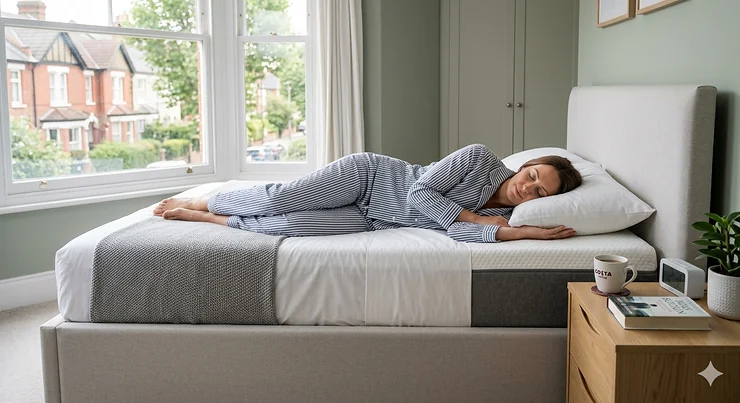
Let’s get one thing straight: sleeping on your side is actually rather good for you. It eases snoring, reduces acid reflux, and — for pregnant women especially — improves circulation. Roughly 74% of British adults sleep predominantly on their side, according to sleep research. So if you curl up on your left or right every night, you’re in excellent company.
The problem? Most mattresses are designed without you specifically in mind.
When you lie on your side, your shoulder and hip protrude further downward than the rest of your body. On a mattress that’s too firm, those pressure points take the full brunt of your body weight — grinding against the surface like a pebble in a shoe, slowly. On one that’s too soft, your spine bows like a hammock and your hips sink so deeply that your lower back screams by morning. What you need — what a genuine memory foam mattress for side sleepers must deliver — is a precise balance: enough give to cushion the shoulder and hip, enough support to keep the spine perfectly horizontal.
Memory foam achieves this through viscoelastic properties: it responds to your body heat and weight, moulding to your contours and distributing pressure evenly, rather than pushing back against your joints. The result, in the right mattress, is that remarkable feeling of being cradled rather than squashed. For side sleepers struggling with hip and shoulder pain, this isn’t a luxury — it’s essential kit.
In this guide, I’ve tested and researched seven memory foam mattresses currently available on Amazon.co.uk, chosen specifically for side sleepers across every budget — from around £150 to over £900. Each pick addresses hip and shoulder pressure relief, motion isolation (invaluable if you share a bed), and genuine British practicality: compact delivery, sensible sizing, and performance in our notoriously draughty, sometimes damp bedrooms.
A quick note on what “memory foam” means in 2026: the term now covers a spectrum, from pure viscoelastic foam to hybrid constructions with pocket springs beneath a memory foam comfort layer. Both have their place. Pure foam wins on motion isolation; hybrids often win on temperature regulation — something worth considering if you’ve ever woken up in a British summer feeling like you’ve been gently poached.
Quick Comparison: Best Memory Foam Mattresses for Side Sleepers UK
| Mattress | Type | Firmness | Depth | Price Range (Double) | Best For |
|---|---|---|---|---|---|
| Nectar Premier Memory Foam | All-foam | Medium-firm | 28 cm | £500–£700 | Side sleepers, couples |
| Emma Original Classic | Hybrid foam | Medium | 25 cm | £250–£400 | All-rounders, budget |
| Silentnight Miracoil Memory | Spring + foam | Medium-firm | 22.5 cm | £200–£350 | British brand loyalists |
| Simba Hybrid Pro | Hybrid | Medium | 28 cm | £850–£1,100 | Hot sleepers, couples |
| Vesgantti Gel Memory Foam | All-foam | Medium | 25 cm | £120–£200 | Budget, guest rooms |
| Dormeo Octasmart Plus | Hybrid foam | Medium | 23 cm | £300–£500 | Hot sleepers, back pain |
| Aspire Beds Orthopaedic Memory Foam | All-foam | Medium-firm | 20 cm | £150–£280 | UK-made, budget-mid |
The table above tells a clear story. For most side sleepers in the UK, the sweet spot sits in the £250–£700 range, where you get genuine pressure relief without mortgaging the spare room. The all-foam options (Nectar, Vesgantti, Aspire) deliver the best motion isolation — crucial if your partner is a restless sleeper — while the hybrids (Simba, Dormeo, Emma) breathe better and tend to suit warmer sleepers more comfortably. If budget is the primary driver, the Vesgantti is a genuine surprise; if longevity and warranty peace of mind matter most, Nectar’s forever guarantee is hard to argue with.
✨ Don’t Miss These Exclusive Deals!
🔍 Take your sleep to the next level with these carefully selected mattresses. Click on any highlighted item to check current pricing and availability on Amazon.co.uk. These picks will help you find the best memory foam mattress for side sleepers — whatever your budget!
Top 7 Memory Foam Mattresses for Side Sleepers: Expert Analysis
1. Nectar Premier Memory Foam Mattress — Best Overall for Side Sleepers
The Nectar Premier is, quite simply, the benchmark by which other memory foam mattresses for side sleepers should be measured in 2026. At 28 cm deep with six distinct layers — including a quilted cooling cover, a dynamic support layer, pressure-relieving memory foam, and a dual-layer honeycomb micro-zoned base — this is a mattress that has been engineered rather than merely assembled.
That honeycomb base is the interesting bit. Most buyers won’t read about it in the Amazon listing and promptly forget it exists, but it matters enormously for side sleepers: the hexagonal cells flex independently under different pressure zones, meaning your hip sinks in precisely as much as it needs to while your waist and shoulder receive calibrated support rather than the same undifferentiated cushioning. The medium-firm feel — roughly 6.5 out of 10 on the firmness scale — hits exactly the right note for most adults sleeping on their side, providing that cradling sensation without allowing the spine to bow.
Who is this for? Primarily dedicated side sleepers and couples who share a bed. The motion isolation on this mattress is exceptional — if your partner thrashes around at 2am, you’ll feel very little of it. UK customers consistently highlight the 365-night trial and the forever warranty as deal-clinchers, and rightly so: that level of risk-free purchase confidence is rarely available at this price point in the UK market.
Amazon.co.uk reviewers (4.1/5 from over 2,300 ratings) frequently mention that the mattress improves noticeably after the first few weeks as the foam acclimates to their body. Worth knowing: allow 48 hours for full expansion after unboxing.
✅ Exceptional pressure relief for hips and shoulders
✅ Outstanding motion isolation for couples
✅ 365-night trial + forever warranty — unmatched in UK market
❌ Can retain some heat (gel infusion helps but won’t solve severe night sweats)
❌ On the heavier side for manoeuvrings up narrow British staircases
Price range: Around £500–£700 for a double | Check current pricing on Amazon.co.uk
2. Emma Original Classic Memory Foam Mattress — Best Mid-Range All-Rounder
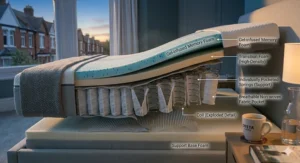
The Emma Original Classic has won more sleep awards than most mattresses will ever see — over 22 awards globally in 2025 — and in the UK particularly, it remains the go-to recommendation for buyers who want proven quality without a premium price tag. The three-layer construction centres on Emma’s proprietary Airgocell® foam: an open-cell design that breathes considerably better than standard memory foam, making it a smarter choice for British bedrooms where central heating and sealed double-glazing can create surprisingly stuffy sleeping environments.
At around 25 cm deep with a medium firmness rating, the Emma Original suits side sleepers who are light-to-average weight particularly well — typically those under 85 kg. The Airgocell® top layer cushions shoulder and hip pressure points immediately, while the Halo Memory Foam layer provides progressive support as you settle. What you won’t get here is the deep “hug” of a thicker memory foam mattress — the feel is more responsive and slightly bouncier than the Nectar, which some side sleepers actually prefer (it’s easier to change position during the night).
This is the mattress I’d recommend to a friend furnishing a new flat in Manchester or Bristol on a sensible budget: it performs genuinely well, arrives promptly via Amazon Prime in most of England and Wales, and the 200-night trial gives ample time to assess suitability.
UK reviewers consistently praise the decompression speed — most report the Emma reaching full depth within 24 hours in a normally heated room, faster than many competitors.
✅ Award-winning design, widely trusted in UK market
✅ Airgocell® foam breathes better than standard memory foam
✅ Compact bed-in-a-box delivery — navigates narrow hallways well
❌ Medium feel may be too soft for heavier side sleepers (over 90 kg)
❌ Motion isolation slightly below Nectar’s standard for light-sleeper couples
Price range: Around £250–£400 for a double | Check current pricing on Amazon.co.uk
3. Silentnight Miracoil Memory Foam Mattress — Best British Brand for Side Sleepers
Silentnight has been making mattresses in Britain since 1946, and there’s something quietly reassuring about that. The Miracoil Memory Foam mattress combines Silentnight’s proprietary zoned Miracoil spring system with a responsive memory foam comfort layer — a construction that delivers rather more support than a pure foam mattress at a similar price point. It’s manufactured in the UK, which means quality control is tighter than many imported alternatives, and replacement or warranty service is considerably more straightforward if issues arise.
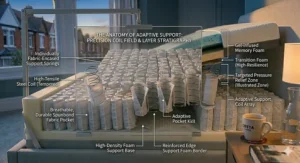
The Miracoil spring system is the defining feature here. Unlike generic open-coil springs that treat every part of your body identically, the Miracoil system zones its support — firmer beneath the heavier lumbar and hip area, slightly softer under the shoulder. For side sleepers, this is genuinely intelligent design: your hip gets the support it needs to sit level while your shoulder is allowed to sink more gently into the foam layer above. The result is better spinal alignment through the night than you’d achieve on most similarly priced alternatives.
At 22.5 cm deep, it’s somewhat shallower than the Nectar or Simba, but entirely functional for most adults. UK reviewers (averaging 4.2/5 on Amazon.co.uk) frequently mention the Miracoil’s “roll-together” resistance — the zoned springs create an effective barrier preventing both sleepers from gravitating to the middle of the bed during the night. Couples in terrace houses with standard double beds will appreciate this more than they might expect.
✅ Genuinely zoned support — shoulder and hip treated differently
✅ UK-manufactured, strong brand reputation and UK warranty support
✅ Good roll-together resistance for couples
❌ 22.5 cm depth shallower than premium alternatives
❌ Slightly firmer feel that may not suit very petite side sleepers
Price range: Around £200–£350 for a double | Check current pricing on Amazon.co.uk
4. Simba Hybrid Pro Mattress — Premium Pick for Hot Sleepers and Couples
If you’ve ever woken at 3am in a well-sealed British bedroom feeling like the mattress has quietly been trying to cook you, the Simba Hybrid Pro is the answer you’ve been looking for. This is a genuinely premium mattress — one of the few on the UK market where the “premium” label is actually earned rather than marketing aspiration — and it justifies its position in the £850–£1,100 price bracket with a construction that is more sophisticated than almost anything else available on Amazon.co.uk.
The headline feature is Simba’s titanium Aerocoil® micro spring system: thousands of tiny individual springs that work in concert with memory foam layers to create a sleeping surface that contours, supports, and — crucially — breathes. Where a standard memory foam mattress traps heat in its viscoelastic cells, the micro springs allow air to circulate through the mattress continuously. This is particularly relevant in the UK context: we tend to keep bedrooms warmer than is physiologically ideal because our homes are draughty in winter and poorly ventilated in summer. A mattress that actively manages temperature rather than simply absorbing it is worth the investment if poor sleep due to heat is a pattern for you.
For side sleepers specifically, the Simba Hybrid Pro’s progressive foam layers provide excellent shoulder and hip contouring, while the spring base prevents the excessive sinkage that can misalign the spine. The motion isolation is very good (though not quite as absolute as the Nectar’s all-foam construction). UK reviews consistently rate it among the best mattresses available through Amazon.co.uk across all categories.
✅ Superior temperature regulation — genuinely cooler than standard foam
✅ Excellent zoned support for shoulder and hip pressure points
✅ Strong motion isolation for couples
❌ Premium price — represents a significant investment
❌ Heavy and bulky once unboxed — plan the move up the stairs before delivery day
Price range: Around £850–£1,100 for a double | Check current pricing on Amazon.co.uk
5. Vesgantti Gel Memory Foam Mattress — Best Budget Option
The mattress world has a complicated relationship with budget products. For every pleasant surprise, there are three disappointments. The Vesgantti Gel Memory Foam sits firmly in the pleasant surprise category — it overdelivers for its price bracket and has built a quietly loyal following among UK buyers who want memory foam quality without committing several hundred pounds.
At 25 cm deep (unusually generous for this price point), the Vesgantti features a gel-infused memory foam comfort layer over a high-density base. The gel infusion matters here more than in pricier alternatives: at lower price points, manufacturers tend to use standard viscoelastic foam that retains heat aggressively. The gel particles in the Vesgantti’s foam conduct heat away from the sleeping surface, meaningfully improving temperature comfort for a mattress in this price range. The OEKO-TEX Standard 100 certification — visible on the Amazon.co.uk listing — confirms the foam is tested against over 1,000 potentially harmful chemicals, which matters for people sleeping with their face close to the surface eight hours a night.
For side sleepers, the Vesgantti works best for lighter individuals — typically those under 75 kg. Heavier sleepers may find the foam compresses fully and loses its pressure-relieving properties after several months. It’s an honest budget option: excellent for guest bedrooms, children’s rooms, or a first flat where £500+ simply isn’t realistic. Don’t expect it to last a decade, but at the price point, that’s not the expectation.
✅ Gel infusion meaningfully improves temperature regulation for the price
✅ OEKO-TEX certified — safe and tested materials
✅ 25 cm depth is generous for this price bracket
❌ Less durable long-term than premium options — plan for 4–6 year lifespan
❌ Not ideal for heavier sleepers (over 85 kg)
Price range: Around £120–£200 for a double | Check current pricing on Amazon.co.uk

6. Dormeo Octasmart Plus Mattress — Best for Back Pain and Hot Sleepers
Dormeo is an Italian brand with strong UK distribution and a genuinely distinctive technology at its core: the Octaspring® system, which replaces traditional foam blocks with individual foam “springs” — think hundreds of small cylinders arranged within the mattress that respond independently to pressure. It’s an unusual construction that occupies an interesting middle ground between all-foam and pocket spring hybrids, and for side sleepers with back or hip pain, it produces results that are worth examining.
The practical benefit of the Octaspring® design for side sleepers is this: each individual foam spring adjusts to local pressure independently. When your hip presses down, the springs directly beneath it compress without forcing adjacent springs to compensate — which is precisely how you prevent the “shoulder push-up” problem that side sleepers often experience on cheaper mattresses (where the shoulder has nowhere to go and ends up elevated, twisting the cervical spine). At 23 cm deep, the Dormeo Octasmart Plus delivers impressive lumbar support for a mattress without traditional springs.
The airflow through the Octaspring® cells is also meaningfully better than solid foam. If you’ve tried gel-infused foam and still found yourself too warm, the Dormeo is a logical next step before committing to Simba-level spending. UK customers frequently highlight it as a revelation for those who’ve bounced through several failed mattress purchases looking for the right combination of support and temperature comfort.
Which? has previously highlighted Dormeo as a recommended choice in the UK market — a trusted endorsement for cautious British buyers.
✅ Unique Octaspring® technology — independent pressure response per zone
✅ Better airflow than solid foam alternatives
✅ Strong UK track record and Which?-recognised brand
❌ Slightly unusual feel that takes adjustment for those accustomed to standard foam
❌ Limited Amazon.co.uk review volume compared to Nectar or Emma
Price range: Around £300–£500 for a double | Check current pricing on Amazon.co.uk
7. Aspire Beds Orthopaedic Memory Foam Mattress — Best UK-Made Budget Option
There’s something to be said for a mattress made in Britain, shipped from a UK warehouse, covered by a UK warranty, and sold at a price that doesn’t require a payment plan. The Aspire Beds Orthopaedic Memory Foam ticks all four boxes and represents one of the better-value propositions currently available on Amazon.co.uk for side sleepers who need genuine orthopaedic support without premium pricing.
The three-layer construction — fifth-generation memory foam atop a reflex support foam and an eco foam base — sounds straightforward, and it is. But Aspire’s fifth-generation memory foam is more temperature-responsive than earlier formulations, acclimatising to the sleeping environment more quickly and dispersing excess heat more effectively than older viscoelastic foams. The anti-bacterial and anti-allergy properties of both the foam core and the cover fabric are particularly relevant for allergy sufferers — a consideration often overlooked in mattress reviews but important in UK homes where dust mite prevalence peaks during damp autumns and winters.
At 20 cm deep, this is the shallowest mattress in our selection, and it shows slightly in the overall sink depth available for pressure relief at the shoulder. Petite and average-weight side sleepers will find it entirely comfortable; heavier individuals (over 90 kg) should consider stepping up to the Vesgantti or Emma for greater depth. The 5-year warranty is honest for the price and the UK manufacturing means any issues are resolved domestically.
✅ UK-manufactured — tight quality control, domestic warranty support
✅ Anti-bacterial and anti-allergy properties — relevant for UK damp conditions
✅ Rolls compactly for delivery — easy to navigate narrow staircases
❌ 20 cm depth — shallower than competitors at similar price points
❌ Not suitable for heavier sleepers needing maximum pressure relief
Price range: Around £150–£280 for a double | Check current pricing on Amazon.co.uk
How to Choose the Right Memory Foam Mattress for Side Sleeping in the UK
Choosing a memory foam mattress is not, despite what the marketing might suggest, a complicated process — provided you know what questions to ask. Here is a numbered framework to guide your decision, developed from both research and the specific realities of British homes.
1. Prioritise pressure relief above all else. Side sleepers experience localised pressure at the shoulder and hip — two points that carry significant body weight in a lateral position. Look for mattresses with at least 3–5 cm of memory foam in the top comfort layer. A mattress marketed primarily for “firm support” will almost always underperform for side sleeping.
2. Match firmness to body weight. A medium mattress (5–7 out of 10) suits most side sleepers weighing 55–85 kg. Under 55 kg, consider a slightly softer option. Over 85 kg, lean toward medium-firm (6.5–7.5) to prevent excessive sinkage that misaligns the spine. This is the single most common buying mistake I see among UK mattress shoppers.
3. Consider mattress depth relative to your existing bed frame. British beds, particularly in Victorian terraced houses and modern new-builds with low-profile frames, often work better with mattresses in the 22–28 cm range. Very thick mattresses (30+ cm) can raise the sleep surface uncomfortably high relative to UK standard bed frames. Measure your divan base or slatted frame height before purchasing.
4. Evaluate heat retention honestly. Pure memory foam retains more heat than hybrid or spring alternatives. If you routinely wake overheated, prioritise gel-infused foam (Vesgantti, Nectar) or hybrid constructions (Simba, Emma, Dormeo) with active airflow technology. British bedrooms in winter may seem immune to this concern — but central heating and sealed windows create warmer sleeping environments than most people expect.
5. Check motion isolation requirements. Sharing a bed? An all-foam mattress will almost always outperform a spring mattress for motion isolation. The Nectar Premier in particular is outstanding here.
6. Scrutinise the trial period and warranty. UK consumer law under the Consumer Rights Act 2015 gives you protections regardless, but a branded trial period (Nectar’s 365 nights is market-leading; Emma’s 200 nights is solid) gives you comfortable time to assess without financial risk. A 10-year minimum warranty is the benchmark for quality mattresses; anything shorter should raise questions about long-term durability.
7. Factor in UK delivery practicalities. Bed-in-a-box mattresses (all seven on this list) compress to manageable roll dimensions — typically 30–45 cm in diameter. This matters enormously if you live in a first-floor flat in Leeds or Edinburgh with a staircase that would challenge a determined contortionist.
Real-World Scenarios: Which Mattress Suits Which UK Buyer?
Sometimes the best buying decision isn’t about specifications at all — it’s about context. Here are three genuinely British scenarios with honest product matching.
The London commuter in a Zone 3 flat. Sarah, 31, works in Canary Wharf and sleeps five hours on a good night. She’s a dedicated side sleeper with chronic shoulder tension from commuting. Budget: up to £600. Living in a one-bedroom flat with a narrow staircase. The Nectar Premier Memory Foam is the match here — its exceptional pressure relief at the shoulder, motion isolation (she’s a light sleeper), and the compact bed-in-a-box delivery that navigates her staircase without drama. The 365-night trial means she can test it through both winter and spring before fully committing.
The retired couple in the Cotswolds. Derek and Margaret, both 66, share a king-size bed in a stone cottage. Derek runs warm, Margaret has hip arthritis. They’ve already tried two disappointing mattresses from the high street. Budget: up to £1,200. The Simba Hybrid Pro is the answer — Derek benefits enormously from the Aerocoil® temperature regulation in their centrally heated bedroom, while Margaret’s hip gets proper independent zone support. The motion isolation ensures Derek’s earlier bedtime doesn’t disturb her.
The student in a Birmingham house share. Callum, 21, needs a single mattress for a rented room. Budget: strictly under £200. He’s a side sleeper but at 68 kg doesn’t need premium depth. The Vesgantti Gel Memory Foam delivers genuine comfort at a price that won’t require parental assistance. The OEKO-TEX certification is a quiet reassurance that he’s not sleeping on chemically dubious foam, and the gel infusion handles the room’s inconsistent heating well.

Common Mistakes UK Buyers Make When Choosing a Memory Foam Mattress
Side sleepers in particular make certain buying mistakes with striking consistency. Here are the five most common — along with honest ways to avoid them.
Choosing by feel in a showroom. Lying on a mattress for three minutes in a brightly lit shop — usually on your back, because lying on your side in public feels absurd — tells you almost nothing about how it will perform over eight hours. Every mattress on this list offers a proper home trial. Use it.
Prioritising depth over construction quality. A 30 cm mattress with poor-quality foam will underperform a 20 cm mattress with excellent foam construction. The Aspire Beds at 20 cm outperforms many deeper competitors for its price bracket precisely because its foam quality is better than comparable depth alternatives.
Ignoring the “off-gassing” period. New memory foam mattresses release a chemical odour (from the volatile organic compounds in the foam) for the first 24–72 hours after unboxing. This is entirely normal and harmless, but worth noting if you have respiratory sensitivities. Air the mattress in a ventilated room for 48 hours before sleeping on it. All OEKO-TEX certified products (Vesgantti included) have lower VOC levels to begin with.
Buying a US-spec mattress for a UK bed frame. Several mattresses reviewed enthusiastically on American sites are not sold on Amazon.co.uk or arrive in non-standard imperial sizes (Queen, California King) that do not fit UK bed frames. All seven mattresses in this guide are confirmed available in UK standard sizes (Single: 90×190 cm, Double: 135×190 cm, King: 150×200 cm, Super King: 180×200 cm).
Skipping a mattress protector. Memory foam is notoriously difficult to clean. A waterproof but breathable mattress protector (budget £25–£40 on Amazon.co.uk) extends mattress life significantly, particularly in British homes where ambient humidity can encourage moisture absorption in the foam. In a damp autumn, this matters more than most buyers realise.
Memory Foam vs Traditional Spring Mattress: Which Is Actually Better for Side Sleepers?
It’s a question that deserves an honest, unambiguous answer rather than hedging: for dedicated side sleepers, memory foam — or a hybrid with a memory foam comfort layer — outperforms a traditional open-coil spring mattress in almost every meaningful metric.
Here is why, in plain terms.
Traditional spring mattresses push back against whatever presses down on them with equal and opposite force — a property that works well for back sleepers who need uniform support but actively works against side sleepers. Your hip presses down; the springs push back. Your shoulder presses down; same result. The mattress treats every point of contact identically, which is precisely the problem. There’s no accommodation for the biomechanical reality that your hip and shoulder are narrower than your waist, creating an uneven pressure distribution that compounds through the night.
Memory foam, by contrast, deforms under pressure and then slowly returns to its original shape. It’s not pushing back — it’s accommodating. The hip sinks in as far as it needs to; the foam rises to meet the waist; the shoulder is cushioned rather than resisted. The result, for most side sleepers, is a profound reduction in morning stiffness and joint discomfort. Research from sleep science literature consistently supports medium-soft to medium-firm foam as the most effective surface for lateral sleeping positions.
| Factor | Traditional Spring | Memory Foam | Hybrid |
|---|---|---|---|
| Pressure relief (hip/shoulder) | ⭐⭐ | ⭐⭐⭐⭐⭐ | ⭐⭐⭐⭐ |
| Motion isolation | ⭐⭐ | ⭐⭐⭐⭐⭐ | ⭐⭐⭐⭐ |
| Temperature regulation | ⭐⭐⭐⭐ | ⭐⭐ | ⭐⭐⭐⭐ |
| Spinal alignment | ⭐⭐⭐ | ⭐⭐⭐⭐ | ⭐⭐⭐⭐⭐ |
| Durability | ⭐⭐⭐ | ⭐⭐⭐⭐ | ⭐⭐⭐⭐ |
| UK price range | £150–£800 | £120–£700 | £200–£1,100 |
The comparison above clarifies why hybrids have grown dominant in 2026: they capture the pressure relief benefits of memory foam while addressing its primary weakness (heat retention) through spring-assisted airflow. For most UK side sleepers, the practical recommendation is: if budget is under £300, consider all-foam; above £300, a hybrid often represents better long-term value.
✨ Don’t Miss These Exclusive Deals!
🔍 Take your sleep to the next level. Click on any highlighted product to check current pricing and availability on Amazon.co.uk. These selections represent the best memory foam mattresses for side sleepers across every budget.
Long-Term Maintenance: Keeping Your Memory Foam Mattress in Peak Condition
Buying the right mattress is half the battle. The other half is keeping it performing well — something that requires rather less effort than most people assume, but slightly more than simply ignoring it for a decade.
Rotation, not flipping. All seven mattresses in this guide are single-sided — the foam layers are directional and flipping them upside down defeats the engineering entirely. Rotate 180° (head to foot) every three to six months. This distributes body impressions evenly across the sleep surface and extends the effective lifespan by one to two years in most cases. Set a reminder on your phone for the first day of every season. British seasons being what they are, you’ll know it’s time to rotate when the central heating clicks back on.
Ventilation matters more in the UK than anywhere. We produce approximately half a litre of perspiration per night, which the mattress absorbs. In summer, strip the bedding weekly and open the window. In winter — when this is less appealing — a mattress protector becomes essential rather than optional. The Dormeo and Simba, with their active airflow systems, manage moisture better than solid foam alternatives, which is worth remembering during the six grey months of a British winter.
Cleaning the cover. Most of the mattresses on this list feature removable, machine-washable covers. Use them. Wash the cover every three to four months on a gentle cycle at 40°C — not 60°C, which can degrade the foam-laminated backing on some covers. Never put a memory foam mattress or topper in the washing machine; spot-clean only with a mild upholstery cleaner and allow to air-dry completely before replacing bedding.
Support the base properly. Memory foam mattresses require firm, evenly spaced support. Slatted bed frames should have slats no more than 6–7 cm apart — wider gaps allow the foam to bow between supports and degrade faster. Platform bases (solid top) are ideal. Many UK buyers place a £400 memory foam mattress on an ageing divan base with broken or bowed slats and then wonder why it sags within eighteen months.
Watch for early warning signs. A good memory foam mattress should spring back to its original shape within a few seconds of you getting up. If body impressions remain visible for more than thirty seconds, the foam has degraded. Most quality mattresses (Nectar, Emma, Simba) are warranted against impressions exceeding 3 cm under normal use — check the specific warranty terms before purchasing, and document any issues with photographs.
Features That Actually Matter (And Those That Don’t)
Marketing in the mattress industry has reached an impressive level of creative fiction. Here’s a candid filter.
Actually matters for side sleepers:
- Comfort layer depth (3 cm minimum for genuine pressure relief)
- Zoned support (different firmness for shoulder vs hip vs waist)
- Motion isolation quality (all-foam beats spring for partners)
- Trial period length (anything under 100 nights is inadequate)
- Certifications (OEKO-TEX Standard 100 or CertiPUR® equivalent)
Marketing language to treat with healthy scepticism:
- “Orthopaedic support” — not a regulated term in the UK. Any manufacturer can use it. Look for actual zoning specifications instead.
- “NASA-developed technology” — yes, NASA developed viscoelastic foam in the 1970s. This doesn’t meaningfully differentiate one mattress from another in 2026.
- “1,000 pocket springs” — spring count alone means nothing without knowing spring gauge (thickness) and tension. 1,000 thin, weak springs underperform 800 properly calibrated ones.
- “Bamboo infused” — bamboo charcoal is sometimes added to foam for marginal odour control. It has no meaningful effect on temperature regulation or pressure relief.
- “Clinically proven” — requires scrutiny. Who conducted the study? Was it peer-reviewed? Who funded it? Legitimate certifications (Which? Best Buy, Good Housekeeping Recommended) carry more genuine weight than proprietary “clinical proof.”
The British consumer watchdog Which? maintains tested mattress recommendations that are independently verified — their endorsements (Nectar holds one) are worth substantially more than self-awarded “Best Buy” badges that some brands apply to their own products.
FAQ
❓ What firmness is best for a memory foam mattress for side sleepers?
❓ Can a memory foam mattress for side sleepers help with hip and shoulder pain?
❓ How long does a memory foam mattress last in the UK?
❓ Is a memory foam mattress for side sleepers suitable for couples with different sleep preferences?
❓ Do memory foam mattresses from Amazon.co.uk come with a UK trial period?
Conclusion: Your Best Night’s Sleep Starts with the Right Choice
The honest truth about memory foam mattresses for side sleepers is this: the technology has matured to the point where excellent sleep quality is available across nearly every budget. You don’t need to spend £1,000 to sleep well — though the Simba Hybrid Pro will remind you, rather persuasively, that there are legitimate reasons why some people do.
For most UK side sleepers, the Nectar Premier Memory Foam represents the definitive recommendation: pressure relief that is genuinely class-leading, motion isolation that will genuinely save relationships, and a warranty structure that turns a major purchase into a risk-free decision. The Emma Original Classic is the right answer for buyers who want proven quality at a sensible price. And the Vesgantti Gel Memory Foam is an honest surprise for anyone who needs to furnish a room without spending more than a month’s Council Tax bill.
Whatever you choose: use the trial period. Take the 365 nights. Sleep on it — literally — before concluding anything. Memory foam takes two to four weeks to fully break in and adapt to your body, and your body takes equally long to adjust to a new sleep surface. Give both of you the time to reach an arrangement.
And buy a mattress protector. Honestly.
✨ Don’t Miss These Exclusive Deals!
🔍 Ready to transform your sleep? Click on any highlighted mattress to check current pricing and availability on Amazon.co.uk — and wake up tomorrow a little less like a question mark.
Recommended for You
- 7 Best Memory Foam Mattress Under £200 Picks UK (2026)
- Best Memory Foam Mattress for Back Pain UK: 7 Expert Picks (2026)
- Best Memory Foam Mattress UK 2026: 7 Top-Rated Picks
Disclaimer: This article contains affiliate links. As an Amazon Associate, I earn from qualifying purchases. If you purchase products through these links, we may earn a small commission at no additional cost to you.
✨ Found this helpful? Share it with your mates! 💬🤗
