

In This Article
One of you sleeps like a starfish on a cloud. The other wants something closer to a yoga mat laid over a paving slab. Welcome to the great British bedroom stand-off, which is far more common than the mattress adverts suggest. Choosing a mattress for couples with different firmness preferences is less like shopping and more like diplomacy, with a side order of spinal negotiation.

The problem fits in one sentence: a mattress has one surface, but two bodies with different weights, shapes and sleeping positions. Lighter side sleepers usually want a softer top layer so the hips and shoulders can sink in. Heavier back sleepers tend to need springier, firmer support to keep the spine level. When one of you has an achy back, the stakes climb. Back pain is very common, and NHS advice leans towards staying active rather than resting in bed. That makes a surface you can move on, and climb out of, matter more than most people think.
So what’s the answer? There isn’t one magic bed. There are three routes. You can buy a dual-sided mattress you flip, a genuine split firmness setup with two tensions side by side, or a well-chosen medium-firm hybrid with decent zoned support. This guide unpicks all three, then analyses seven real mattresses seen in UK Amazon listings in 2026, from budget buys to premium natural-fibre builds.
One note on method. I haven’t slept on any of these, and I won’t pretend otherwise. What you’ll get is analysis grounded in published specs, retailer data and honest caveats, including where I couldn’t verify review data and you’ll need to check for yourself.
Quick Comparison: 7 Mattresses at a Glance
| Mattress | Feel | Depth | Support | Price guide | Best For |
|---|---|---|---|---|---|
| Silentnight 2000 Pocket Gel Pillowtop | Medium soft | 30cm+ | 2,000 nested pocket springs, gel foam | Mid-to-upper tier; check current price | Mixed side and back sleepers |
| Bedmaster Cotswold 3000 | Firm | 30cm | 3,000 pocket springs, wool and cotton | Premium tier; check current price | Heavier back sleepers |
| SleepSoul Space 2000 | Medium-firm | 34cm | 2,000 pocket springs in two layers, plus foam | Roughly £330-£540 by size at UK retailers | Most couples seeking a middle ground |
| Brinlawb 4FT6 Dual-Sided | Plush one side, firm the other | 21cm | 7-zone hybrid pocket sprung | Budget tier; check current price | Couples who want to trial both feels |
| Vesgantti 20CM Cooling Gel | Medium firm (“dual firmness” claimed) | 20cm | Gel memory foam | Budget tier; check current price | Warm sleepers, foam fans |
| Queblox 7-Zone Pocket Sprung | Medium firm | 28cm | 7-zone pocket springs, memory foam | Around £100-£150 | Spare rooms, tight budgets |
| Good Nite King Pocket Sprung | Medium firm | 28cm | Pocket springs, 5cm layered foam | Budget tier; check current price | Budget king-size couples |
Looking at the table, only the Brinlawb and (maybe) the Vesgantti offer two feels in one mattress. Both do it by flipping, which gives you a choice of firmness but not a different firmness for each of you. If your partner’s idea of comfort is genuinely opposite to yours, the SleepSoul Space and the Silentnight 2000 Pocket Gel Pillowtop are the safer middle-ground bets. Prices are guides only, so check current prices before you commit.
💬 Just one click — help others make better buying decisions too!😊
Top 7 Mattress Picks for Couples With Different Firmness Preferences: Expert Analysis
1. Silentnight 2000 Pocket Gel Pillowtop — forgiving medium-soft comfort for mismatched bodies
A medium-soft pillowtop on a double-layer spring system is the sort of surface that forgives two sleepers who don’t match. The Mirapocket system in Silentnight’s 2,000-spring models is described as two nested layers of individually wrapped springs with zoned support. Retailer listings put depth at over 30cm and carry a five-year guarantee. In practice, springs that move independently mean the lighter partner isn’t dragged into the heavier partner’s dip. The gel-infused foam and pillowtop add shoulder and hip relief.
Based on the spec comparison, this suits couples where one person is a side sleeper who wants some give and the other can live with plush. It won’t satisfy a partner who wants a board-flat surface. I couldn’t verify a robust pool of reviews for this exact Amazon listing, so I can’t report aggregated sentiment. Before buying, scan recent reviews for comments on sagging and edge support.
Pros:
- ✅ Nested pocket springs help limit roll-together
- ✅ Pillowtop cushions hips and shoulders
- ✅ Zoned support helps spinal alignment
Cons:
- ❌ Too plush for dedicated stomach sleepers
- ❌ Deep build needs deep-fitted sheets
Price: expect it above the budget imports below. Check current price. The value verdict is strong if one of you is a side sleeper.

2. Bedmaster Cotswold 3000 — firm natural-fibre support for heavier sleepers
The standout here is the build. This is a firm-tension, 30cm-deep mattress with 3,000 pocket springs and wool and cotton fillings, finished with hand-tufting and a soft woven cover. More springs means more points of independent response. That helps a heavier sleeper stay supported without the lighter partner feeling tipped sideways. Wool also tends to manage temperature better than synthetic fillings. The listing describes a double-sided design, but this is a turnable build for even wear, not two firmness levels.
My honest read is that this is a firm mattress. Medium-firm is the usual middle ground for couples, so this works best when the softer-preferring partner is only mildly soft-leaning or happy to add a topper on their half. Review data for this listing wasn’t verifiable during research, so check recent buyer comments on firmness accuracy and delivery condition.
Pros:
- ✅ 3,000 springs for precise, localised support
- ✅ Natural wool helps regulate temperature
- ✅ Turnable design spreads wear evenly
Cons:
- ❌ Firm feel may be harsh for light side sleepers
- ❌ Heavy to turn without a second person
Price: premium tier. Check current price. The value verdict is good for heavier back sleepers who plan to keep it a decade.
3. SleepSoul Space 2000 — the best-documented medium-firm middle ground
Medium-firm is where most couples with different firmness preferences end up, and this one sits right there. The SleepSoul Space 2000, developed by Birlea, packs 2,000 pocket springs into two layers, with foam and memory foam above, a quilted boxtop, 34cm depth and a 10-year warranty. Retailers say it earned a Which? Best Buy. That’s a brand-reported claim, so verify it on Which? before relying on it.
The two-layer spring design matters for couples. It supports weight deeper in the mattress while the foam on top handles pressure relief. As a result, a lighter partner gets cushioning and a heavier partner still gets support. UK retailers list it at roughly £330-£540 depending on size, and Amazon pricing can differ, so check current price. I couldn’t verify aggregated Amazon review sentiment, so check the most recent three-star reviews for comfort-layer feedback.
Pros:
- ✅ Two-layer springs balance support and cushioning
- ✅ Medium-firm feel suits many mixed couples
- ✅ Ten-year warranty offers reassurance
Cons:
- ❌ Neither partner gets their ideal feel exactly
- ❌ Deep 34cm profile needs deep sheets
Value verdict: the most sensible all-rounder here.
4. Brinlawb 4FT6 Dual-Sided — flippable plush and firm in one slim hybrid
The hook is flexibility. This 4ft6 double has a 21cm hybrid build with 7-zone pocket springs, a plush side and a firm side. The listing also claims low motion transfer. A dual-sided mattress is a clever way to experiment: sleep on plush for a fortnight, flip it if your back complains.
The catch is that you both sleep on the same side. A dual-sided mattress picks one feel for the pair, not one each. A 21cm profile is also slim, so the plush side will be less cloud-like than a deep pillowtop. A standard double is 135cm wide, which leaves each sleeper about 67cm, so a larger size is worth checking. Reviews weren’t verifiable here, so look for notes on flipping and side-to-side feel.
Pros:
- ✅ Two comfort options without buying twice
- ✅ 7-zone springs add targeted support
- ✅ Slim profile is easier to flip
Cons:
- ❌ Both partners share the same side
- ❌ Thin build limits plush depth
Price: budget tier. Check current price. The value verdict is good for trialling, less good for strongly opposed preferences.
5. Vesgantti 20CM Cooling Gel Memory Foam — cooling gel foam with a “dual firmness” claim
The headline here is cooling. This king-size, 20cm gel memory foam mattress has a honeycomb jacquard cover that’s washable, which is a practical bonus. The listing says “dual firmness levels” but also “medium firm”, so I can’t tell whether that means a flip design or a general description. Read the product page carefully before assuming you can flip it.
Memory foam typically handles motion transfer well, so a restless partner is less likely to wake you. The trade-off is less bounce and a sink-in feel that some heavier sleepers dislike. Based on the spec sheet, this suits warm sleepers wanting pressure relief rather than couples with deeply opposed tastes. Check recent reviews for comments on odour on unboxing and firmness drift.
Pros:
- ✅ Gel foam aims to keep sleepers cooler
- ✅ Washable cover simplifies hygiene
- ✅ King size gives each partner room
Cons:
- ❌ Foam-only build lacks spring bounce
- ❌ “Dual firmness” wording needs checking
Price: budget tier. Check current price. The value verdict is decent if the flip design is confirmed.
6. Queblox 7-Zone Pocket Sprung — a budget hybrid with reinforced edges
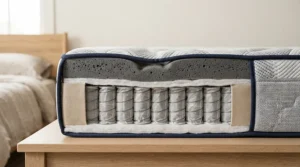
The standout is how much construction you get for the money. This 4ft6 double is 28cm deep, with 7-zone pocket springs, memory foam, a Euro top and wave-cut foam designed to improve airflow. It also has dual-row reinforced springs around the perimeter. That edge matters for couples, because it means you can use the full width without feeling you’ll roll off.
It’s a medium-firm mattress, so it’s a compromise rather than a split firmness solution. I’d see it as a spare-room or student option, or a sensible choice for lighter couples. Tracked pricing at one deal site suggested a range of around £100-£150. Check current price. Long-term durability at this price point is the open question, and I couldn’t verify a robust review pool.
Pros:
- ✅ Reinforced edges maximise usable width
- ✅ 7-zone springs add head-to-toe support
- ✅ Boxed delivery eases awkward stairs
Cons:
- ❌ Double width feels cramped for two
- ❌ Long-term durability is unproven
Value verdict: strong for the price, with realistic expectations.
7. Good Nite King Pocket Sprung — king-size room for two on a modest budget
The hook is width. This 5ft king, at 150x200x28cm, is medium firm, with a breathable knitted cover and 5cm of layered foam. The listing promises steadier edges and more room for two. A king gives each sleeper about 75cm, which is 7-8cm more than a double and often the difference between sharing and fighting over space.
Based on the specs, it sits in the same compromise category as the Queblox and SleepSoul Space, but with a simpler construction. Spring count isn’t clear in the listing details I could see, so ask the seller or check the product page. It’s a sensible pick for couples who want size first and fine-tuning second. Reviews weren’t verifiable, so look for comments on edge support and firmness accuracy.
Pros:
- ✅ King width gives each partner more room
- ✅ Layered foam adds cushioning
- ✅ Edges are designed for steadier sitting
Cons:
- ❌ Medium-firm only, so no split option
- ❌ Spring count and track record are unclear
Price: budget tier. Check current price. The value verdict is good for space, modest for fine-tuned comfort.
Here’s the full side-by-side view before we dig deeper.
| Mattress | Size to look for | Feel | Support type | Best For |
|---|---|---|---|---|
| Silentnight 2000 Pocket Gel Pillowtop | King | Medium soft | 2,000 nested springs, gel foam | Side-sleeper-led couples |
| Bedmaster Cotswold 3000 | King | Firm | 3,000 springs, wool | Heavier back sleepers |
| SleepSoul Space 2000 | King | Medium-firm | 2,000 springs in two layers | Most mixed couples |
| Brinlawb 4FT6 Dual-Sided | Largest available | Plush or firm (flip) | 7-zone hybrid | Trialling both feels |
| Vesgantti 20CM Cooling Gel | King | Medium firm | Gel memory foam | Warm sleepers |
| Queblox 7-Zone Pocket Sprung | Double | Medium firm | 7-zone springs, foam | Budget spare rooms |
| Good Nite King Pocket Sprung | King | Medium firm | Pocket springs, layered foam | Budget king-size couples |
The pattern is clear: spring-based hybrids dominate the better-supported end, and foam-led builds win on cooling and quiet. If one of you runs hot, the Vesgantti is worth a look. If you want depth and durability, the SleepSoul Space and Bedmaster Cotswold 3000 carry the most weight in their specs. Most listings here only offer one feel, which is why the next sections matter.
What Is a Mattress for Couples With Different Firmness Preferences?
A mattress for couples with different firmness preferences is any bed designed so two sleepers can each get a comfortable, supportive surface despite different weights, positions or tastes. In practice that means one of three things: split firmness (two tensions side by side), a dual-sided mattress you flip, or a carefully chosen medium-firm compromise.
Each route solves a slightly different problem. Split firmness solves the “we want different things” problem directly. A dual-sided mattress solves the “we don’t know what we want” problem. A medium-firm hybrid solves the “we want to stop arguing” problem, usually by making each of you give up a little. None is universally best. Which one suits you depends on how far apart your preferences really are, and on how much you’re willing to spend to close the gap.
How to Choose a Mattress for Couples With Different Firmness Preferences
Here is a practical six-step approach to picking the right mattress for couples with different firmness preferences.
- Map your differences honestly. Write down weight, main sleeping position and any pain points for each of you. A 30kg weight gap matters more than a taste gap.
- Decide how far apart you are. Mild disagreement points to a medium-firm hybrid. Strong disagreement points to split firmness.
- Pick the support system. Pocket springs isolate movement better than open coils. Foam-only builds minimise motion but can feel warm.
- Check size first. A king gives each person about 75cm. A standard double gives about 67cm, which is tight for two adults.
- Check depth and layers. Thicker comfort layers cushion lighter sleepers. Thin builds feel firmer than their label suggests.
- Read the returns policy. A trial period or easy returns is your safety net when two opinions have to agree.
Dual-Sided Mattress vs Split Firmness: Which Actually Solves the Problem?
Here’s the distinction most listings blur. A dual-sided mattress has one firm face and one soft face, and you choose one at a time. Split firmness means each half of the bed has its own tension, so each of you sleeps on a different feel at the same time. UK retailers such as Dreams describe split tension as a single mattress with two firmness zones sewn into one construction, while a zip-and-link mattress is two separate mattresses joined by a zip.
| Option | How it works | Solves two different preferences? | Weak spot | Best For |
|---|---|---|---|---|
| Dual-sided mattress (e.g. Brinlawb) | Flip for plush or firm | Not directly; one feel for both | Both share the same side | Couples trialling firmness |
| Split firmness (zip-and-link or split tension) | Two tensions side by side | Yes | Slight feel change in the middle | Couples with strongly opposed tastes |
| Medium-firm hybrid (e.g. SleepSoul Space) | One balanced surface | Partly, via compromise | Neither partner gets their ideal | Mild disagreements |
| Two singles plus topper | Separate mattresses, one topper | Yes, if toppers differ | Gap in the middle | Large budgets |
Honestly, a dual-sided mattress solves the problem only if you agree on which side to sleep on. A medium-firm hybrid is the sensible compromise when preferences are close. Genuine split firmness is the right tool when they aren’t, and it’s mostly sold by dedicated UK mattress retailers rather than through marketplace listings. If you go that route, check each half’s tension, spring count and warranty individually.
Zoned Support Explained: What It Does for Two Different Bodies
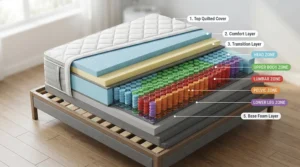
Zoned support means different areas of the mattress, from head to foot, are built with different firmness. Typically there’s more support under the hips and lower back and more give under the shoulders. The Brinlawb and Queblox advertise 7-zone springs, and Silentnight 2000 Pocket Gel Pillowtop describes zoned Mirapocket support.
It’s worth being clear about what zoned support does and doesn’t do. It improves spinal alignment for a wide range of bodies. It does not give each of you a different feel from left to right. Think of it as a refinement, not a fix, for mismatched preferences. A mattress with good zoned support and a medium-firm feel will usually please more couples than one with a gimmicky split.
If one of you is a side sleeper, softer shoulder zones matter. If the other is a back sleeper, firmer lumbar support matters. Good zoning does both at once along the length of the bed, which is why it helps in a shared mattress even without a left-right split.
Mattress for Couples With Back Pain: What the Evidence Actually Says
If one or both of you has back pain, the old advice was “go firm”. The evidence is more nuanced. A randomised, double-blind trial in The Lancet assigned 313 adults with chronic non-specific low-back pain to either firm or medium-firm mattresses. At 90 days, the medium-firm group had better outcomes for pain in bed and disability.
Take that with proper caution. The trial covered chronic non-specific low-back pain, not every cause of pain, and one study isn’t a rulebook. It does suggest that firmest isn’t automatically best, which is good news for any mattress for couples with back pain. If one partner has a sore back and the other likes soft, a medium-firm base is a sensible meeting point, with a topper added on the softer-preferring side.
Practical points for a mattress for couples with back pain:
- Prioritise support and alignment over a marketing label.
- Choose a surface you can move on and get out of easily.
- Don’t blame the bed for everything, and see your GP if pain persists or comes with worrying symptoms.
This is general information, not medical advice.
Features That Actually Matter (And Those That Don’t)
Features that matter:
- Spring type. Individually wrapped pocket springs reduce motion transfer compared with linked open coils.
- Edge support. A reinforced perimeter, like the Queblox has, lets you use the full width.
- Depth and comfort layers. These decide how plush or firm a mattress actually feels.
- Size. King beats double for two adults.
Features that matter less than the marketing suggests:
- Spring counts as a headline. 3,000 is not automatically three times better than 1,000, because quality and layering matter too.
- “Cooling” labels. Gel and breathable covers can help, but a mattress that’s too warm for you is often a bedding issue.
- Awards in small print. A Which? Best Buy is meaningful, but check the date and the exact model on the Which? site.
The best use of a spec sheet is to ask what each number means for two sleepers. If you can’t explain it in plain English, it probably isn’t deciding your night’s sleep.

Long-Term Cost & Maintenance: What Two Sleepers Really Pay
Think in cost per night rather than ticket price. A mattress costing around £500 and lasting eight years works out at about 17p a night for the pair, so roughly 9p each. A £150 mattress that sags in three years costs around 14p a night, so the cheaper buy isn’t automatically cheaper. These are illustrations, not quotes, and your numbers will vary.
Maintenance extends that lifespan. Many makers suggest rotating non-flip mattresses every few months. Truly double-sided designs, like the turnable Bedmaster Cotswold 3000 and the flippable Brinlawb, need regular turning for even wear. A breathable mattress protector helps with spills and hygiene, and some brands tie sleep trials to using one, so read the terms.
Consider the hidden costs too. A king-size mattress needs a base that fits, and a deep mattress needs deep sheets. A topper to fine-tune one side adds to the total. If your preferences differ a lot, a pricier split firmness solution may be better value than a cheap compromise you both resent.
Safety, Labels and UK Regulations: What to Check Before You Buy
UK mattresses fall under the Furniture and Furnishings (Fire) (Safety) Regulations 1988, which cover new domestic furniture. Mattresses don’t need the display label that sofas carry at the point of sale. Trading standards guidance says mattresses meeting the rules should carry a permanent label, and the regulations were amended in October 2025.
For marketplace shoppers, the practical steps are simple:
- Check the product page for fire-safety compliance details.
- Look for the permanent label when the mattress arrives.
- Keep the seller’s contact details, and ask questions before opening if the label is missing.
- Don’t assume a low price means compromised safety, but don’t assume it means compliance either.
If a label is missing or unclear, contact the seller and your local trading standards office. This is general information, not legal advice.
Setting Up Your New Mattress: A Practical 30-Day Guide
Your first month decides whether a mattress works for you. Follow this routine to give any of the seven a fair trial.
Day 1-3: unbox and settle. Roll-packed hybrids like the Queblox and Good Nite need time to expand. Some brands say it takes 24 hours or more to reach full shape. Leave the room ventilated and don’t judge comfort on night one.
Week 1: protect and track. Fit a breathable protector, and keep a simple two-column note: how each of you slept and what felt wrong.
Week 2-3: adjust. Add a topper to one side if one of you wants softer. Rotate or flip per the maker’s guidance.
Week 4: decide. Compare notes honestly. Aches that persist beyond the settling-in phase are worth acting on, ideally within any return window.
Common mistakes in the first 30 days:
- Judging after one night.
- Skipping the protector, which can complicate returns.
- Ignoring return deadlines.
- Forgetting a mattress can feel firmer when the room is cold.
If a back problem is involved, keep moving as normal during the day. A mattress helps, but it isn’t a treatment on its own.
Real-World Scenarios: Three Couples, Three Matches
Scenario 1: The sore back and the soft-lover. One partner, 45, has a lower-back ache. The other, 42, loves a soft bed. Budget: mid-range. Bedroom: a modest main room. Nightly use. The SleepSoul Space 2000 in king gives a medium-firm base that suits the sore back. A soft topper on the other side adds give without removing support.
Scenario 2: The hot sleepers on a budget. Two lighter sleepers in their 20s share a flat. Budget: tight. They sleep warm. The Vesgantti 20CM Cooling Gel in king gives a foam-led surface with cooling intent, and a washable cover helps in a busy flat. Check the “dual firmness” claim before relying on it.
Scenario 3: The weight gap. One partner is much heavier. Budget: higher. Long-term purchase. The Bedmaster Cotswold 3000 gives a firm, spring-dense build that suits the heavier sleeper. The lighter partner needs a soft topper on their half, or the couple should look at split firmness from a dedicated UK retailer instead.
In every case, the match depends on how far apart you are, how long you’ll keep the bed, and whether you can return it.
Buyer’s Decision Framework: If This, Choose That
Use this quick checklist for your own mattress for couples with different firmness preferences.
- If your tastes are close, choose a medium-firm hybrid, such as the SleepSoul Space or Good Nite, because compromise costs little.
- If you’re unsure what you like, choose a flippable dual-sided mattress, such as the Brinlawb, because you can trial both feels.
- If one of you is heavier, choose a spring-dense build, like the Bedmaster Cotswold 3000, because support depth matters more.
- If one of you runs hot, choose a cooling-focused build, like the Vesgantti, and check breathability.
- If you’re on a tight budget, choose the Queblox for a spare room, or the Good Nite in king for extra width.
- If you want plush comfort for a side sleeper, choose the Silentnight 2000 Pocket Gel Pillowtop for its pillowtop and zoned springs.
- If your tastes are far apart, go beyond one mattress and look into split firmness, because compromise may cost more in sleep than the premium does in cash.

FAQ
❓ Can I get a mattress with two different firmness levels in one bed?
❓ What size bed do couples with different firmness preferences need?
❓ Is a medium-firm mattress a safe compromise for couples with back pain?
❓ Do zip-and-link mattresses leave a noticeable gap in the middle?
❓ How long should we test a new mattress before judging it?
Conclusion
Finding a mattress for couples with different firmness preferences comes down to being honest about three things: how far apart your preferences really are, how much support your bodies need, and how long you want the bed to last. Mild disagreement points to a medium-firm hybrid like the SleepSoul Space 2000 or Good Nite King Pocket Sprung. Unsure preferences point to a flippable dual-sided mattress like the Brinlawb. Mismatched weights point to deeper spring systems like the Bedmaster Cotswold 3000, or the plush comfort of the Silentnight 2000 Pocket Gel Pillowtop. Warm sleepers and budget buyers have the Vesgantti and Queblox to consider.
If your tastes are truly opposed, don’t let a clever listing convince you that a flip fixes it. A dual-sided mattress is a choice of feel, and zoned support is a refinement. Real split firmness is a different product, usually from specialist UK retailers. Whatever you choose, check the safety label, the return policy and the real size before you commit. A few careful checks now save a lot of tossing and turning later.
Recommended for You
- Mattress For Couples: 7 Best Picks For Sound Sleep (2026)
- Mattress For Heavy Front Sleepers: 7 Best Supportive Picks (2026)
- Mattress For Front Sleepers With Back Pain: 7 Best Picks (2026)
Disclaimer: This article contains affiliate links. As an Amazon Associate, I earn from qualifying purchases. If you purchase products through these links, we may earn a small commission at no additional cost to you.
✨ Found this helpful? Share it with your friends! 💬🤗
